



Jamaica rolls out Caribbean’s first portable spectrum monitoring unit
JAMAICA’S Spectrum Management Authority (SMA) has commissioned a portable spectrum monitoring unit which it says is the first of its kind in the Caribbean.
According to a media release from the SMA, the mobile unit will allow it to investigate radio frequency interference and monitor spectrum use in locations that may be difficult to reach with fixed monitoring stations.
The trailer-mounted unit, which can be deployed across Jamaica, will allow the SMA to monitor radio frequencies, detect interference, and support communications during emergencies and major national events.
SMA Managing Director Dr Maria Myers-Hamilton said the mobile system is intended to address gaps created by Jamaica’s terrain, where mountains and valleys can limit the reach of fixed monitoring stations.
“Jamaica’s terrain is unforgiving to radio waves. The Blue Mountains, the Cockpit Country and the island’s many valleys create shadows that no reasonable number of fixed sites can cover completely…For those situations, the monitoring capability has to go to the problem,” said Myers-Hamilton in the release issued on Monday.
She said the unit is equipped with receiving and direction-finding technology, a workstation for SMA engineers, a telescopic mast, and antennas capable of monitoring different frequency ranges. It also has an integrated generator, allowing it to operate for extended periods without relying on the national electricity grid.
The SMA also pointed out that the station can be transported to hillside communities, stadiums, coastal areas and parishes affected by disasters and become operational within hours. Information collected in the field can then be transmitted to the SMA’s National Monitoring Centre for analysis.
Myers-Hamilton said the mobility of the unit should allow the SMA to identify the source of harmful interference more quickly, check whether telecommunications providers are complying with their licence conditions, and assess the use of assigned frequencies.
“For the ordinary user, the benefit is simple — better-protected services,” Myers-Hamilton said.
“Interference that previously took days or weeks to trace can be localised in a fraction of the time,” she added.
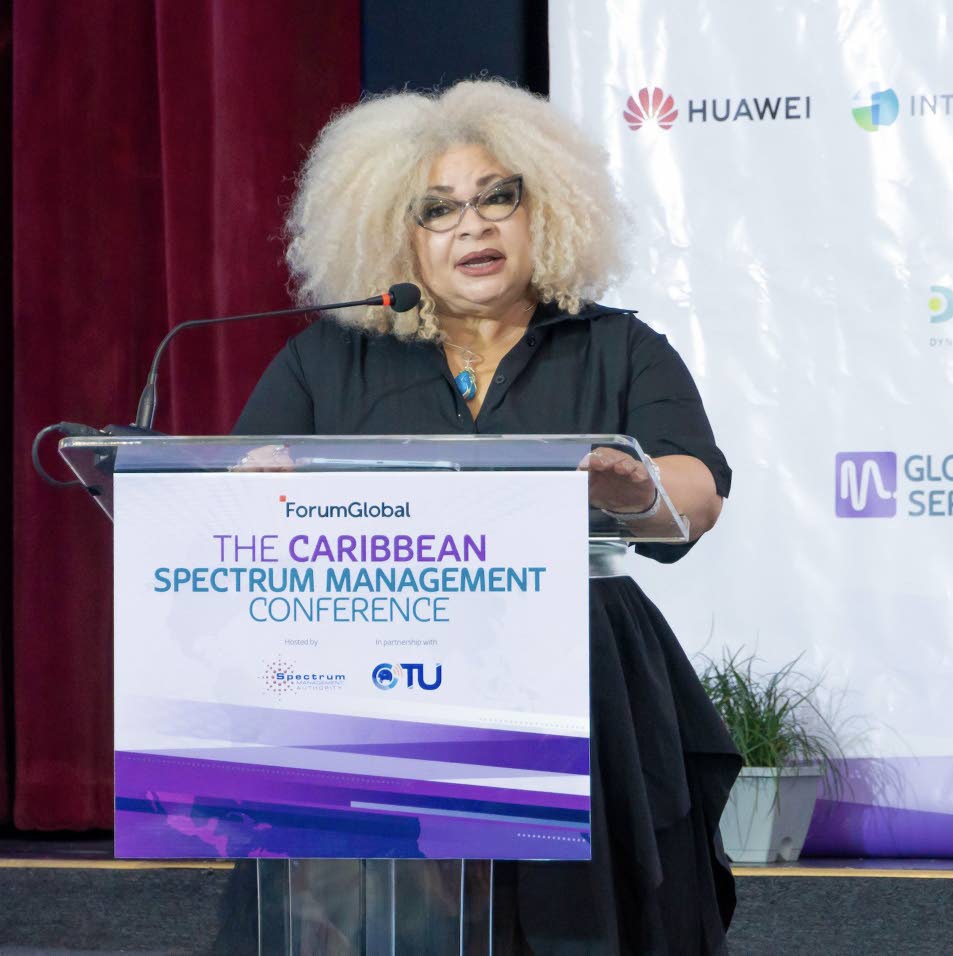
MYERS-HAMILTON…interference that previously took days or weeks to trace can be localised in a fraction of the time
The SMA said the unit will also be used at large events where several organisations may be operating radio equipment within a concentrated area.
The authority identified Carnival, Reggae Sumfest, national elections, and international sporting fixtures as examples of events where engineers may need to respond to competing or unauthorised signals that could interfere with communications.
The equipment will also be used for field assessments before and after telecommunications providers activate services on newly assigned spectra, including the 600 MHz band which the SMA said was recently awarded to help expand connectivity across Jamaica.
The authority said the mobile station could also be deployed when natural disasters damage fixed communications infrastructure or leave monitoring sites inaccessible or without electricity.
Myers-Hamilton pointed to the SMA’s response following Hurricane Melissa last October, when it coordinated emergency direct-to-device satellite services to help maintain connectivity.
“When Hurricane Melissa struck, the SMA coordinated emergency direct-to-device satellite services to help keep Jamaicans connected. A deployable monitoring unit strengthens that response. It allows us to confirm that emergency links are clear, identify what is still transmitting, and support restoration teams with real information rather than guesswork,” Myers-Hamilton said.
She pointed out that regulators elsewhere in the Caribbean generally rely on fixed monitoring stations supported by hand-held or vehicle-mounted receivers.
Myers-Hamilton said the unit forms part of the SMA’s responsibility to monitor how radio spectrum is being used in Jamaica.
“The radio spectrum belongs to the people of Jamaica. Stewardship requires more than allocating it well; it requires knowing, at all times, how it is being used.
“We have been entrusted with a resource on which the nation’s economy, safety and daily life depend. Watching over it, wherever and whenever it is needed, is a responsibility the SMA takes seriously — and one we are now better equipped than ever to fulfil,” added Myers-Hamilton.


