



The way forward for the PNP — Part 1
...and the leadership imperative
Eighty-eight years is a long life for a political party. The People’s National Party (PNP), founded in 1938 as a national movement to advance Jamaica’s social, political, and economic development, has survived colonialism, the Cold War, structural adjustment, and the age of the sound bite. Survival, however, is different from health. And the question before the PNP today is not whether it has a glorious past — it does — but whether it has a future worthy of that past. That question will be answered, or not, by leadership.
Begin at the beginning: A party that does not know its own history cannot chart its course. The PNP was not Jamaica’s first political party. That distinction belongs to Marcus Garvey’s People’s Political Party, founded in 1929. Nine years later, O T Fairclough organised the PNP — Norman Manley was a founding member and first president, alongside N N Nethersole, Howard Cooke, Ken Hill, Frank Hill, Wills Isaacs, Vivian Blake, and Richard Hart.
From Fairclough and Norman Manley through Michael Manley, P J Patterson, Portia Simpson Miller, Dr Peter Phillips, and Mark Golding, the party can claim substantial achievements — in social reform, in institution-building, in expanding what the Jamaican citizen believes the State owes her. Like all parties, the PNP has also made its share of mistakes — of policy, political-economic management, of implementation. To pretend otherwise is to bury its head in the sand. Honesty about failure is the first discipline of renewal.
Why now? Because the moment is both urgent and forgiving: A year after the 2025 General Election the party has had time to reflect, but events have not yet forced it to do so — and already the untamed ambition of a 2027 leadership contest stirs, threatening to replay the old film before the party has studied it. Diagnosis delayed is prescription denied.
THE LEDGER
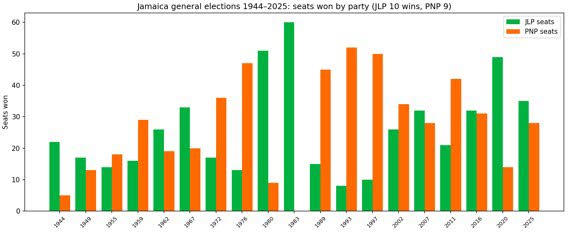
Of the general elections held between 1944 and 2025, the Jamaica Labour Party (JLP) has formed the Government 10 times to the PNP’s nine. But count the years, not just the wins. Of the 82 years from 1944 to 2026, the JLP has governed for 43 and the PNP for 39. The JLP’s fewer victories have been longer ones.
A note of honesty: One of the JLP’s victories — 1983 — was won by default, when the PNP held to an agreement not to contest on an outdated voters’ list and Seaga called a snap election. It counts in the record books; it should count differently in our judgement.
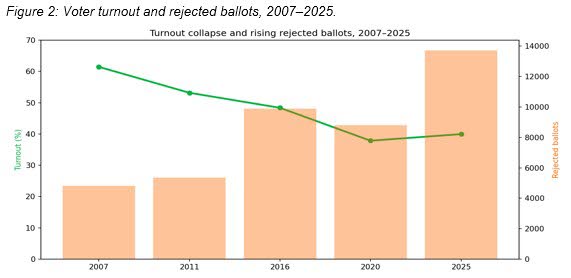
The five most recent contests deserve close reading. See figures 1 and 2.
.
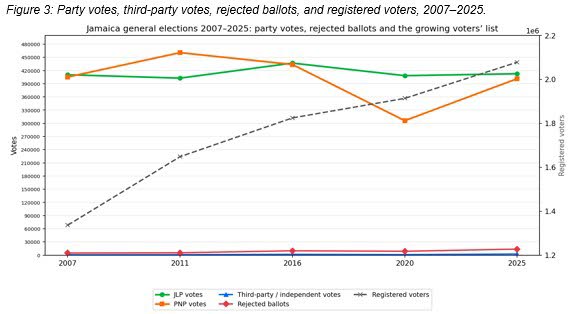
In Figure 3, two things should arrest every serious analyst. First, the arithmetic of the voters’ list. Between 2007 and 2025 the number of registered electors grew by more than half — from 1.34 million to 2.08 million — while votes cast stayed flat — between 820,000 to 880,000 in every election except the pandemic-hollowed poll of 2020. The turnout percentage fell from 61.46 per cent to under 40 per cent, but the votes did not collapse; the list outgrew them.
Three out of five registered electors now stay home — a democracy with a legitimacy problem, whichever party benefits. Second, the rejected ballots. In 2016, rejected ballots (9,875) exceeded the JLP’s popular-vote margin (3,237) threefold. In 2025, rejected ballots (13,705) again exceeded the margin (11,307). The rise is absolute — 4,819 to 9,875 to 13,705 across the three close elections. That pattern requires study, not insinuation. I raise it because a party serious about winning must be serious about every vote the system fails to count.
A third lesson comes by contrast. In 2011 — the PNP’s last victory — the party won 42 seats to 21 on a 6.67-point margin with turnout above 53 per cent. The machinery worked, the message cohered, and base and middle moved together. Everything since — 2016’s near-miss, 2020’s collapse, 2025’s recovery without victory — measures the distance travelled from that standard, and the road back.
A fourth lesson sits in the third-party and independent column. Add the rejected ballots and in three of these five elections the votes that went to neither major party exceeded the winning margin — 5,594 against 5,145 in 2007; 11,682 against 3,237 in 2016; 16,195 against 11,307 in 2025.
These are not the numbers of an apathetic people. They are the numbers of a people the system is failing to count — and of voters neither party has given sufficient reason to choose. It should haunt the PNP most of all because it claims to be the party of the people.
.
THE CONTESTS WITHIN
The PNP has held leadership contests that range from the orderly to the brutal, and their cumulative residue is the party’s deepest wound. Vivian Blake challenged Michael Manley in 1969. P J Patterson defeated Portia Simpson Miller in 1992 to succeed Michael Manley. Simpson Miller then defeated Dr Peter Phillips twice — 2006 and 2008. Phillips survived Peter Bunting’s challenge in 2019 by 76 votes — 1,427 to 1,351. And, on November 7, 2020, Mark Golding defeated Lisa Hanna, 1,740 to 1,444, to become the party’s sixth president.
These contests reveal a party of ambitious people, and ambition in politics is no sin — leadership requires ego, productively deployed. But each contest chiselled fissures of resentment, distrust, and disunity a little deeper, and the ugliness of some of them stripped the party of prestige and pedigree. Too often the PNP has presented itself less as a castle of intellectual seriousness and policy depth than as an empire of unserious, power-hungry tribes fighting for glory. That is a harsh sentence, but it is an honest one — and honesty is the tribute serious people pay to an institution they love.
The wounds of the last three contests continue to afflict the party. The PNP declares, correctly, that a united PNP is hard to beat; the results of the last three general elections are the proof. A party that telegraphs unity while practising its opposite devastates its own mission. What makes these contests poisonous is not the ambition but the aftermath. Each produced a public inventory of who stood where — delegates counted, loyalties mapped, grudges itemised — and the party has never built a ritual of reconciliation to match its ritual of combat. The loser’s camp is seldom reintegrated; it is tolerated, watched, and quietly frozen out of influence. A contest that ends at the ballot box but continues in the corridors is not democracy; it is a slow bleed.
Say what you will, the JLP does not possess the PNP’s depth of talent — warts and all. What it possesses is unity — from Bustamante to Andrew Holness, the party falls in line behind its leader with something approaching devotional discipline. Deity-like devotion to a leader is a control mechanism. It is not a model to emulate. It is, however, a reality to reckon with: Discipline, even misdirected discipline, beats divided brilliance at the polls.
The difference is audible, too. The JLP’s anthem, “Stand Up Jamaica,” is a hymn to its founder — “Remember Bustamante, he served you well” — the party as the lengthened shadow of one man, and then of his successors. The PNP’s anthem,
Jamaica, Arise, summons no leader at all: “The trumpet has sounded, my countrymen all, so awake from your slumber and answer the call.” One party sings about its leader; the other sings to its people. The PNP’s problem is not that it lacks leaders. It is that it has forgotten it was once a movement.
GOLDING AND THE CHARISMA FALLACY
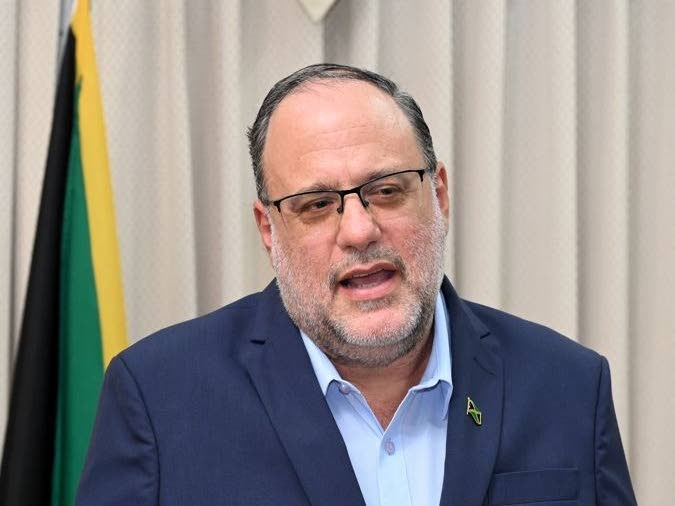
Mark Golding is not a seasoned retail politician. He is an earnest one. An excellent legislator, an Oxford-trained lawyer, a man who plainly cares about advancing Jamaica. Like Norman Manley, he is an intellect. And, like Manley, he lacks spontaneous charisma. He is more at home in Parliament than on the political hustings.
PNP President Mark Golding
Charisma cannot be bought, and the natural display of charisma does not a great leader make. Adolf Hitler was mesmerisingly charismatic; so was Benito Mussolini. The PNP should abominate the idea that any single personality — charismatic or otherwise — can carry a disunited, disorganised party to victory. That belief is fundamentally flawed.
Under Golding the PNP performed creditably in the February 2024 local government elections — winning the popular vote — and in the 2025 General Election it doubled its parliamentary representation from 14 to 28. But there is no second prize; electoral results are binary, win or lose. The doubling of seats is a foundation, it is not a victory.
The question before the party is not whether Mark Golding is charismatic enough. It is whether the PNP will finally build the institutional discipline that makes any single leader’s charisma secondary. Unity practised, and not merely preached, defeats a ground game that reaches beyond the faithful. Leaders do not rescue parties. Parties rescue themselves and then choose leaders worthy of the rescue.
Tomorrow: The unlearned lessons of 2020 and 2025 — corruption, money, and messaging — and the leadership imperative.


