How Dis Mek: Jerk pans
THE smoky, spicy taste of Jamaican jerk is celebrated worldwide, but while some purists might insist the term “jerk” only refers to meat smoked with a special type of wood and a particular sauce, many locals use it as a catch-all for meats prepared in a traditional jerk pan.
The origin of jerk is generally credited to Jamaica and is cited as a mix of practices from the native inhabitants, the Taíno, and enslaved Africans who escaped and their descendants — the Maroons — who lived in the mountains.
Both groups are thought to have interacted, sharing meat preparation practices that have evolved.
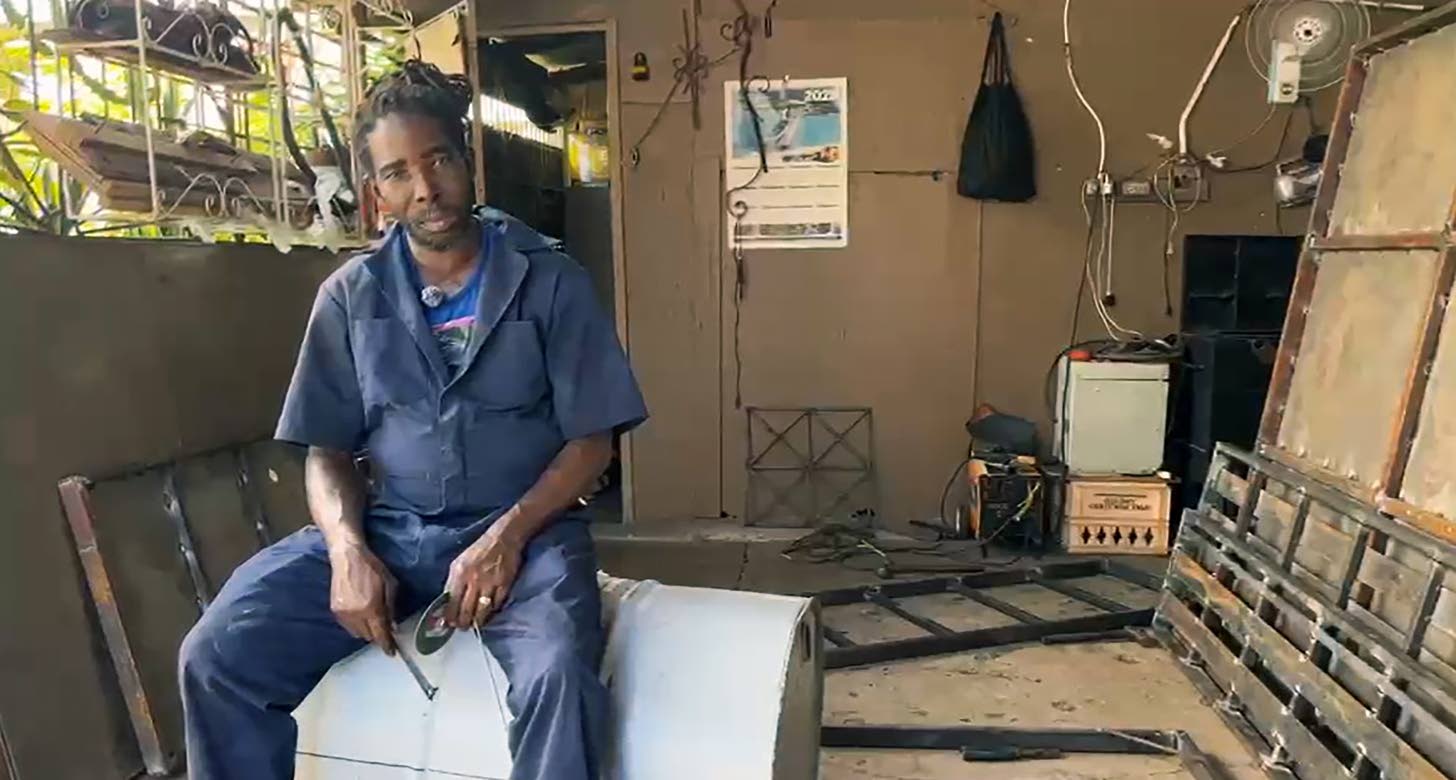
Melton Gooden takes a break from making an in-demand jerk pan.
In the past, the Maroons are thought to have used a smokeless pit to achieve the tender, blackened and flavourful meat, which for them may have been wild boar.
Now, ‘jerkies’ or pan chicken vendors use repurposed drums fitted with internal grills and smoke spouts to cook everything from pork to chicken necks.
The Jamaica Observer took a trip to downtown Kingston where Melton Gooden showed us the process behind creating the pans that bring the delicious meats to life.
Gooden works as a taxi driver but is a trained welder who, for years, has specialised in making jerk pans.

“I did this a very long time back, from [my] school [days]. I had certificates and so forth. I see that people have needs for this stuff, so I thought I’d invest in it,” he explained.
The welder sources drums from factories across the island for repurposing, and depending on what they held previously or if they are pressurised, these drums must be opened carefully.
“Water is my basic product I use to be safe on opening those containers — I fill them first with water,” he explained.
After a vigorous cleaning process, the drums are ready to be cut to make jerk pans, a process that takes more customisation than you might expect.
“You have to know…whatever type of space you’re working with, the person you’re working with. So if it’s a tall person, you build a tall [pan], if it’s a short person you build a short [pan]…so you don’t make everything the same way,” he said, adding “It’s all about being stylish and so forth.”
Working mostly in silence, due to the welding mask he is required to use for safety, Gooden first maps out where the opening of the pan will be with a ruler and pencil.
He also measures the distance at which he’ll stop cutting, so hinges can be applied. This measurement must be precise, as without it, the pan will not open and close properly, effectively making it useless.
After this, a small hole is cut in the pan, and a metal spout is welded on to provide a release for the smoke that will be generated during cooking. A grill is also placed in the middle of the pan.
Once this is done and the pan is painted, it is ready for sale!
Gooden plies his wares at the Vineyard Town/Mountain View taxi park.