Spend on electricity tops household utility expenditure
Spending on electricity accounted for the largest share of utility expenditure by households across the island, findings from the 2023 Jamaica Survey of Living Conditions (JSLC) have revealed.
The survey, conducted jointly by the Statistical Institute of Jamaica (Statin) and the Planning Institute of Jamaica (PIOJ), found that households spent an average of 6.0 per cent of their total consumption on electricity. This translated to a mean monthly payment of $9,268.
“By region, nominal mean monthly electricity payments were highest in the Greater Kingston Metropolitan Area (GKMA) at $12,100 and lowest in rural areas at $7,572,” the report noted.
Electricity supplied from the national grid remained the primary source of lighting for 96.6 per cent of households surveyed while an additional 2.9 per cent relied on alternative sources, including solar, wind, and kerosene.
Electricity costs are expected to climb further this year amid ongoing geopolitical tensions in the Middle East, with increases in global oil prices likely to drive higher charges. In light of these forecasts, Jamaica Public Service (JPS), as the island’s sole electricity distributor and operator of the national grid, has already warned customers to brace for higher fuel charges in upcoming bills.
The looming increase in oil prices comes at a time when JPS continues to face financial pressures following the impact of Hurricane Melissa last October, which damaged significant portions of its infrastructure. As part of its response, the company has since secured a US$150-million loan from the Government of Jamaica to accelerate recovery efforts, which are still not yet 100 per cent complete.
According to its latest financial filings, JPS recorded operating revenues of US$1.07 billion, a slight decline from US$1.09 billion earned in 2024. Profit for the year, however, fell sharply to US$28.9 million, down from US$61.9 million in the previous year, largely due to hurricane-related expenses and reduced electricity usage.
Other utilities accounting for a smaller share of household spending saw payments for monthly telephone expenses averaging about $7,871, representing 3.1 per cent of total consumption. These costs were highest in the GKMA at $8,970, compared to $8,168 in other urban centres and $5,477 in rural areas.
Water bills, on the other hand, accounted for 2.7 per cent of household consumption, with an average monthly cost of $4,881.
The 2023 survey, now in its 32nd instalment, drew its findings from a sample made up of 4,442 individuals from 1,719 households. Playing a vital role in advising public policy and informing programme development over the years, the annual survey is used to provide invaluable insights into the social and economic well-being of Jamaican households.
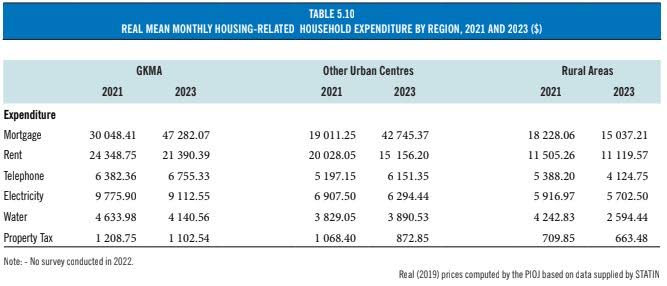
In terms of other expenditure, the survey also showed where housing-related expenses represented a significant portion of household budget as mortgage payments accounted for an average of 15.7 per cent of total expenditure. This resulted in mean monthly payments of almost $58,000.
“In real terms, this represented a 57.0 per cent increase relative to 2021,” the survey indicated.
Among rent-paying households, an average of 14.0 per cent of total household expenditure went towards these payments, reflecting a mean monthly cost of $23,700.
Rent payment in the Corporate Area, found to be the highest, was averaged at little over $28,000 when compared to $14,765 charged in rural areas.
Despite higher nominal costs, the data collected indicated that rental payments declined in real terms across all regions relative to 2021.
“In the GKMA [rental payments] were reduced by 12.1 per cent compared with 24.3 per cent in OUC and 3.3 per cent in rural areas,” the data showed.