



Trailblazer: Dr Mavis Gilmour-Petersen
The life and legacy of national icon Dr Mavis Gilmour-Petersen stand as a powerful testament to purpose, perseverance, and an unwavering commitment to service.
Her journey, from the quiet rural communities of St Elizabeth to the forefront of Jamaica’s medical and political leadership, is not merely a story of personal success but one of nation-building, driven by an enduring desire to uplift others through health, education, and opportunity.
Born on April 13, 1926, in humble circumstances in St Elizabeth, Gilmour-Petersen’s early life was shaped by modest means but rich values.
She attended a local public school where her curiosity and determination quickly distinguished her. Even as a young girl, she displayed a bold sense of ambition.
One defining moment came when she sat an entrance examination and declared her dream of becoming a doctor. An educator dismissed her aspiration, suggesting it was beyond her reach.
Rather than discouraging her, the remark became a quiet source of motivation. Years later, after earning her medical degree, she returned, not with resentment, but as living proof that determination could overcome doubt.
Her academic path carried her far beyond Jamaica’s shores. After attending Blake’s Tutorial College, she enrolled at Howard University in Washington, DC, one of the most respected historically black institutions in the United States. There she pursued medicine with focus and discipline, graduating from the Howard University College of Medicine in 1951.
Her thirst for excellence did not end there. She went on to study at the University of Edinburgh in Scotland, undertaking rigorous surgical training and eventually earning her Fellowship with the Royal College of Surgeons in 1959, an extraordinary accomplishment, particularly for a Jamaican woman in that era.
When she returned home, Dr Gilmour-Petersen made history by becoming the first woman surgeon in the Caribbean. From 1960 to 1976, she served at Kingston Public Hospital (KPH), where she built a reputation for clinical excellence, compassion, and professionalism.
In a male-dominated field, she not only secured her place but redefined expectations. Notably, she chose not to enter private practice, dedicating her entire career to public health care. For her, medicine was never about prestige or financial gain; it was about service.
“I became a doctor to help my people,” she shares with JIS News, a philosophy that guided every aspect of her work.
Her years at KPH were marked by tireless dedication to patient care and a deep belief in human dignity. She viewed the hospital not simply as a workplace but as a vital institution where lives could be transformed and hope restored. Beyond the countless patients she treated, her influence extended to the many young medical professionals she mentored and inspired.
Her legacy in health care remains deeply embedded in Jamaica’s public health system. Yet even as she excelled in medicine, Dr Gilmour-Petersen recognised that broader systemic change was needed to address the challenges facing the Jamaican society. Motivated not by ambition for power but by a desire to serve on a larger scale, she entered politics.
“Politics is a place where you can do the most for the people who have the least,” she explains, underscoring her commitment to advocacy and equity.
In 1980, after being re-elected Member of Parliament for St Andrew West Rural, she was appointed minister of education, a role she held until 1986. Her tenure marked a transformative era for Jamaica’s education system. With vision and resolve, she implemented sweeping reforms that expanded access, improved quality, and strengthened institutional capacity.
Among her most impactful initiatives was the enforcement of compulsory primary education, ensuring that every Jamaican child had access to schooling. She spearheaded the expansion and upgrade of primary schools across the island, improving infrastructure and access for thousands.
Recognising the critical role of teachers, she enhanced teacher training by upgrading teachers’ colleges and establishing Passley Gardens Teachers’ College. She also facilitated the expansion of the College of Arts, Science and Technology (CAST), now the University of Technology (UTech), Jamaica. She also played a central role in relocating and upgrading the Jamaica School of Agriculture, which later merged with Passley Gardens to form the College of Agriculture, Science and Education (CASE).
In addition, Dr Gilmour-Petersen was instrumental in establishing the HEART/NSTA Trust, laying the foundation for technical and vocational training in Jamaica. Her forward-thinking approach ensured that education was not limited to traditional academic pathways but included skills training essential for national development. She was also ahead of her time in integrating technology into education. She introduced computer science programmes when such initiatives were still emerging globally and implemented computer-based reading programmes in partnership with Control Data Corporation. These innovations positioned Jamaica as a regional leader in educational modernisation.
Understanding the link between nutrition and learning, she championed the expansion of the school-feeding programme, including the provision of Nutribun and milk to students. This initiative addressed a critical barrier to education, ensuring that children were not only taught but nourished. She also expanded the students’ loan programme, making higher education more accessible to families across the island.
Her leadership extended to strengthening the Ministry of Education itself, improving infrastructure and establishing a robust Education Planning Division. These efforts made the system more strategic, data-driven, and responsive to national needs.
Throughout her tenure, she remained deeply connected to the people she served, engaging with parents, teachers, and communities. Her ability to mobilise support became one of her defining traits.
“I am a good beggar,” she jokingly states, referring to her skill in securing resources for education.
Minister of Education, Skills, Youth, and Information Senator Dana Morris Dixon, reflecting on her influence, said: “We celebrate the 100th birthday of Dr Mavis Gilmour. She became minister of education in 1980, and I was born in 1980. For me, it’s an honour really to be able to come to celebrate her life. She is known across Jamaica for the work that she did [and] she focused a lot on nutrition.”
“I have been able to take up that mantle in terms of ensuring that our children not go to school hungry. She started it and I am trying to just work in her footsteps,” she added.
Former Minister of Education Maxine Henry Wilson also highlighted her strength and pioneering spirit, noting that she “was a very strong woman… a trailblazer… passionate about education and an advocate for women’s advancement”.
From the medical community, president of the Medical Association of Jamaica (MAJ) Professor Marvin Reid underscored her dual legacy in health care and governance.
“On behalf of the Medical Association of Jamaica I would just like to extend our heartiest congratulations and wish happy birthday to Dr Mavis Gilmour. We recognise, acknowledge, applaud the work that she has done… She would have been one of the contributors towards… the overall improvement in health of our nation,” he told JIS News.
Over the years, Dr Gilmour-Petersen’s contributions have been recognised with some of Jamaica’s highest national honours, including the Order of Distinction (Commander Class) in 2004 and the Order of Jamaica in 2009. In that same year, she achieved yet another milestone, earning a Doctor of Philosophy (PhD) in Curriculum and Instruction Cultural Studies from Ohio University, demonstrating her lifelong commitment to learning.
Despite these accolades, she remains deeply humble. She often credits her upbringing and her mother’s influence for her success, viewing her achievements not as personal triumphs but as the natural outcome of a life dedicated to service.
— JIS
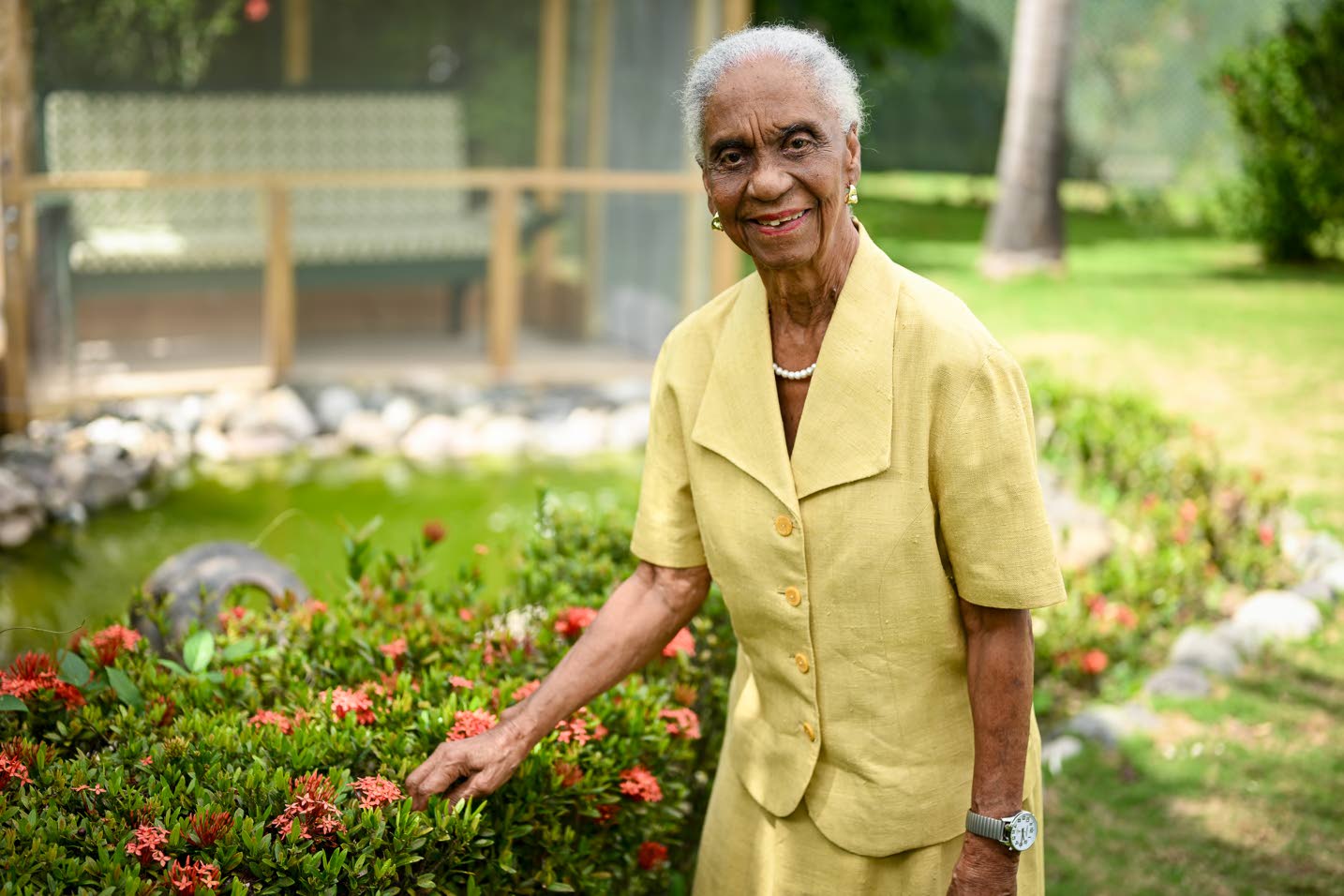
National icon, first woman surgeon in the Caribbean, and former Minister of Education Dr Mavis Gilmour-Petersen poses in her garden during a visit to her St Andrew home by JIS, on April 16. (Photo: Adrian Walker)


