



Global policing contradicts Chang on body-worn cameras, says Mark Shields
MINISTER of National Security Dr Horace Chang is coming under fire for his declaration that members of the Jamaica Constabulary Force (JCF) will not be equipped with body-worn cameras (BWC) when going on operations in which they are confronting armed criminals.
“This thing that you must wear a camera when you going to look for a man who has a M16 that’s firing 60 rounds per second is a crazy idea. When gunshot start blaze across your head or over your head, you’re going to dive, you’re going to find cover even if you’re a policeman and look a place where you can find a space to, in fact, return fire,” said Chang during a post-Cabinet media briefing on Wednesday.
He doubled down as he declared that for a planned operation at 3:00 am in search of a gunman, the police will not wear cameras.
But former Deputy Commissioner of Police Mark Shields, who is now the managing director of Shields Crime & Security Consultants, told the Jamaica Observer on Thursday that Chang’s position is not supported by global evidence or by the operational reality of the most capable and battle-tested tactical police units across the world.
“The suggestion that armed environments are incompatible with body-worn cameras was tested and rejected years ago by police agencies operating in far more challenging and dangerous conditions than Jamaica currently faces. The evidence from those deployments is instructive,” said Shields.
He pointed to the London Metropolitan Police’s Specialist Firearms Command and argued that its members have operated with body-worn cameras on armed deployments for more than a decade.
“Officers who carry Glock 17 pistols, Heckler and Koch G36 carbines, and tasers are required to activate their cameras during firearms operations. The rationale is simple: because the stakes are highest in armed encounters, the need for evidential integrity and accountability is also at its highest.
“In the United States — which the minister himself referenced — it is true that early SWAT [special weapons and tactics] and special operations units had mixed or limited camera policies. However, that position has evolved significantly. The New York Police Department’s Emergency Service Unit (ESU), the Los Angeles SWAT, and the Chicago SWAT all now operate with BWC protocols that include high-risk warrant executions and armed confrontations. Following high-profile incidents, those agencies did not retreat from cameras, they embedded them more deeply,” argued Shields.
He also pointed to one of the comments made by Chang about the Los Angeles Police Department and racial profiling and declared that this needed to be addressed.
According to Shields, while Chang was correct when he identified racial profiling as one of the reasons body-worn cameras became so popular among law enforcement agencies in the United States, “That argument actually reinforces — not undermines — the case for cameras in Jamaica, where the rate of police fatal shootings is among the highest in the hemisphere and where the Independent Commission of Investigations [Indecom] has repeatedly raised concerns about the quality of evidence presented at the coroner’s inquests and in use-of-force investigations.
“The claim that cameras make officers targets on armed operations is an assertion, not a finding. There is no credible, peer-reviewed evidence from any major policing jurisdiction that body-worn cameras have caused or contributed to officer fatalities on tactical deployments. This argument was also made in this public debate by others, and it is addressed in detail in my letter to the Jamaica Observer earlier this year,” Shields added.
He said the Axis III body-worn cameras procured by the JCF — 1,000 of which are currently on order — are equipped with stealth mode that disables the visible status light and all audible indicators while continuing to record.
“This means the camera captures footage without any visible or audible signature. On a 3:00 am planned operation, a correctly configured Axis III camera on stealth mode presents no greater visual profile than any other piece of kit on the officer’s vest. The question, therefore, is not whether cameras are safe on such operations. The question is whether the JCF’s operational protocols have been updated to mandate stealth mode deployment during pre-planned covert and armed operations. That is a policy and governance issue — entirely within the police commissioner’s authority to resolve,” argued Shields.
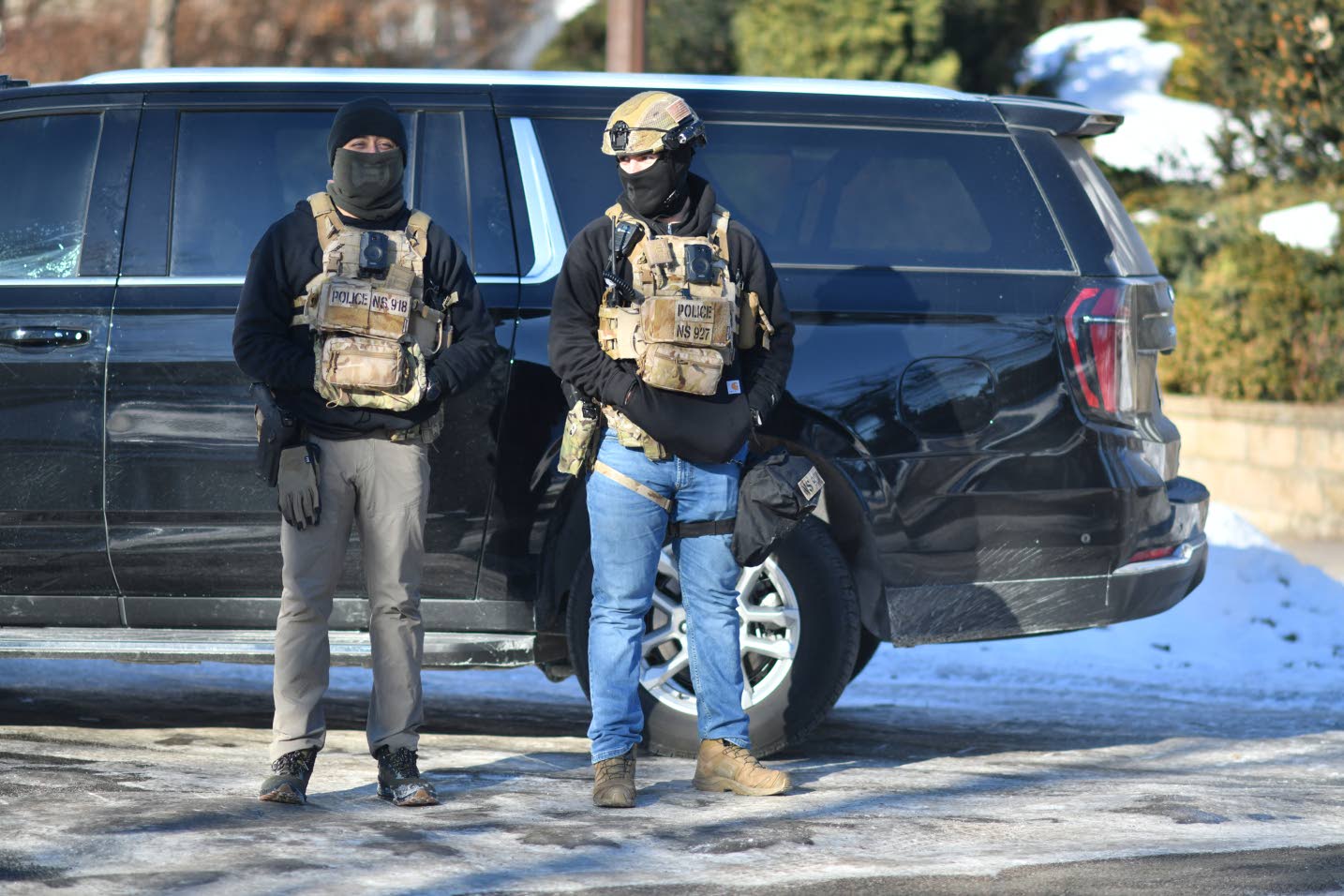
Masked agents wearing body cams stand at an intersection during an Immigration and Customs Enforcement (ICE) operation in a St Paul neighbourhood following a multi-vehicle crash on January 31, 2026 after the US Department of Homeland Security ruled that immigration agents should be be equipped with body cameras. (Photo: AFP)


