



Silence from JLP as MP breaks ranks over NaRRA Bill
Malahoo Forte supports Opposition’s position that proposed legislation needs rework
THERE has been no official word yet from the leadership of the governing Jamaica Labour Party (JLP) after one of its members broke ranks over the proposed National Reconstruction and Resilience Authority (NaRRA) Act being piloted through the House of Representatives by Prime Minister Dr Andrew Holness.
Hours after a rare and pointed break from the Government’s line on NaRRA by Member of Parliament for St James West Central Marlene Malahoo Forte on Tuesday, JLP sources told the Jamaica Observer that they were disappointed but not surprised by the position taken by the former Cabinet member.
“Marlene has always been an independent thinker so it is no surprise that she disagrees with aspects of the proposed legislation, although it must be noted that she agrees with the need for NaRRA,” said one Government source.
“As an elected representative sitting in the Parliament she is certainly entitled to her opinion but she is not entitled to her own facts — and that was what was disappointing in her presentation,” added the source.
Making her contribution to the NaRRA Bill on Tuesday, Malahoo Forte charged that it will require significant reworking if it is to effectively accomplish its mandate.
“The Bill in its current form will not achieve the goals that are set,” Malahoo Forte said during Tuesday’s debate on the Act in the House of Representatives.
Expanding on that position, Malahoo Forte raised concerns about accountability and the breadth of authority granted under the Bill.
She made clear that while there is broad agreement on the need to rebuild following the devastation of Hurricane Melissa, the structure of the legislation could create serious governance challenges if not carefully refined.
The former Cabinet member further argued that concerns raised by Opposition members of Parliament should not be dismissed and the issues brought to the fore in the debate be seriously considered as Parliament reviews the Bill.
“This Bill, as the Prime Minister [Dr Andrew Holness] has said, is the most consequential piece of legislation that is to be passed, and he invited all of us to approach the consideration of the Bill seriously and so we can’t really rush it too much, even though time is of the essence… I do not believe that anyone who has spoken has taken issue with the goals that are being pursued, but the concerns are whether the Bill in its form will achieve those goals,” she stated.
Malahoo Forte, who served as minister of legal and constitutional affairs in the last Holness-led Cabinet, argued that a central concern is how the NaRRA would be constituted. She pointed out that the Bill, as drafted, appears to vest significant responsibility in a single office holder.
“The schedule speaks to a CEO (chief executive officer) and only a CEO, and so if the intention is to constitute the authority with a single office holder then that is what will be achieved — but if that is not the intention then the Bill will require some rework. Now the question naturally arises, in light of the objectives being pursued, whether a single person constituting the authority is the model that we should use — [and] it is an appropriate question to be answered,” she said.
The former attorney general also argued that the Bill does not clearly define the qualifications required for such a CEO’s role, as she raised further concerns about governance and accountability in an entity expected to oversee billions in reconstruction spending.
Beyond structure, Malahoo Forte pointed to potential conflicts within the functions assigned to the authority, particularly where it would both execute and oversee projects.
“Clause four, when you read all of it, you’re going to see that, for example, the function of procuring goods, works and services for the implementation of projects, programmes and plans; and then the function of establishing project management, compliance, monitoring, reporting and risk management systems necessary for timely, efficient and effective performance of procurement contracts for the implementation of approved projects, programmes and plans, may run the authority into some trouble, and you may invite all kinds of genuine concerns,” she pointed.
She warned that such an arrangement could effectively lead to self-monitoring — a situation she suggested would weaken independent oversight and invite disputes over how power is exercised.
The NaRRA Bill, which aims to create a central body to coordinate reconstruction and resilience efforts after Hurricane Melissa, has been framed by the Government as essential to speeding up recovery and addressing long-standing inefficiencies. However, Malahoo Forte cautioned that urgency must not come at the expense of clarity in law.
“I do not subscribe to the school of thought which says that power granted shouldn’t be exercised. I believe that if power is granted, it should be exercised. But I also subscribe to the school of thought which says it is not for a minister or an entity to determine the extent of the power that is granted on the law, that the law itself must set it out and set it all clearly so that we do not then start quarrelling as to whether action taken was actually intended,” she continued.
She also drew attention to the wide scope of powers embedded in the Bill, warning lawmakers to be deliberate on how such authority is framed.
“So when we say that anything can be done, it literally means anything can be done, and we have to consider carefully if this is the power we want to grant,” she said, referring to the wide-ranging authority and discretion granted to the proposed body under the Bill.
Malahoo Forte also raised concerns about provisions allowing ministerial intervention in approval processes, which could override decisions typically handled by local authorities and regulatory bodies.
She noted that such provisions could significantly alter established processes involving planning, environmental and infrastructure approvals, raising broader questions about institutional balance.
Despite her concerns, Malahoo Forte underscored that there is no disagreement over the need for reconstruction or the broader goals of the legislation, but rather whether the Bill, in its current form, can deliver on those objectives.
“This is too important for us not to have the kind of buy-in and take into account the very valid concerns that have been raised. So, on that note, I invite the prime minister piloting the Bill and the team to take into account the very valid points that have been made — the Bill needs some reworking,” she said.
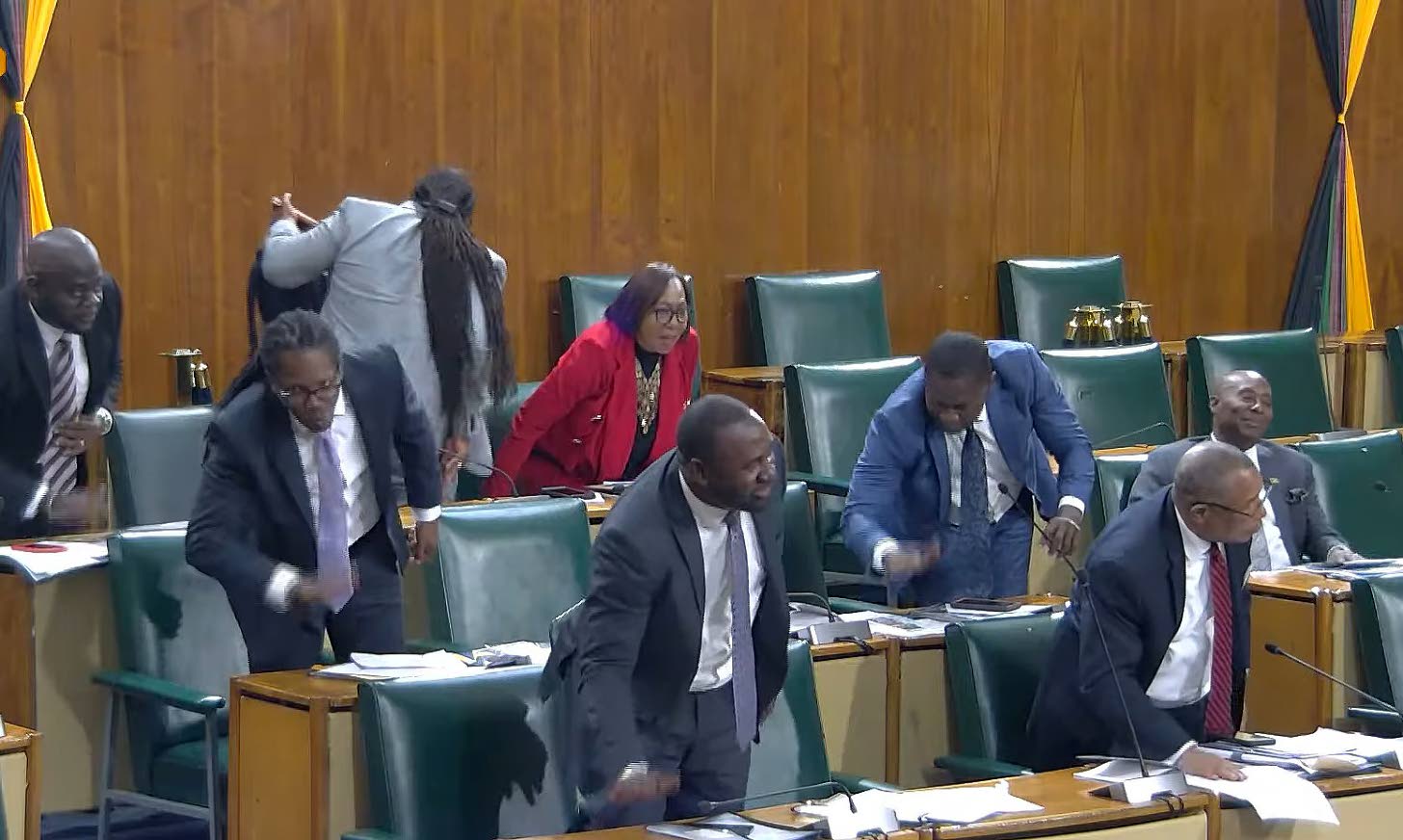
Screen grab shows Opposition members banging their desks in support at the end of Marlene Malahoo Forte’s presentation during Tuesday’s debate on the NaRRA Bill.


