



Triumphs and trials
Antonette Wemyss-Gorman reflects on moments of pain and pleasure in long military career
MORE than three decades of military service have afforded Vice Admiral Antonette Wemyss-Gorman a wealth of experiences — moments of triumph that fill her with pride and others that have tested her emotional resilience.
One such incident that left an indelible mark on her heart came on February 22 last year — the sudden death of one of her soldiers: Chief Petty Officer Diana Drummond-Thomas.
“There have been many deaths of soldiers that I’ve had to treat with as their direct commander, but the one that shook me most to my core [was that of] a female soldier who was in the peak of her life,” Wemyss-Gorman, Jamaica’s chief of defence staff, told the Jamaica Observer last Friday during a discussion about her memoir titled Life, duty and command.
“She was deployed overseas as an instructor in a US training institution — Jamaican soldier instructing in the US. Fit, nothing, no indication of anything wrong with her, and I got a call that she was on a run, just by herself, and collapsed and died,” the Jamaica Defence Force (JDF) chief shared.
“I didn’t think I could manage to go through the ceremony to bury that soldier… the hardest part was watching her daughter put a wreath on her grave and I’m thinking, ‘That girl is 14 years old and she’s just lost her mother.’ My son is just a few years older,” Wemyss-Gorman said.
“That was very, very emotional for me… it was so difficult to comprehend why she had died like that. She was just at the top of her game, and really an extraordinarily fit soldier,” Wemyss-Gorman added, her voice tinged with sadness.
A JDF condolence statement issued at the time noted that 37-year-old Drummond-Thomas was the first female Class 1 coxswain in the JDF Coast Guard.
The statement added that Drummond-Thomas served in various appointments at the coast guard and other units, including the Naval Police at the Port Royal base, instructor on recruit intakes at the Military Training Wing, and an instructor at the then Caribbean Military Maritime Training Centre in Port Royal.
“We had to repatriate her body. We had to go to the airport… it was the first time we were doing a repatriation ceremony in the history of the JDF, so we had to design the protocol to do it, which we now have codified,” Wemyss-Gorman told the Observer.
“But yeah, that one shook me to the core,” she reiterated.
The recollection brought to mind another episode that also tested her emotional strength, one that she admitted she could not forget.
“It was around 1995 or so when there was mass migration from Haiti; there was another crisis and people were leaving in droves by boats,” the vice admiral related.
She said, at the time, the American Mercy-class hospital ship, the USNS Comfort was in Kingston Harbour conducting operations with the JDF Coast Guard.
“As a young officer I was going back and forth out to sea to retrieve persons who the US Coast Guard had picked up out of the water on unsafe boats, take them to the hospital ship for them to be screened and so on,” she shared.
Wemyss-Gorman said that on one of those missions she rescued a pregnant Haitian woman and while transporting her to the hospital ship, the woman went into labour. The emergency, she said, placed her in a dilemma: Should she drive her vessel at maximum speed, or “go slowly” because the woman was uncomfortable.
Asked what option she employed, Wemyss-Gorman said, “Somewhere in-between”.
She said that when she got to the hospital ship the sight of the pregnant woman being hoisted aboard on a stretcher brought an immediate sense of relief, as though a heavy weight had finally been lifted from her shoulders.
“But I recall that was a very challenging, emotionally challenging period where you saw persons — human beings — who had put themselves in a vessel and their children with all their possessions in a plastic bag trying to find a better life,” the JDF chief said.
“I don’t think ordinary Jamaicans understand how much the Haitian people have endured and why it is so important for us to be a part of their stability,” she added.
Although those moments tested Wemyss-Gorman’s resolve, they were balanced by experiences that brought fulfilment and a deep sense of accomplishment.
Those experiences, she told the Observer, are usually related to the success of a mission.
“I mean, as a coast guard officer you do search-and-rescue missions, where you find the fisherman after several days of him hanging on to his canoe or something. Those are the kinds of things that when you go home you feel really good,” she said.
“There’s also, throughout my career, having the opportunity to see, enable, mentor, and watch someone just achieve way more than they even thought they could, which I think… is what I would have done for persons who mentored and guided me. Those are the kinds of really, really rewarding things. But it’s 34 years, it’s a lot,” added Wemyss-Gorman, who in January 2022 became the first female head of an armed force globally.
DRUMMOND-THOMAS… died suddenly while on assignment in the United States last year February
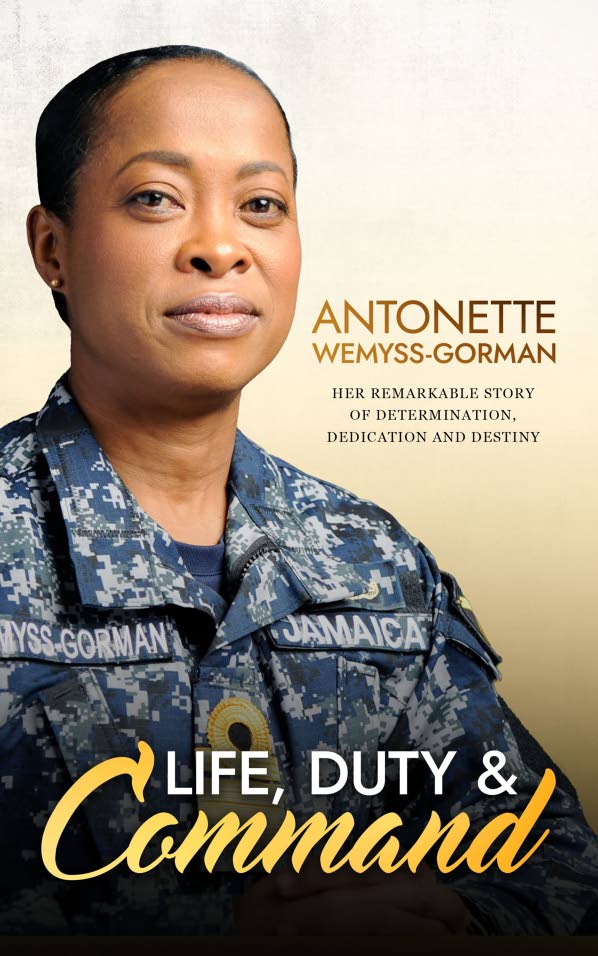
The cover of Chief of Defence Staff Vice Admiral Antonette Wemyss-Gorman’s memoir, which is available in digital format and is scheduled to be released in hard copy format soon.


