



INSIDE LASCO’S POST-LASCELLES PLAN
Dr Eileen Chin outlines plans for exports, acquisitions and succession
MORE than two years after the death of founder Lascelles Chin, LASCO is beginning to put in place the leadership structure that will carry the company beyond its founder era, elevating long-time executive Dr Eileen Chin into expanded roles as it prepares for its next phase of growth.
Chin was appointed deputy executive chairman of LASCO Manufacturing Limited and LASCO Distributors Limited on May 26. Her appointment to the same position at LASCO Financial Services is expected following a planned June 17 board meeting after the financial services company’s auditors requested additional time to complete the audit of its 2026 financial statements.
The appointments place Chin, a veteran executive of the organisation, at the centre of an effort to strengthen leadership continuity across a group whose businesses generated more than $44 billion in annual revenue last year and are now navigating very different opportunities and challenges. One of her first priorities, she said, will be strengthening leadership development across the organisation to ensure the company remains successful across generations.
“LASCO’s future cannot rest on any single individual,” she said. “It must be built on strong leadership at every level, a culture of accountability and innovation, disciplined execution, and an unwavering commitment to the customers and communities we serve.”
Chin made the comments in an interview with the Jamaica Observer and subsequent written responses discussing her appointment and vision for the company.
“For me, succession planning is not about identifying one person to replace another,” she said. “It is about ensuring that the organisation has a strong pipeline of capable leaders at every level.”
Having previously served as a director within the LASCO group, Chin said the new role will involve direct participation in the company’s operations as responsibilities are allocated between herself and Executive Chairman James Rawle.
“The chairman and I will be agreeing on what portfolio of the operation I will be looking after,” she said.
The focus on leadership continuity comes as LASCO’s businesses occupy sharply different positions, illustrating the complexity of the challenge facing the group’s leadership team.
Manufacturing remains the group’s strongest performer. For the year ended March 31, 2026, LASCO Manufacturing reported record net profit of $2.76 billion, up 7.6 per cent, while revenue climbed to $12.69 billion. The company also commissioned a new high-speed beverage and water filling line as part of an ongoing investment programme aimed at increasing capacity and efficiency.
LASCO Distributors generated $31.67 billion in annual revenue, making it the group’s largest company by sales. Yet profit declined 20.6 per cent to $1.06 billion as rising operating costs, increased marketing expenditure and investment activity compressed margins. The company continues to invest heavily in its White Marl warehouse expansion project, which management expects will improve logistics efficiency and support future growth.
Financial Services presents a different challenge. While its most recent audited results showed a sharp decline in profitability, more recent figures suggest a recovery may be emerging. For the nine months ended December 31, 2025, operating profit rose 166 per cent to $213.3 million as lending activity expanded and the company returned to profitability. Loans and receivables increased to approximately $2.18 billion from $1.49 billion a year earlier, signalling a growing emphasis on lending activity.
LASCO Financial has advised that its audited financial statements for the year ended March 2026 will be filed on or before June 17 after external auditors requested additional time to complete their review. Chin said the timing also delayed consideration of her appointment as deputy executive chairman of the financial services subsidiary until the company’s planned June 17 board meeting.
The appointment elevates a long-time LASCO executive whose journey to corporate leadership began far from the boardroom.
Born in Cuba, Chin entered medical school at age 16 and trained as a physician and researcher before moving to Jamaica in 1998. She joined LASCO the following year, initially assisting with product labels, translations and export-related work while learning the business from the ground up.
She later earned an MBA and worked across exports, product development and manufacturing before rising to become managing director of LASCO Manufacturing, the group’s most profitable subsidiary. Her elevation follows several years leading the business, which delivered record earnings during the last financial year.
Chin, the widow of founder Lascelles Chin, has been part of LASCO’s growth from a local business into a diversified publicly listed group.
The appointment also extends the continued involvement of the founder’s family in the business. The Estate of Lascelles Chin remains one of the largest shareholders across the LASCO companies, holding approximately 30 per cent of LASCO Manufacturing and LASCO Financial Services and just under 29 per cent of LASCO Distributors. The estate’s principal co-shareholders include East West (St Lucia) Limited and Mayberry Jamaican Equities Limited, while Chin also maintains personal shareholdings in each company.
Speaking with Business Observer, Chin outlined a growth strategy centred on exports, new product development, higher-value offerings and acquisitions.
Despite decades of regional expansion and a presence across Caribbean and North American markets, exports currently account for only about 4 per cent of business activity, leaving considerable room for growth if the company can successfully expand its international footprint.
“The biggest opportunity now, just the low-hanging fruit, is expanding export,” she said.
The company plans to deepen its presence across the Caribbean while pursuing additional growth in the United States and Canada. Chin also identified Guatemala, Nicaragua, Honduras, Panama and Belize as markets where LASCO products previously enjoyed recognition and market acceptance and where it sees opportunities to rebuild its presence. Those markets, she said, provide an opportunity to build on existing brand awareness while creating a platform for broader regional expansion over time.
Beyond exports, Chin said LASCO intends to continue growing organically through the introduction of new products and the expansion of its existing portfolio.
“What we have been doing is also looking at new ideas,” she said. “There is a lot of other things that we could expand on through the organic growth of the company.”
She said the company is also examining opportunities in higher-value product categories, including food drinks, as it seeks to broaden its product mix and improve profitability. The strategy represents an evolution for a company whose growth has historically been driven largely through organic expansion rather than acquisitions.
Chin said LASCO is now prepared to evaluate acquisition opportunities that complement its existing businesses and strengthen its long-term competitive position.
“We are not interested in acquisitions simply for the sake of growth or scale,” she said. “Any business we pursue must be strategically meaningful, aligned with our core operations, and capable of strengthening our capabilities, extending our market reach, or enhancing our product portfolio.”
“Our ambition is not simply to build a larger company, but to build a stronger, more diversified and more internationally competitive Jamaican enterprise,” she said.
Against that backdrop, Chin believes one of the biggest long-term risks facing LASCO — and Jamaican business more broadly — is the growing shortage of specialised talent. As equipment, automation and digital technologies become increasingly sophisticated, she argues that the supply of qualified workers is failing to keep pace.
“If you look at the manufacturing industry, equipment and machinery have become much more sophisticated,” she said. “You need people with more skill. More technical skill.”
She said the challenge extends into emerging technologies such as artificial intelligence.
“AI is coming on-board. We need more people that understand it, that are trained in AI and how to use it to drive efficiencies.”
Chin argues that a disconnect between the education system and the needs of modern industry is limiting the pool of skilled workers available to Jamaican businesses. While she said the entrepreneurial culture established by Lascelles Chin remains one of the group’s greatest strengths, she believes preserving that legacy will require adaptation rather than simply maintaining the status quo.
“The greatest threat is not adapting quickly enough to a world that is changing at an unprecedented pace,” Chin said.
“Companies that fail to anticipate and respond to these changes risk losing relevance over time.”
For LASCO, the challenge now is translating that philosophy into an organisation capable of sustaining growth, leadership continuity, and competitiveness long after the founder era.
LASCO is targeting exports, new products and acquisitions as part of a strategy to drive future growth while strengthening leadership continuity across the group. (Photo: Joseph Wellington)

CHIN…LASCO’s future cannot rest on any single individual (Photo: Joseph Wellington)
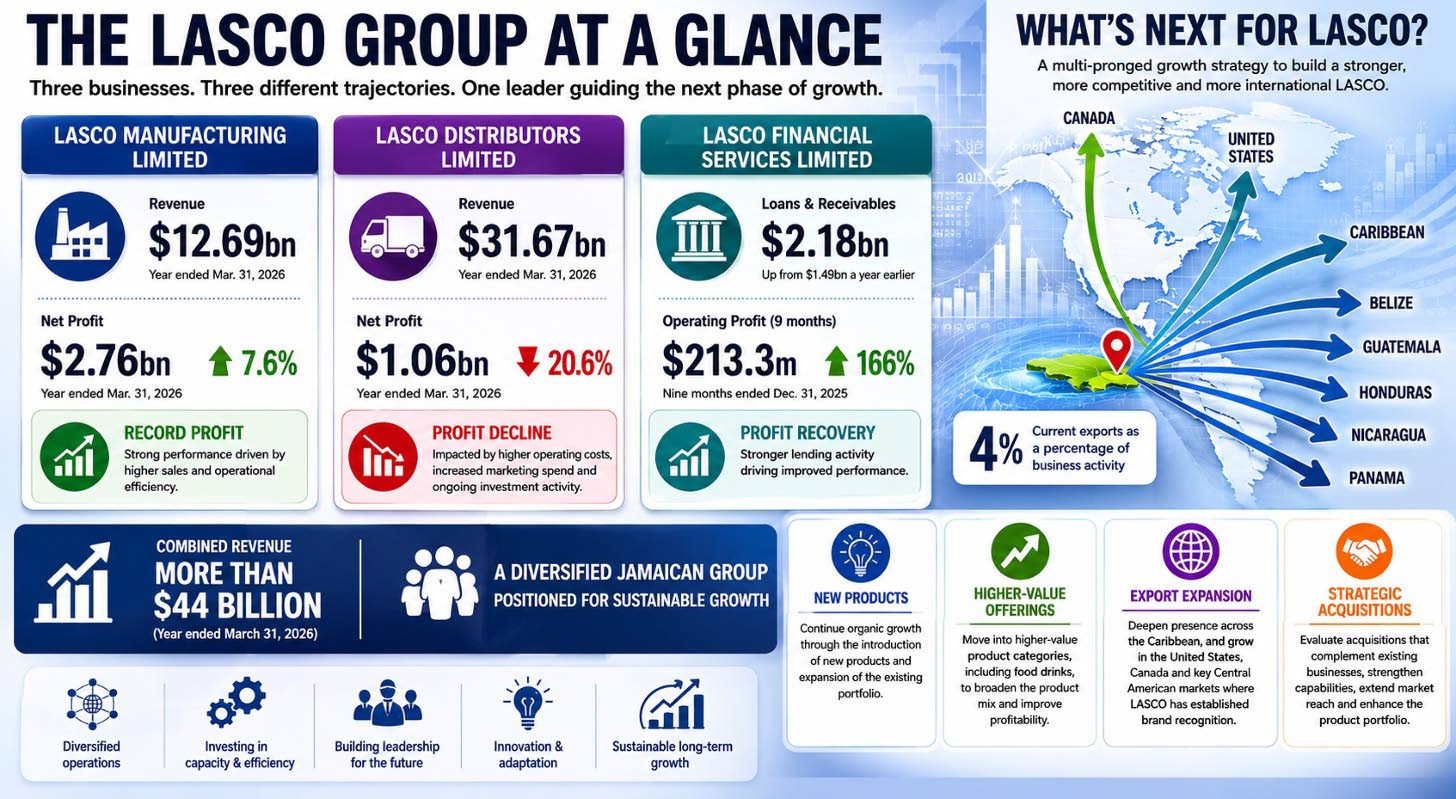
Image generated using ChatGPT.

LASCO founder Lascelles Chin. More than two years after his death, the company is strengthening its leadership structure as it prepares for its next phase of growth and succession.

LASCO Executive Chairman James Rawle. Dr Eileen Chin said she will work closely with Rawle as the company strengthens leadership continuity and prepares for its next phase of growth.


