



Blood donation: a gift of life Jamaica can’t afford to ignore
IT began as an ordinary Monday afternoon, until one woman’s life suddenly depended on a blood supply she had never seen and donors she would probably never meet.
The patient had suffered a massive gastrointestinal bleed. By the time she reached the emergency room she was pale, unconscious, and losing blood faster than doctors could replace it. The surgical team worked frantically to save her life, but their efforts depended on what was available beyond the operating theatre — blood products, laboratory precision, and a chain of people working against time.
“A call went out to the blood bank,” recounted Dr Michelle Hamilton, a medical and naturopathic doctor. “There, a medical laboratory scientist processed one unit of blood after another — red cells, plasma and platelets — each requiring careful cross-matching before use. By the end of the emergency more than 100 blood products had been processed.”
Hamilton shared the experience during her sermon, Written in Blood, at the Half-Way-Tree Seventh-day Adventist Church on April 18, at the start of this year’s Caribbean Association of Medical Technologists (CASMET) Week.
For her, the story was more than a dramatic hospital emergency. It was a reminder that survival in a medical crisis does not depend solely on doctors.
“It depends on donors, nurses, surgeons, laboratory professionals, and, most importantly, a blood supply ready before the emergency,” said Hamilton.
As Jamaica joins the world in observing International Blood Donor Day on Sunday, June 14, Hamilton’s message carries a national urgency: Blood donation is not only an act of kindness; it is a public health necessity and a shared responsibility, Andrews Memorial Hospital said in a release.
That same spirit of precision guided the Andrews Memorial Hospital Laboratory team blood drive held on April 23, 2026, under the theme ‘Precision in Every Decision’. The initiative brought together health professionals, hospital leaders, donors and the National Blood Transfusion Service to remind Jamaicans that every donation may become someone’s second chance at life.
Donmayne Gyles, president and chief executive officer of Andrews Memorial Hospital, said the hospital’s annual blood drive forms part of its wider commitment to service and community outreach.
The hospital, which has served Jamaica since 1944, continues to support medical and charitable initiatives across the island. For Gyles, the need for blood is constant because emergencies are unpredictable.
“There is always the need for blood for varied reasons,” he said. “We do many surgical procedures that require blood because eventualities can take place during some of those procedures and they will require blood. Accidents do happen, and individuals require blood; and serious medical emergencies can take place which will require blood.”
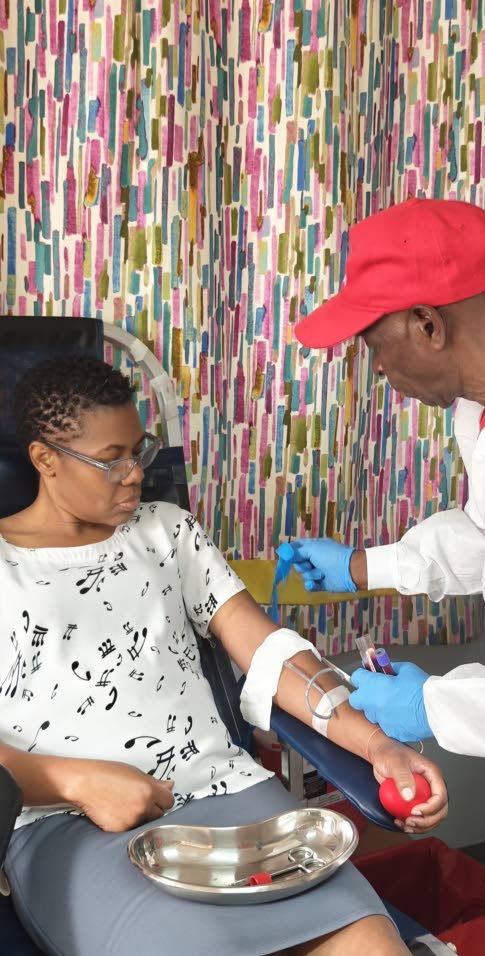
Camiele Rose-Brown, Andrews Memorial Hospital Ltd’s top blood donor, participates in her fifth blood donation. She began donating in 2018.
He urged Jamaicans to treat blood donation as a collective responsibility.
“Individuals need to come together as citizens,” he said. “We need to join together to ensure the blood bank has adequate supplies.”
That call is especially urgent because, according to Igol Allen — blood donor organiser at the National Blood Transfusion Service — Jamaica currently satisfies only half of the national required supply of blood and blood products.
“Blood drives help us to fill that gap,” Allen said. “Jamaica meets 50 per cent of the demand for blood and its by-products. This is us going out there in the market place to meet those who are able to donate so more persons can live, because remember, blood is essential medicine needed in hospitals right across Jamaica everyday.”
Allen also encouraged Jamaicans not to disqualify themselves without first checking their eligibility.
“What we always say, ‘Don’t self-defer, come out and try,’ because every donation helps to save at least three lives,” he said.
Allen also addressed common myths about donation.
“Persons with tattoos, yes, you can donate blood once six months have passed,” he said. “If you are a diabetic, you can donate [blood] once you’re not on insulin. Some people say, ‘My blood pressure was high, I can’t donate.’ It depends on what your blood pressure is at that time.”
For Dr Jordan Hardie, obstetrician and gynaecologist, blood donation is especially important in maternal care.
With over a decade of experience Dr Hardie advised that having blood products available allows doctors to plan for complicated gynaecological surgeries and deliveries properly. Without blood, some procedures may have to be delayed, or delivery plans adjusted.
“Readily having blood products available allows us to prepare for complicated cases,” Hardie said. “For complicated gynaecological surgery, if we have blood products available we can then tailor the surgical plan with that in mind. For patients who are for delivery, then we can also tailor the delivery plan, having blood products available.”
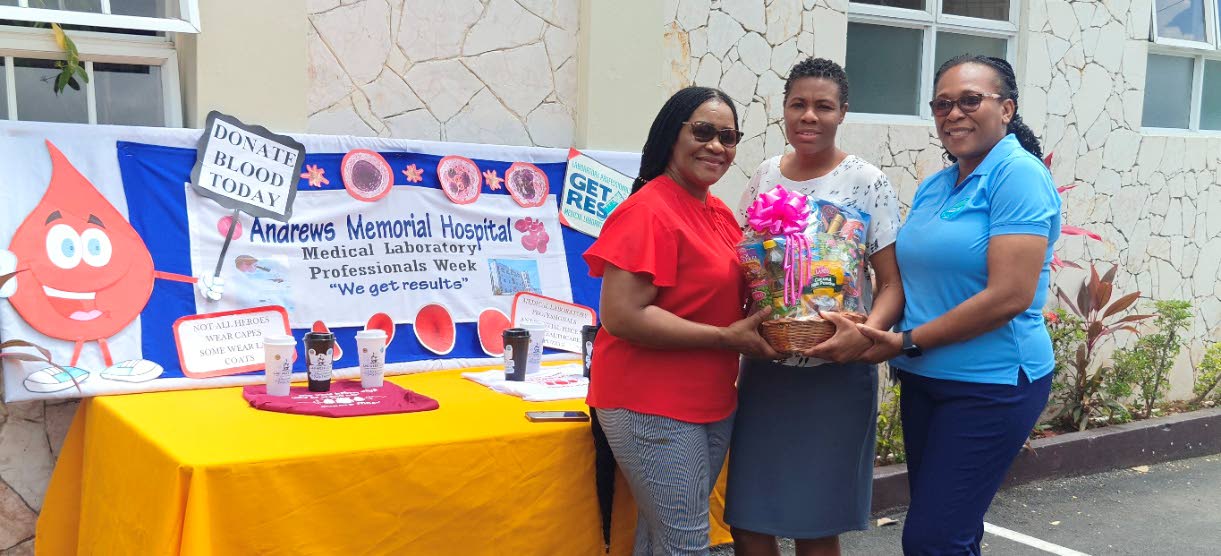
Charmaine Blythe (right), AMH’s assistant laboratory manager; and Sonia Binns-Lawrence (left), Jamaica’s top voluntary blood donor with more than 130 lifetime blood donations, present a gift basket to Camiele Rose-Brown, AMH’s top blood donor.
However, he continued: “If you don’t have blood products available we may need to, in the case of the surgery, delay the surgical procedure, or depending on the nature of the patient, if it’s an obstetric patient we may have to adjust the delivery plan if delivery is imminent.”
He said some women may not be eligible to donate, including those who are anaemic, pregnant, experiencing very heavy periods, or dealing with uncontrolled high blood pressure.
For Dr Lucien Tomlinson, general surgeon at Andrews Memorial Hospital Limited, the need for blood is not theoretical. With more than four decades of surgical experience, he has seen how quickly a routine procedure can become a life-threatening emergency.
He recalled a patient who was undergoing laparoscopic gall bladder surgery when complications occured.
“She started bleeding. It was like a geyser, and her pressure fell,” he said.
He explained that the surgical team controlled the bleeding but blood was urgently needed after the repair. The patient survived, but the incident remains a powerful reminder that complications can happen even when surgery is carefully planned.
“Blood transfusion is absolutely a necessity in ensuring that you do no harm, or minimise the harm that you might do, or be able to handle the complications that you might have at surgery,” Tomlinson said.
Tomlinson described the blood drive as both “nationalistic” and “humanitarian”, comparing donation to making a deposit in a bank.
“It seems easier to do a withdrawal when you have credit,” he said. “You might be saving your own life.”
His advice to families was simple: Prepare before a crisis comes.
“I reach out to all those families who have patients coming into the hospital that they try and help by going and donating blood so that we can have positive and good outcomes in case we run into complications,” he said.
Behind every safe transfusion is also the work of laboratory professionals. Charmaine Blythe, assistant lab manager at Andrews Memorial Hospital, said medical laboratory technologists help doctors diagnose, treat, and manage patients by testing samples and ensuring accuracy throughout the process.
She explained that donated blood must be screened, properly matched, correctly labelled, and safely stored before it can be used. Blood products may include whole blood, plasma or platelets, depending on the patient’s need.
“It takes a while for the processing of that product so it’s important that donations are done ahead of time,” Blythe said. “The important thing is to be willing to donate.”
For some donors, the decision to give blood is deeply personal.
Phillip Williams, business development officer at the hospital, has been donating for more than 20 years. He said he has always had a spirit of “sharing and caring” and sees blood donation as a way to serve others.
Williams said “fear of needles should not prevent people, especially men, from donating. For me, blood is life, and I want to contribute life,” he said. “If my blood can help somebody to be preserved, to be restored to life, it will always be a no-brainer for me.”
That same conviction has kept Sonia Binns-Lawrence, described as Jamaica’s leading blood donor, giving 130 times since 1983. She first donated when her sister needed blood during childbirth. Since then, she has continued to donate whenever she can, usually every three months.
To prepare, she hydrates, eats iron-rich foods, and ensures her body is ready. After donating, she avoids prolonged sun exposure, exercise and heavy lifting.
What keeps her returning is the thought of the people she may never meet.
“Every pint of blood I give means a life saved, at least three lives saved,” she said. “A mother gets to hold her child, a patient survives surgery, and a family somewhere gets that chance to spend more time with their loved ones.”


