



New Grammy rules, categories
Awards introduces 5 new genre accolades; dancehall again shut out
Five new categories and rule changes are in effect for the 69th Grammy Awards, which will culminate at the main presentation show on February 7, 2027.
The new categories are Best Asian Pop Music Performance, Best R&B Collaboration or Duo/Group Performance, Best Traditional Pop Vocal Performance, Best Traditional Folk Album, and Best Latin Song.
Immediately after the announcement on June 16, social media erupted. Most users on Instagram and X (formerly
Twitter) vented at the non-inclusion of a dancehall category.
The Best Reggae Album category was instituted beginning with the 1985 ceremony; however, dancehall releases are included among the nominees, with most of the winners since then being reggae acts.
Local music industry practitioners have opined that dancehall deserves its own category and some international players have even lobbied for same over the years.
Cristy Barber, a Grammy-nominated producer, music executive, and former co-chair of the Grammy Reggae screening committee, believes there should be a category for Reggae Singles, which will also include dancehall submissions.
“I think it would be great if we had a Reggae Singles category. That would be exciting, because dancehall falls under Reggae Album, and it would fall under that category as well,” Barber, who has worked at several major labels throughout her decorated career, told the Jamaica Observer’s Splash on Wednesday.
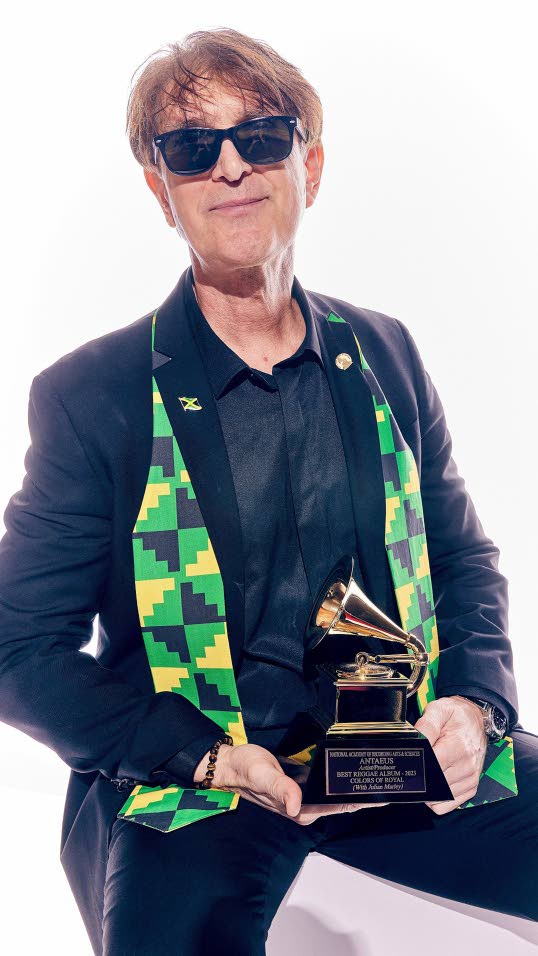
Grammy-winning producer Alexx Antaeus with the Grammy Award that he won.
Barber shared possible reasons a dancehall category has not been recognised by the National Academy of Recording Arts and Sciences (NARAS), which is responsible for the staging of the Grammy Awards.
“The reason why a second category hasn’t been added, there’s a lot of different factors, but they’ve addressed it and they’ve had conversations about it, and petitions have been put in place from the 1990s into the early 2000s. We’re constantly talking about it and fighting for it. Low submissions is also a part of it, and I’ve said this before. A lot of categories have low submissions these days, and you can’t really ramp up what isn’t there. I think we’re okay, and people are getting educated about how the submissions work and how to submit their albums. I think it’s just education within our reggae community, support, and standing together and alliance,” Barber said.
She posited that continuing to push for a separate category and making representation could yield results.
“We gotta keep the good fight. I feel that a singles category for reggae, I think, would be more digestible than a dancehall category. But, then again, it’s still an uphill battle. And that’s why the Latin Grammys are so successful, that’s why you see all those global categories popping up; there’s strength in numbers, there’s strength in unity,” she continued.
But while Barber is batting for a Reggae Singles category, multi-Grammy Award-winning producer, author, and record label executive Alexx Antaeus, who has collaborated with a diverse range of artistes, including The Rolling Stones, Earth, Wind & Fire, Julian Marley, Keznamdi, and Spice, would like to see a separate category designated for dancehall submissions.
Multi-Grammy Award-winning producer, author, and record label executive Alexx Antaeus, for his part, said: “Dancehall has had a profound global cultural impact and deserves recognition through its own GRAMMY category. In fact, I believe the category should focus on dancehall singles rather than albums, as dancehall has traditionally been driven by hit singles,” said Antaeus, who has been a member of NARAS for approximately 30 years.
He has collaborated with a diverse range of artists, including The Rolling Stones, Earth, Wind & Fire, Julian Marley, Keznamdi, and Spice.

The 69th Grammy Awards presentation show is set for February 7, 2027.
“I have witnessed first hand the evolution of the Grammy Awards, its membership and its category structure over the decades,” Antaeus shared explaining how the Recording Academy makes decisions on the implementation of new categories.
“The Recording Academy does not create new categories simply because a genre is popular. Category decisions are largely driven by member participation, industry engagement, and demonstrated demand. Members can submit proposals, gather support from fellow professionals, and advocate for changes. If sufficient interest and activity exist, the Academy will seriously consider creating a new category or revising an existing one,” said Antaeus, who believes that yearly submissions should be ramped up.
“Without question. Strong and consistent annual submissions are essential. The Academy looks at the volume of eligible recordings, industry participation, and overall activity within a genre. Increased submissions help demonstrate that dancehall has the depth and consistency necessary to support a dedicated category… For years I have encouraged more Jamaicans and Caribbean music professionals to become Recording Academy members. Unfortunately, many people want to win a Grammy but are not willing to invest the time and effort required to engage in the process,” he shared.
He referenced th disappointed experienced by some at the 64th Grammy Awards when American reggae band SOJA won Best Reggae Album over five Jamaican nominees.
“The reality,” he said, “is that SOJA understood the Grammy process, actively campaigned, built relationships within the Academy, and did the work necessary to compete successfully.”
“Membership in the Recording Academy provides opportunities to network with industry professionals, participate in committees and advocacy groups, attend educational and networking events, and gain a deeper understanding of Grammy voting and For Your Consideration (FYC) campaigns.
Over the years, I have successfully recommended for membership a significant number of Jamaican artistes and producers, yet many either never join or allow their memberships to lapse,” he said. “If the dancehall community wants its own category, we need more artistes, producers, songwriters, engineers, managers, and executives actively involved in the Academy.
“We need more submissions, more participation in Recording Academy events throughout the year, stronger professional relationships with fellow members, and a more consistent voice within the Academy’s various constituencies. Real change comes through engagement, not observation from the sidelines,” Antaeus reasoned.


