



Labour minister rejects special minimum wage for tourism workers
MEMBER of Parliament (MP) for St Catherine North Western Damion Crawford has called for a special minimum wage to be paid to workers in the tourism sector.
The Opposition MP made the call in the House of Representatives on Tuesday during his contribution to the debate on the Minimum Wage (Industrial Security Guards) (Amendment) Order, 2026 Resolution and the National Minimum Wage (Amendment) Order, 2026 Resolution.
In his interjection Crawford argued that workers in the tourism sector are not the normal type of workers, as in many situations their time is unpredictable and their work hours often expose them to risk, especially when travelling late at nights.
“Also, the area in which they exist because of the prevalence of tourism, often has a higher cost of living that is not considered by those who are paying the minimum wage,” Crawford pointed out.
He charged that a bartender in the tourism sector cannot claim at 10:00 pm that he’s leaving work if people are still at the bar.
“And a waitress or waiter can’t pick up themselves like the rest of us to wash our face at 4:00 [pm] in preparation to leave at 5:00 [pm],” he added.
Crawford also argued that tourism workers have to navigate “emotional labour”, that is “the effort to be friendly even when your current state of mind does not facilitate that friendliness”.
He told the House, emotional labour was one of the main reasons for burnout in the tourism sector.
“There are many, even in the face of disrespect, who must make a smile because it is demanded for work. There are some, even at the point of hunger, who must serve the lobster because it was ordered,” he said.
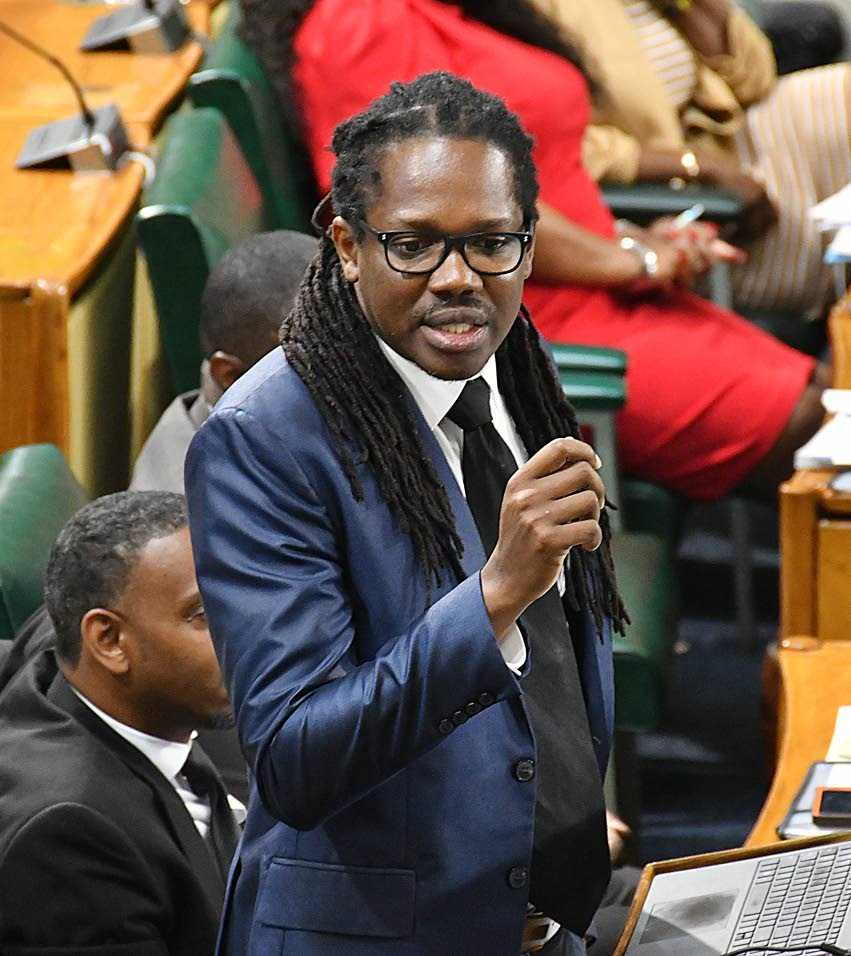
CRAWFORD… tourism workers are not the normal type of workers, as in many situations their time is unpredictable and their work hours often expose them to risk
“Indeed, there are some who return to homes that don’t have the necessary roof, bed, or walls, having left a sprawl of luxury [at work] and that emotion must be catered to in our considerations,” Crawford insisted.
The Opposition MP was responding to Minister of Labour and Social Security Pearnel Charles Jr, who opened the debate by reminding the House that Prime Minister Andrew Holness announced the increase in the minimum wage during his contribution to the 2026/27 Budget Debate on March 19.
At that time Holness said the national minimum wage would move up by $1,000 to $17,000 per week, effective July 1.
This was below the level of increase he had promised in the lead-up to the September 2025 General Election, but Holness sought to explain the change.
“Last year, we signalled our intention to continue the journey from a minimum wage to a liveable wage, and we indicated that the next step would be to increase the minimum wage to $18,500.
“However, in the aftermath of Hurricane Melissa, many of our businesses are rebuilding, many households are still recovering, and the economy is navigating yet again another external shock in terms of energy prices and shipping costs. In this context, the Government believes it is important to strike the right balance by continuing to improve earnings of workers while recognising the realities employers face,” Holness said.
He told the House that the proposed increase does not represent a departure from the Government’s long-term policy objective.
“The Government remains committed to transition from a minimum wage to a liveable wage, and as economic conditions stabilise, we will continue the phased increase necessary to realise that vision of the Jamaican worker,” he said.
However on Tuesday Opposition MPs signalled that they were not impressed with the explanation and called for the introduction of a liveable wage.
MP for Westmoreland Eastern Dr Dayton Campbell called for legislation that would allow necessary consultations around the minimum wage and would prevent politicians from making eleventh-hour announcements for a political advantage.
“That is necessary to prevent this continuous practice of a political party playing on the minds of the poor people of this country to get an advantage and then reneging on their promise,” argued Campbell.
In the meantime, Opposition spokesperson on labour Wavell Hinds rapped the Government for not keeping its election promise.
Describing the pending $1,000 increase as woefully lacking, Hinds said, “On this side we would have proposed from the outset that we want a liveable wage not a minimum wage.”
“An increase of $1,000 is certainly one that cannot match the growing cost of living,” charged Hinds as he pointed out that the rate of inflation was more than five per cent.
In his response to Crawford, Charles Jr said it would not be practical to have special minimum wage conditions for different groups of workers.
“That is exactly the reason why this government’s policy is for a fair and equitable minimum wage floor that is national so that it doesn’t lead to what we saw a while ago, which is not that we don’t believe that workers require more, but the national minimum wage in my opinion, is not perhaps the mechanism to treat with the increase in wages that is required in tourism or in other sectors,” Charles Jr said.
He argued there are other ways to provide more for tourism workers, but insisted that to go down the road proposed by Crawford would open a can of worms that would see workers in other sectors demanding similar treatment.
Charles Jr noted that the Government has moved to a level and fair playing field that includes industrial security guards who were previously treated separately.
“Those things are better pursued by collective bargaining and service charge protections as well as labour market protections. That is why you have competition in the fair market,” added Charles Jr.


