



Flyover Sandy Gully
Second phase of SPARK to see $25 billion spent on 37 main roads, easing commute for nearly 900,000 motorists
A road over the Corporate Area’s Sandy Gully and the rehabilitation of several other heavily trafficked thoroughfares across the island are part of the $25-billion second phase of the Shared Prosperity through Accelerated Improvement to our Road Network (SPARK) Programme launched on Thursday.
This stage of SPARK is expected to transform travel across the island with 37 major roadways slated for rehabilitation in a bid to reduce congestion, improve connectivity, and strengthen access to essential and commercial services.
Announcing the initiative during a media briefing at Jamaica House, minister with responsibility for works Robert Morgan said the main roads to be rehabilitated were selected based on their economic importance and the volume of commuters who use them daily.
“SPARK is not a patching programme. It’s a total rehabilitation of our road infrastructure… The programme will address culverts, retaining structures, sidewalks, road markings, and safety features,” said Morgan.
“The roads leading to our schools, hospitals, offices, town centres, markets, plazas, and government services transport hundreds of thousands of people and facilitate billions of dollars in economic activity. They are not simply surfaces on which vehicles travel. They are the arteries through which the Jamaican economy moves,” added Morgan as he pointed to some of the main roads to be rehabilitated and the impact this is expected to have on the commuting public.
“Every day, approximately 12,500 [motor vehicle] trips along Red Hills Road; 45,000 use Washington Boulevard; more than 38,000 trips [on] Oxford Road; approximately 33,000 trips [on] Port Henderson Road [in St Catherine]; and another 23,000 travel between Old Harbour [St Catherine] and Freetown [Clarendon]. On those five corridors alone, more than 150,000 daily journeys are being made.
“Those numbers represent workers trying to reach their jobs, students travelling to school, patients seeking healthcare, businesses transporting goods and families carrying out the ordinary activities of life. When we launch this next phase of SPARK, those are the people we have at the forefront of our minds,“ declared Morgan.
He pointed out that the work will includes two major grade-separated projects on Washington Boulevard and Dunrobin Avenue, costing just under $7 billion, which are expected to significantly improve traffic congestion in the Corporate Area.
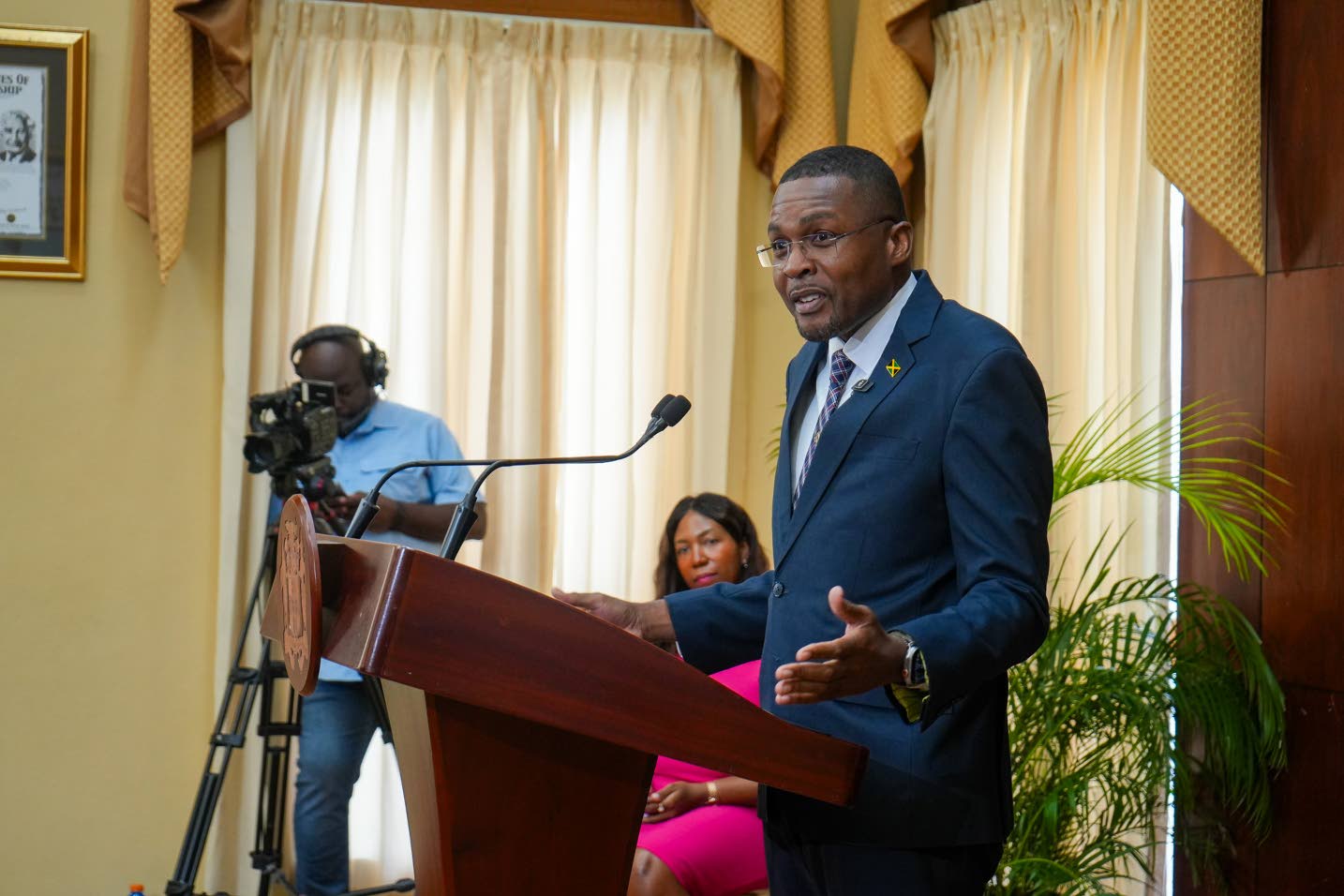
Minister with responsibility for works Robert Morgan speaking to the value of the SPARK programme during the launch of phase two on Thursday at Jamaica House.s
The main roads programme, launched on Thursday, forms part of the Government’s wider $45-billion SPARK initiative and will cover approximately 170 kilometres of roadway across 11 parishes, benefiting more than 900,000 people.
Senior director of project implementation at the National Works Agency (NWA) Varden Downer told the media briefing that among the flagship projects under this stage of SPARK is the reconstruction of Washington Boulevard with a grade-separated intersection at Moylnes Road, along with the expansion of Pembroke Hall Bridge, which will be widened from two lanes to three.
He also explained that the expansion of Dunrobin Avenue to East King’s House Road will be facilitated by an overhead route that will carry motorists above the Sandy Gully.
“We will have a grade separation at Constant Spring Road and Dunrobin Avenue. There’s also another grade separation by Upper Waterloo Road with the new road that is actually going through the Sandy Gully area that will be used to carry this road through. So we should not have any land issue as far as that part is concerned and the Sandy Gully will remain in place.
“We will be doing it similar to how we did down by Three Miles [St Andrew], where we will actually have piers spanning over the Sandy Gully so the gully will still be functional. The road will be significantly above it to be able to carry the traffic all the way through,” explained Downer.
He added that the new roads would also be made with improvements in safety, with priority casted on signage, signalisation, traffic advancements, and street lighting.
“So, as I mentioned before, the main road component we’re looking at just under a million persons being directly affected. We did look at the impact on schools for every single road. We looked at health centres and we also looked… at emergencies such as police, fire stations, et cetera.
“Why this matters to every Jamaican? Faster more reliable journey for commuters, reduce fuel and vehicle operating costs overall, time saved during commuting and of course improve access and reduction in time being wasted to get to health care and emergency centres,” said Downer.
Morgan recently told Parliament that under SPARK phase one 26 per cent of the roads selected for rehabilitation had been completed as of April.
At that time, Morgan said nine work orders valued at $18 billion had been instituted, covering 369 community roads across four packages.
On Thursday he told the media briefing that the occasion was momentous as this was the first time in Jamaica’s history that such an extensive roadwork programme is being undertaken.
“There’s never been a time in Jamaica’s history that the Government has attempted to rehabilitate 300 roads in the span of two years. And I think that is something we should consider and congratulate the Government and the people of Jamaica for,” said Morgan.
For his part, Prime Minister Dr Andrew Holness said it would cost $5 to $7 trillion to fully repair Jamaica’s roads. Holness pointed out that this would be equal to the country’s entire budget for five consecutive years to achieve this.
Holness told the media briefing that, while that was not possible, the Government would continue to advance roadwork projects to ensure the population’s comfort as they traverse the roads.
“The good thing about spending on roadways is that it helps productivity. It helps to create growth, and that’s why we are making the investment as we are, these massive investments in our roadways, because they increase productivity, which will improve growth, which will give us the funds to reinvest in the infrastructure. So I hope today that I’ve been a little bit more clear.
“It’s an explanation as to why it is that the roads are the way they are, and what the Government is doing to ensure that we can address the road conditions in the country,” said Holness.
National Works Agency Senior Director of Project Implementation Varden Downer during the launch of the $25 billion expansion of the Shared Prosperity through Accelerated Improvement to our Road Network (SPARK) programme, showcases map that highlights one of the roads selected to be rehabilitated under the initiative, at Jamaica House in St Andrew on Thursday.


