



Atlantic Hardware resumes trading after late audited results
JSE lifts suspension after delayed filing; accounts reduce 2025 profit by more than $50m
TRADING in shares of Atlantic Hardware & Plumbing Company Limited resumed on Monday after the Jamaica Stock Exchange lifted the suspension imposed on the Junior Market company for failing to file its 2025 audited financial statements on time.
The resumption brought the company back into compliance with the immediate filing requirement, but the audited accounts also showed that Atlantic’s 2025 profit was significantly lower than the unaudited figure previously released to the market.
The stock closed Tuesday at $1.51, down one cent, or 0.66 per cent, after trading resumed on the Junior Market.
The Jamaica Stock Exchange said the suspension was lifted after Atlantic submitted its audited financial statements for the year ended December 31, 2025. The accounts had been due on March 31, 2026.
Atlantic’s shares had been suspended effective July 1 after the company’s audited financial statements became more than 90 days overdue. Under Junior Market rules, companies whose audited financial statements are 90 days overdue may have trading in their shares suspended until the reports are submitted.
The company’s unaudited full-year results had shown profit after tax of $119.2 million for 2025. In the audited accounts, that figure was reduced to $68.9 million, a reduction of just over $50 million.
Profit before tax was also reduced, moving from $124.7 million in the unaudited results to $74.9 million in the audited accounts. Earnings per stock unit moved from $0.049 to $0.03.
Revenue was largely unchanged at approximately $1.82 billion. However, the audited accounts reflected higher expenses and finance costs than previously reported, lowering the company’s final profit for the year.
The audited statements show revenue rising from $1.60 billion in 2024 to $1.82 billion in 2025. Net profit, however, fell from $90.5 million to $68.9 million, while operating profit declined from $264.7 million to $229.5 million.
Selling, general and administrative expenses rose to $340.2 million from $213.7 million in 2024. Staff costs increased to $118.6 million from $71.9 million, while audit and accounting fees rose to $17.4 million from $3.4 million.
The audited accounts also show a $52.1-million provision for expected credit losses, compared with $6.7 million in 2024. Expected credit losses are provisions companies make for money they may not collect from customers or other parties.
Atlantic had previously advised shareholders that the audited accounts would be delayed. On March 31, the company said the delay was primarily due to a change of external auditors during the 2025 financial year, and that the statements were expected by April 30.
The expected filing date was later pushed to May 31, and then to June 30. The company also advised that its annual report was delayed.
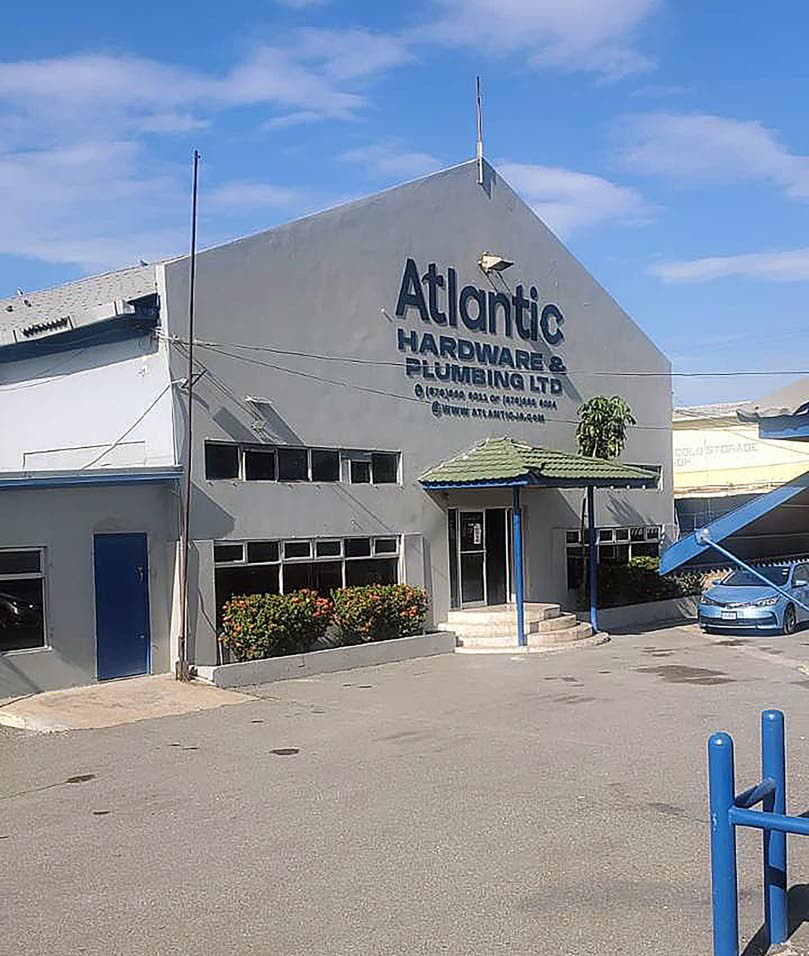
Atlantic Hardware & Plumbing Company Limited’s headquarters. Trading in the Junior Market company’s shares resumed after it filed its delayed 2025 audited financial statements.
In a statement after the suspension, Atlantic said the delay was linked to its transition from a private business to a listed company.
The company said the business had been acquired just over two years ago from its founders, who had operated it for three decades using a small local audit firm. Atlantic said new ownership had since made several changes, including a new management team, a new enterprise resource planning system, strengthened controls, a new location, and its Junior Market listing.
It said the appointment of a global Big Four audit firm for the 2025 financial year meant the first-year audit took longer than expected.
The audited accounts were signed by Deloitte & Touche on July 3 and carried an unqualified opinion, meaning the auditors did not qualify or modify their opinion on the financial statements.
The accounts also show that Atlantic’s balance sheet improved from the previous year, although the audited equity position was weaker than the unaudited figure previously reported.
Shareholders’ equity moved from a negative $49.1 million at the end of 2024 to positive equity of $480.1 million at December 31, 2025. The unaudited report had shown equity of $530.4 million.
The improvement was supported by proceeds from Atlantic’s initial public offering and the sale of property, both of which helped reduce debt. The audited accounts show IPO proceeds of $500 million, with transaction costs of $39.7 million, leaving net proceeds of $460.3 million. The company said those proceeds were used primarily to pay down existing debt.
The audited accounts also show that Atlantic missed one of the financial tests attached to some of its loans — the debt service coverage ratio — relating to facilities with Jamaica Money Market Brokers Limited and Quantas Advantage Incorporation. As a result, those facilities were classified as current liabilities, meaning they are treated as amounts due within the short term.
Since year-end, Atlantic has refinanced part of its debt. The audited accounts state that on February 3, 2026, the company secured a $590-million term loan at an interest rate of 10 per cent, replacing acquisition debt that carried a rate of 14.5 per cent. The refinancing also included a $100-million overdraft facility and a $10-million credit card facility.
Atlantic has also moved into agro-distribution. The audited accounts state that in February 2026 the company acquired assets and distribution rights from a local distributor, adding agricultural brands covering fertilisers, pesticides, seeds, veterinary products, pet shop supplies, and home and garden items.
The company’s unaudited first-quarter results for 2026 showed revenue of $687.1 million, up from $459.5 million in the corresponding period of 2025. Profit after tax rose to $74.2 million from $24.4 million, while finance costs fell to $23.3 million from $43.7 million.


