



Yearning to see decency return to Parliament
One of the most important features of any democratic society is the free and robust exchange of contending ideas. Such contention can be fierce, and at times may move some participants to violence, but at the end of the day one expects that such exchanges can lead to resolutions that will be in the best interest of the country.
The free expression of what is on one’s mind is essential to the functioning of the democratic process, but at profound levels it helps to define who we are as people. Such free expressions of self, when properly governed, are epitomised by the canons of decency, respect for the views of others, and decorum befitting reasonable and well-thinking people.
It is these canons of decency which give legitimacy to one’s arguments and the eventual outcome of any discourse. Indecency, especially if it is perpetual, also shows up key aspects of a person’s characterological make-up. When you listen to certain public figures speak, for example, you do not expect much different from them when they spew indecent invectives and diatribes at other people. In fact, it is an occasion for great surprise and even shock if the opposite happens.
In a democratic society like Jamaica, the Parliament is the key institution where issues are debated, consensus arrived at, and laws passed for the good governance and well-being of the society. There are 63 members of the House of Representatives and 21 senators. Every Member of Parliament is duly elected by the people of his/her constituency who are essentially his/her employers.
When they are afforded the privilege to sit in the hallowed halls of this august House, there is a certain level of decorum that constituents and citizens, in general, expect of them. Even though they are free-thinking beings, they are not there to represent their own agenda, blow their own trumpets by showing off their oratory skills, or worse, abuse the privilege by being corrupt. Their absolute duty is to serve with probity the people who elected them and the wider constituents of Jamaicans whose lives their decisions will and can affect in profound ways.
So enter what has been transpiring in the people’s Parliament, at least for the past decade. There is no well-thinking Jamaican with any modicum of decency who could be happy with the acrimonious exchanges that have been occurring in Parliament. The hostility between the two political tribes has grown more palpable and disgusting. Yes, I know there are those on either side of the political fence who silently or otherwise resent this label of political tribalism, but I shall continue to use it until I get solid proof of its inappropriateness.
For what we see is often a battle between political gladiators who seem to believe that they are engaged in a blood sport in the Roman Colosseum. There is a place for “ribbing” an opponent and for light banter, but what we see emanating are personal invectives that are hurled at each other which often devolve into rancour and chaos in the House.
This is particularly noticeable in the House, perhaps because there are more representatives there. But it is also present in the Senate, which once had a reputation for cerebral and thoughtful deliberation on the issues before it. A virus of bellicosity has invaded both chambers in recent times that has hampered the work that the Parliament is mandated to do for the people. Moreover, the Parliament is fast becoming a laughing stock to many Jamaicans, not a place where serious business is done, but where cheap partisan political posturing has gained ascendancy. This is not good.
The obvious animus between the Opposition People’s National Party (PNP) and the Speaker of the House, Juliet Holness, tells the story. It is clear that the PNP never wanted Holness to be the Speaker. Her proximity to the prime minister, as wife, has heightened its concern.
In and outside of Parliament the animosity is quite palpable as members denounce the way she has been handling her job as Speaker. She is frequently accused of being partisan and unfair. Often what we see from the Opposition is not a subscription to hard-held principles on the part of the Speaker, but a meanness that does not augur well for those who exhibit it.
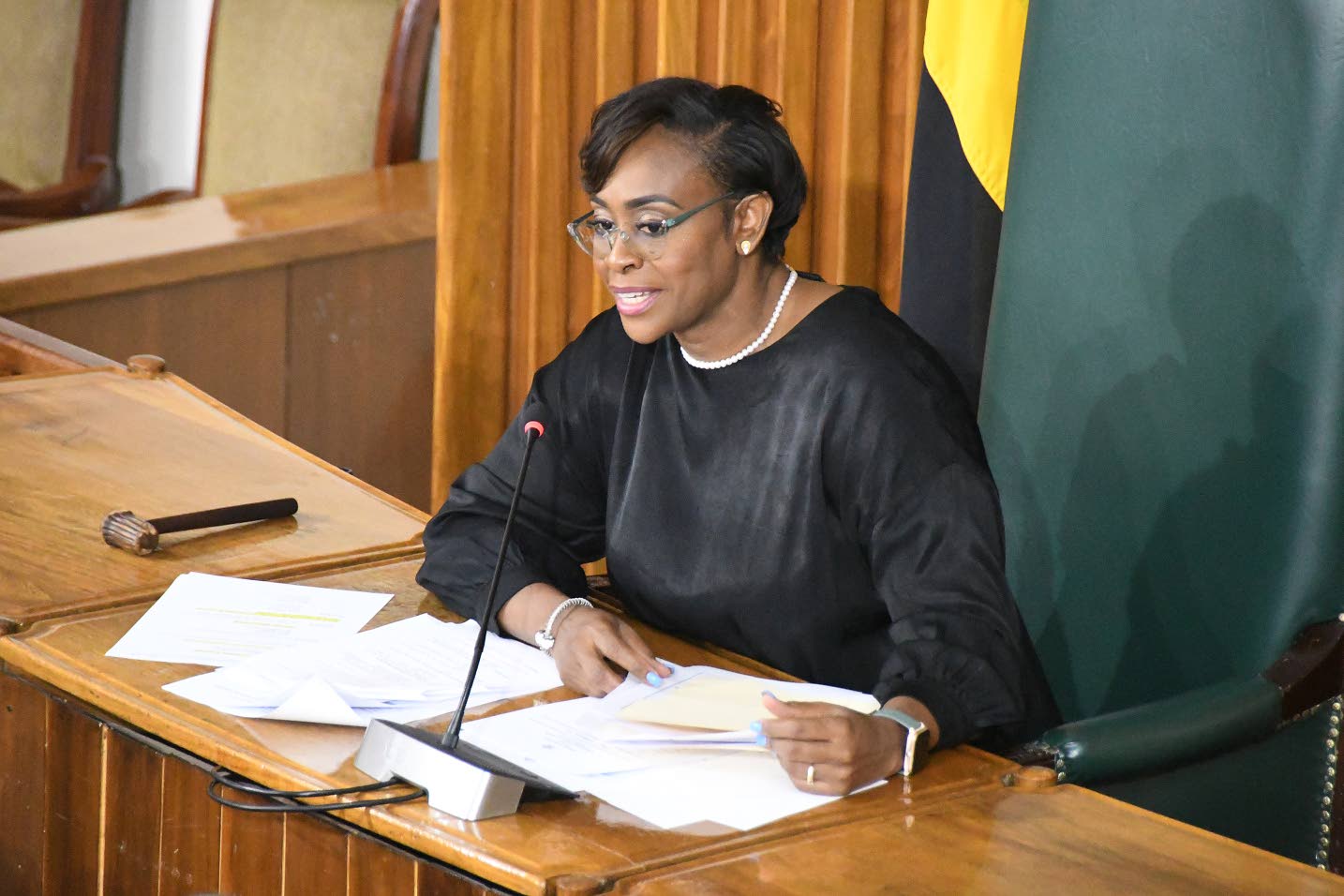
Juliet Holness
As I have said in this space before, Speaker Holness has been elected within her own right and remit as a Member of Parliament. I do not believe that being the prime minister’s wife played any great role in her being appointed Speaker in two different Jamaica Labour Party (JLP) Administrations. I can see how this can be a problem to some people, but she ought to be judged on the basis of how she does the job, not on any perceived functionality of her relationship as wife of the prime minister. Those who make this connection are merely betraying their biases and poor grasp of the duties and responsibilities of the Speaker.
Many well-thinking Jamaicans will agree that Speaker Holness has shown commendable improvement in how she is handling the portfolio. There were jerky moments in the beginning, but she has grown on the job and does her best to enforce the rules and the Standing Orders fairly. Some may argue that she has been too rigid in exercising this function, but when mistakes might have been made, it is to maintain decorum in the Parliament and restrain the over-zealous parliamentarian who may be more interested in hearing his or her voice.
Parliamentarians need to know that well-thinking Jamaicans are not impressed by the political gymnastics or the facile, superficial banter that often passes for serious wrestling with the people’s business. What we want to see are strong, robust debates — with respect for the views of others — that will result in well-reasoned and appropriate legislation being passed for the betterment of all Jamaicans.
With older members now heading for the exit lounge, we have a Parliament largely of young people. This is a very good development and both political parties must be commended for seeking out and deploying these young talents in the political arena. But it is clear that there is need for training on parliamentary procedures and processes. Problems with decorum and decency should not reside with parliamentarians who have a good grasp of why they were elected to this august body.
Dr Raulston Nembhard is a priest, social commentator, and author of the books Finding Peace in the Midst of Life’s Storms; Your Self-esteem Guide to a Better Life; and Beyond Petulance: Republican Politics and the Future of America. He hosts a podcast — Mango Tree Dialogues — on his YouTube channel. Send comments to the Jamaica Observer or stead6655@aol.com.
Raulston Nembhard


