



Hurricane Health Response Programme enters second phase
Tender process begins October
FREEPORT, St James — The Ministry of Health and Wellness is now in the second phase of its Hurricane Health Response Programme, with the tendering process for infrastructural repairs slated to begin between late September and October.
The announcement was made on Tuesday by minister of state in the Ministry of Health and Wellness Krystal Lee during the handing over of medical supplies from the United Nations Population Fund (UNFPA) to the Western Regional Health Authority (WRHA) at the authority’s technical office at Freeport in St James.
The three-phased Hurricane Health Response Programme — encompassing relief, rehabilitation, and reconstruction — was established to restore and modernise health services and facilities affected by last October’s Hurricane Melissa.
“We are now in phase two. Phase two is focused on restoring the infrastructure, strengthening resilience, and advancing the health system reform. I am pleased to announce that all design briefs for the 101 health centres to be repaired under this phase are now in-house,” stated Lee.
“Our next steps include moving to the BQs [bills of quantities]. The tendering process for the works is expected to begin in late September to October on a phased basis,” she added.
According to Lee, this segment of the work follows the successful completion of phase one of the programme, which focused on restoring essential services at the primary, secondary, and tertiary levels, protecting the population from disease outbreaks, and providing psychosocial support to affected communities and healthcare workers.
“As we rebuild and recover, we must recognise that recovery is not a one-time event, neither is it simply about restoring what existed before; it is about building stronger, more resilient health-care systems capable of withstanding future shocks. Our vision remains for a health-care system that is accessible, responsive, resilient, and capable of meeting the evolving needs of every sector and our citizens at home and abroad,” stated Lee.
During Tuesday’s ceremony, the WRHA was supplied with a significant donation of reproductive health contraceptive kits and specialised midwifery kits aimed at reinforcing maternal care in areas heavily impacted by the Category 5 storm.
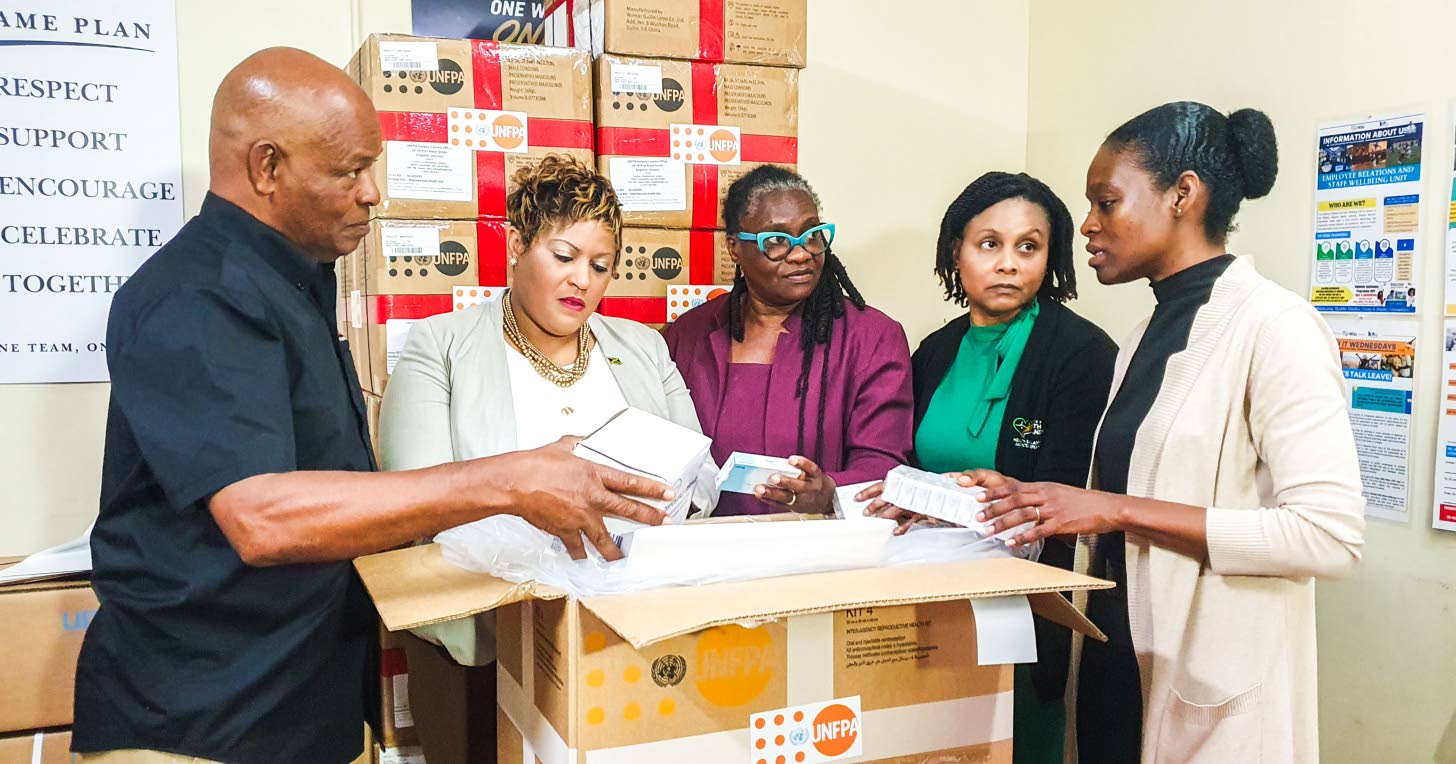
UNFPA Sexual and Reproductive Health in Emergencies Officer Dr Deandra Romain (right) giving a briefing on some of the items her organisation provided to the Western Regional Health Authority on Tuesday. Listening keenly are director and representative of the UNFPA Sub-Regional Office of the Caribbean Harold Robinson (left); minister of state in the Ministry of Health and Wellness Krystal Lee (second left); coordinator of the Regional Priority Non-communicable Diseases Programme and Family Health Dr Marcia Johnson-Campbell (third right) and Adolescent Men and Women Programme Development Officer Dr Lisa Pilgrim. (Photo: Anthony Lewis)
“These supplies will help ensure the continuity of safe childbirth services even in emergency settings and support the delivery of essential maternal and newborn care, including emergency obstetric and surgical interventions at hospitals and health centres in all parishes that were heavily hit, including St Elizabeth, Westmoreland, Trelawny, Hanover, Manchester, and St James,” stated the appreciative state minister.
“We are equally grateful for the provision of the midwifery kits, which will further enhance the readiness of frontline health-care providers to deliver quality maternal healthcare where they are needed most,” added Lee.
She said this support complements the ministry’s post-hurricane maternal health outreach initiatives, which are under way in the parishes most impacted.
UNFPA Regional Director for Latin America and the Caribbean Harold Robinson highlighted that Tuesday’s handover signifies a strengthening partnership and support for the ministry’s preparedness framework.
Robinson noted that, nine months after the storm, the strain on the health sector remains despite the ministry’s response efforts.
“This reminds us that the focus must be extended beyond temporary relief to sustainable recovery of the health systems to ensure its resilience. This is critical because amidst the destruction of infrastructure, one reality remains constant, sexual and reproductive health needs do not stop in emergencies,” he argued.
UNFPA’s intervention is guided by the Minimum Initial Service Package (MISP) for sexual and reproductive health — a UN emergency framework designed to maintain critical care, prevent maternal and newborn complications, limit infections, and provide safe refuge and clinical care for survivors of gender-based violence (GBV).
Tuesday’s donation builds on prior UNFPA assistance provided earlier this year, which included emergency obstetric and newborn care kits, solar direct drive refrigerators, and comprehensive contraceptive supplies comprising condoms, subdermal implants, injectables, and oral contraceptives.


