



No apology for slowing growth — Byles
Outgoing governor defends BOJ’s inflation fight as MPC prepares final decision of his tenure
RICHARD Byles left the Bank of Jamaica (BOJ) Tuesday defending one of the hardest choices of his seven years as governor: Slowing the economy when necessary to stop inflation.
The defence comes as the Monetary Policy Committee (MPC), which began its latest meeting Monday and continued deliberations Tuesday, prepares to announce its interest-rate decision at the close of business Wednesday — the first day of Dr R Brian Langrin’s tenure as governor.
The decision has taken on added weight after Jamaica’s annual inflation rate jumped to 7.5 per cent in July from 6.7 per cent in June, moving further above BOJ’s four-to-six-per-cent target.
In an exit interview with the Jamaica Observer, Byles acknowledged that the high interest rates used to contain the post-pandemic inflation surge had restrained economic activity, but said that was part of the purpose of tighter monetary policy.
“No doubt, a high policy rate has had a constraining effect on growth,” he said. “But that’s the point of it, to slow growth, to contain growth so that inflation is also restrained. So we can’t apologise for constraining growth if we are trying to fight inflation.
“The two things just go together. Constrain growth, inflation comes down. Relax monetary policy, growth continues again.”
His comments frame the policy choice now confronting BOJ as Dr R Brian Langrin formally takes over the institution Wednesday. Langrin, who previously served as BOJ’s chief economist and head of financial stability, has already been at the central bank working through the transition with Byles.
The MPC’s decision Wednesday will therefore close the Byles era against a backdrop that looks increasingly familiar: Inflation above target, an economy that needs room to grow and a central bank having to decide how much restraint is necessary.
What is driving inflation?
For Byles, the answer depends less on the headline inflation number than on what is causing it.
“If it is domestically generated, interest rates will go up again,” he said. “If it is from imported inflation which we don’t have any control over, we have to be a little more restrained in how we carry up rates.”
The distinction is important because Jamaican interest rates cannot lower world oil prices, repair damaged crops or undo an overseas supply shock.
The central bank becomes more concerned when those initial price increases begin spreading through the economy.
Higher fuel prices, for example, can push up transport and production costs. Businesses may pass those increases to consumers, workers may seek higher wages and expectations of future inflation can begin influencing decisions throughout the economy.
“We do have the second-round effects from imported inflation, which we have to watch carefully,” Byles said. “But generally speaking what we are looking for is domestic inflation. That’s what monetary policy manages directly.”
BOJ had already identified signs of those second-round pressures before July’s inflation increase.
When the MPC last met in June, it said headline inflation was expected to rise above the six-per-cent upper limit of its target in the near term, while core inflation was also expected to increase. The committee held its policy rate at **5.50 per cent**, saying the existing stance was appropriate to limit second-round price increases, but warned that it was prepared to adjust policy if the risks worsened.
The policy rate has remained at 5.50 per cent since February. Wednesday’s announcement is the next scheduled decision.
The cost of fighting inflation
Byles’s argument is rooted in the experience that followed COVID-19.
BOJ entered the pandemic with its policy rate at 0.5 per cent, providing exceptionally cheap money as the economy contracted sharply.
As the global economy reopened, supply shortages, higher commodity prices and Russia’s invasion of Ukraine sent inflation soaring. BOJ responded by raising rates aggressively, eventually taking its policy rate to seven per cent.
Byles said the tightening was one of the most difficult tests of the operational independence BOJ received in 2021.
“When you are raising interest rates from 0.5 per cent…we know that that is hurtful to businesses and institutions and borrowers,” he said.
“We know that it is restraining on economic growth, so that was a very difficult decision to make. But we did it knowing that we had to compress inflation and once inflation was compressed we could begin to relax it again.”
Higher interest rates work partly by discouraging borrowing and spending. A company may postpone an investment, a household may delay a large purchase and savers may find it more attractive to hold money rather than spend it.
The result can be weaker demand and slower growth.
That is the trade-off Byles says BOJ cannot avoid when inflation itself presents the greater threat.
Asked whether BOJ kept rates too high for too long after the earlier inflation shock began to subside, he rejected the suggestion.
“Too long? No,” Byles said.
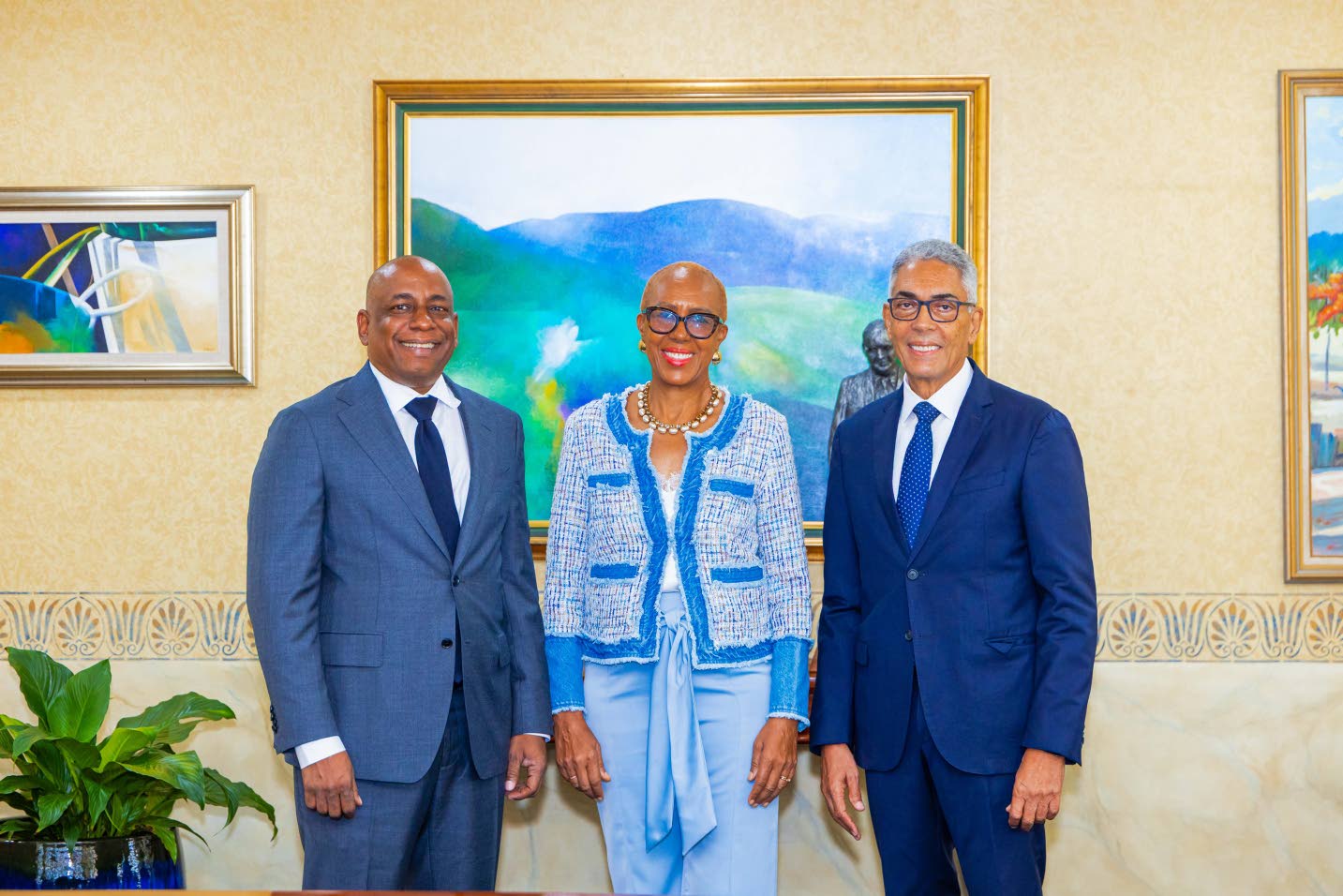
From left: Bank of Jamaica Governor-designate Dr R Brian Langrin; Minister of Finance and the Public Service Fayval Williams; and outgoing BOJ Governor Richard Byles at the central bank on Monday, August 17, 2026, ahead of the leadership transition.
He noted that Jamaica’s interest rates did not reach the levels seen in several comparable Latin American economies during the global inflation surge and pointed to the country’s inflation record over his tenure.
“The fact that inflation over the seven-year period has averaged six per cent, if you compare that to any other period in our history, you will see that six per cent is a very good number,” he said.
That does not mean monetary tightening was costless. Byles readily accepts that it restrained growth.
His case is that the cost has to be weighed against allowing inflation to become entrenched — eroding household purchasing power, making business planning harder and potentially requiring even more severe action later.
An imperfect tool
There was another complication during the Byles years: BOJ’s rate changes did not flow evenly through the banking system.
Many loans were issued at fixed rates and therefore did not immediately become more expensive when the central bank tightened policy.
“Although our rates went up there are many loans that were not impacted,” Byles said.
“Why? Because deposit-taking institutions made those loans on a fixed-rate basis.”
He said banks told BOJ that while variable-rate loans were repriced, much of their loan portfolios remained unchanged.
“So what has happened is that the full effect of monetary policy hasn’t gone right through all of the loan portfolio, only some of it.”
BOJ’s own data show the same weakness working in the other direction.
During 2025, as the central bank eased monetary policy, the weighted average commercial-bank deposit rate fell to **2.14 per cent** at December from a year earlier. Yet the weighted average lending rate edged up to **12.44 per cent**.
BOJ’s 2025 Financial Stability Report attributed the limited pass-through to structural features of Jamaica’s credit market, including fixed-rate lending and the slow repricing of variable-rate loans.
Byles has identified that weak monetary transmission as one of the major issues he leaves unfinished.
It matters because if a central bank changes its policy rate but the effect reaches borrowers only slowly or unevenly, its main tool for controlling inflation becomes less effective.
A difficult handover
Langrin will therefore inherit both an immediate inflation problem and the longer-term challenge of improving the way monetary policy works through the financial system.
His appointment comes with extensive experience in monetary policy and financial stability, including earlier senior roles at BOJ and positions with the International Monetary Fund, Inter-American Development Bank and World Bank Group.
Nigel Chalk, director of the IMF’s Western Hemisphere Department, welcomed the appointment.
“On behalf of the IMF, I congratulate Dr R Brian Langrin on his appointment as Governor of the Central Bank of Jamaica. We look forward to working closely with Governor Langrin and the central bank as we continue our constructive engagement. We wish him every success in this important role,” Chalk said in a statement shared with the Business Observer.
Langrin’s first days will come with little room for ceremony.
July’s 7.5-per cent inflation rate is the highest since February 2023, according to data released this week, and has widened the breach of BOJ’s target.
Much will turn on whether the MPC believes the increase is still largely temporary and imported, as previously forecast, or whether the pressures are becoming more broadly embedded in the domestic economy.
A rate increase is not automatic simply because inflation is above six per cent. Monetary policy operates with a lag, and BOJ had already expected inflation to breach the target temporarily.
But Byles’s position on the threshold for action is clear.
If inflation becomes domestically driven, he said, the central bank must be prepared to tighten — even at some cost to growth.
The MPC will say Wednesday whether that argument now requires another change in interest rates.
For Langrin, who formally assumes the governor’s chair Wednesday, that judgement — balancing inflation against growth without allowing either to destabilise the economy — is now his.


