



Academic urges Caribbean to target Diaspora food market
OCHO RIOS, St Ann — Entrepreneurship and sustainable development expert and The University of the West Indies lecturer Dr K’adamawe K’nife is urging Caribbean countries to place greater emphasis on supplying food to their Diaspora communities, rather than focusing primarily on creating markets for regional products in distant international markets.
“If we produce to feed the 25 million here and the 25 million in the diaspora, that is 50 million people we have to feed. Why do you need to try to convince somebody in Europe or China to eat a green banana when we cannot produce enough green bananas for over 50 million people to eat?” he questioned.
He was speaking with the Jamaica Observer on the periphery of last Wednesday’s opening ceremony for the 10th International Conference on Food Security and Sovereignty 2026, held at Sandals Dunn’s River in Ocho Rios, St Ann.
“It’s our people, why you want to feed stranger instead of your family? Feed your family first. Your market focus has to be: I am producing good, nutritious food for your Caribbean people, whether they live in the Caribbean or outside the Caribbean. And they are the ones you have to convince the least to eat the food because they want it to eat,” he added.
The expert in sustainable development also called for a fundamental shift in the region’s approach to food production, arguing that excessive dependence on international markets and external food supplies leaves Caribbean countries vulnerable to global disruptions.
“They were saying because of world trade you would be able to access food as you like, which is not correct. Because when you have COVID, you have Hurricane Melissa and you have global wars, that is not a reality [that we can depend on]. You must be able to control your food supply,” K’nife stressed.
“Even if Jamaica is unable to supply all their needs, when you look at the region as a land space we can not only supply all that we need, we can also supply a lot of other places,” he insisted.
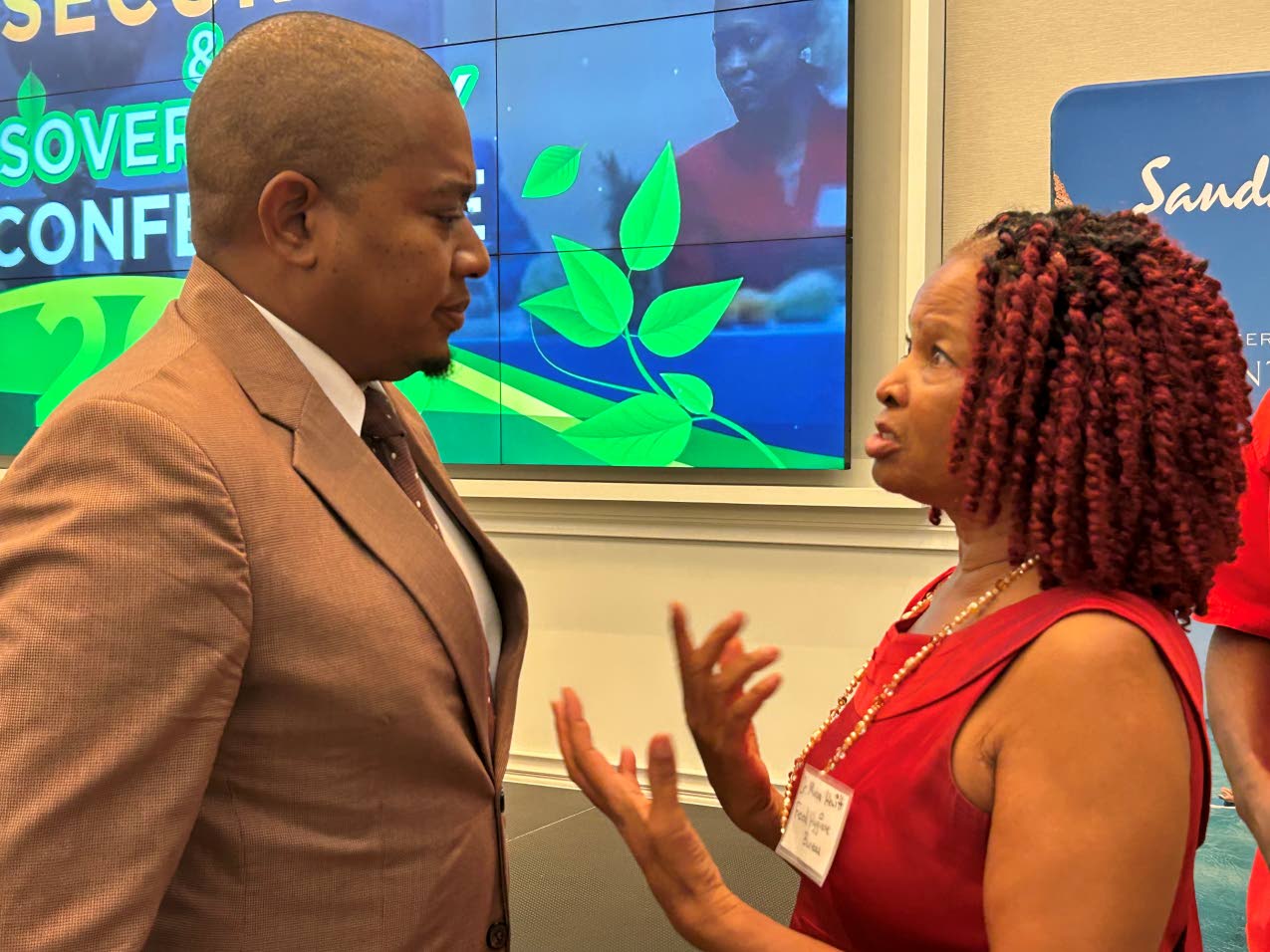
Chief executive officer and founder of Food Hygiene Bureau, Dr Marva Hewitt (right) making a point to Agriculture Minister Floyd Green after last Wednesday’s opening ceremony for the 10th International Conference on Food Security and Sovereignty 2026, held at Sandals Dunn’s River in Ocho Rios, St Ann.
Against this backdrop, he advocated greater movement of crops and food products among Caribbean countries, noting that several territories produce foods with significant nutritional and commercial value that could benefit consumers elsewhere in the region.
“Right now, in Guyana, you have some things like awara and kuru, these are edible palms. We used to have a programme like that in Jamaica where we exchanged the palm trees… but I don’t know what happened to ours. When you go online and see what they are doing on Amazon with oil from kuru and awara, it is one of the most important things for your skin to prevent skin cancer, and we don’t have those. Why we don’t have the food exchange programme again?” he asked.
K’nife said Caribbean governments should invest more heavily in storage and processing to cauterise food wastage.
“We have no real food problem because everywhere raise food. If you go to the markets — Coronation Market, Bordeaux Market in Guyana, the market in Kingstown in St Vincent, or any other Caribbean territory — and you will see the amount of food that is wasted in those marketplaces. We just need to store and process food better,” he said.
Arguing that resources are available to support agriculture through the Tourism Enhancement Fund and the Caribbean Development Bank, K’nife said the greatest impediment to deeper regional food cooperation may ultimately be political rather than cultural.
“The problem that we have tends to be in the parliaments across the region, not among the people,” he said.
The two-day conference, hosted by the Food Hygiene Bureau, was held under the theme: ‘Building Resilience in Food Systems: Enhancing Food Security and Sovereignty’. Speakers were drawn from Jamaica, the United Kingdom, the United States, Asia and Guyana, with discussions focused on practical solutions to challenges affecting food production, security and sovereignty.


