



Still sold on 90
Beliefs about cleaner fuel and better mileage persist despite Petrojam’s advice
MONTHS after Petrojam urged motorists to stop paying for higher-octane petrol their vehicles may not need, some taxi operators remain convinced that 90 is cleaner, gives more power, or lasts longer in the tank.
Drivers who depend on their cars to earn a living may see the extra cost as money well spent if they believe it protects the engine or takes them further. But Petrojam says those using 90 in vehicles designed for 87 are generally spending more without getting those benefits.
“The general view is that 90 is cleaner. The 87 kinda dirtier and heavier than the 90. That’s why most people use the 90, because they feel it cleaner. But the 87 burns better to me,” said one operator who gave his name as David during a Jamaica Observer vox pop.
With world oil prices climbing again, that extra spending deserves another look. Brent crude, the international benchmark, rose 4.9 per cent last week to close at US$109.86 a barrel on October 16,
Reuters reported. While that does not mean an immediate increase at Jamaican pumps, it puts the possible savings from choosing the correct grade back in focus.
Another operator, identified as “Bigga”, associated 90 with greater power and newer vehicles.
“The 90 burns better to me. The newer type vehicles work with 90 better. The older type vehicles you have to work with the 87. The 90 puts a stronger power on the system and a stronger revv.”
The interviews offer a glimpse of beliefs surrounding fuel purchases rather than a measure of how all taxi operators choose. They also do not establish whether participants had heard Petrojam’s earlier advice.

Barry Johnson and Sheryl Johnson discuss their fuel choices during a Jamaica Observer vox pop. Barry says he buys 90 octane based on his understanding of his vehicle’s requirements. Photo: Garfield Robinson
In May, the refinery encouraged motorists to check their manufacturers’ requirements, explaining that using 90 in a vehicle designed for 87 usually offered no benefit.
Yet Petrojam told the Business Observer that its sales still reflect a stronger preference for 90, even though most vehicles on Jamaica’s roads are designed to operate on 87.
“It is a misconception that 90-octane gasoline is inherently ‘stronger’ than 87. Both 87 and 90 contain 10 per cent ethanol (E-10) and have broadly similar energy content per litre. A higher octane rating means greater resistance to engine knocking, not more energy or power,” the company said in written responses.
“For years we’ve been advising the motoring public that 90-octane fuel is only required for high-compression, turbocharged, or spotrs car engine. However, because the premium grade is really for those types of vehicles, people are often mistaken in their belief that adding 90-octane gas to a non-high-performance vehicle will make it run faster,” Petrojam said.
The refinery, which is the only internationally rated fuel testing facility in Jamaica, also dismissed claims that 90-octane gas “burns” slower or stronger than 87-octane.
“Both grades operate at the same rate…For vehicles designed to operate on 87-octane gasoline, the additional octane generally provides no meaningful benefit.”
Petrojam attributes some of the preference to the instinctive belief that a higher number means a better product, alongside established buying habits and perceived performance benefits.

Kema Neil says she uses 87 octane petrol on the advice of her mechanic. Garfield Robinson
“The 90 lasts longer in the car. They say 90 is for certain cars and 87 is for the older cars. 90 is for the higher end vehicles,” motorist Renea told the Business Observer.
Meanhile, Kema Neil follows her mechanic’s advice.
“My mechanic always tells me to use 87, so I just work with the 87. He said that depending on the vehicle, it can take 90, but the older vehicles take 87 and they run much better.”
However, a vehicle’s age alone does not determine the correct grade, according to Petrojam. The octane number measures resistance to knocking — abnormal combustion inside the engine — rather than cleanliness or how much energy the petrol contains.
Petrojam says servicing, tyre pressure, and driving habits have a far greater influence on fuel efficiency than switching to 90 in an engine designed for 87.
For a taxi operator buying fuel regularly, the price difference can add up. At an illustrative pump-price gap of $30 per litre, purchasing 40 litres of 87 instead of 90 would save $1,200. Repeated weekly, that would amount to $62,400 over a year, assuming purchases and the price gap remained unchanged.
Actual savings depend on prices at the station, and apply only where 87 meets the vehicle’s requirements.

Renea says she chooses 90 octane petrol because she believes it lasts longer and is better suited to higher-end vehicles. Garfield Robinson
Understanding the octane numbers
Even motorists who check their manuals can become confused if the number printed there differs from those displayed at Jamaican pumps.
Petrojam explained that Jamaica uses the Anti-Knock Index, or AKI, while many vehicle manuals use the Research Octane Number, or RON. AKI is calculated by averaging RON and another measure, the Motor Octane Number.
The different scales mean a manual specifying 91 RON does not automatically rule out Jamaica’s 87-octane petrol.
“As a general guide, 87 AKI is approximately equivalent to 91 RON, while 90 AKI is approximately equivalent to 95 RON. Motorists should therefore compare their vehicle manufacturer’s minimum octane requirement with the corresponding local grade,” Petrojam said.
Under that guide, local 87 is generally suitable where the manual specifies a minimum of 91 RON or lower. Local 90 is generally appropriate for a 95 RON requirement. The refinery added that motorists whose manuals specify above 95 RON should check the manufacturer’s requirements against the available fuel specifications.
The wording in the manual also matters. A higher grade being “required” establishes a minimum the fuel must meet. A recommendation can allow more flexibility.
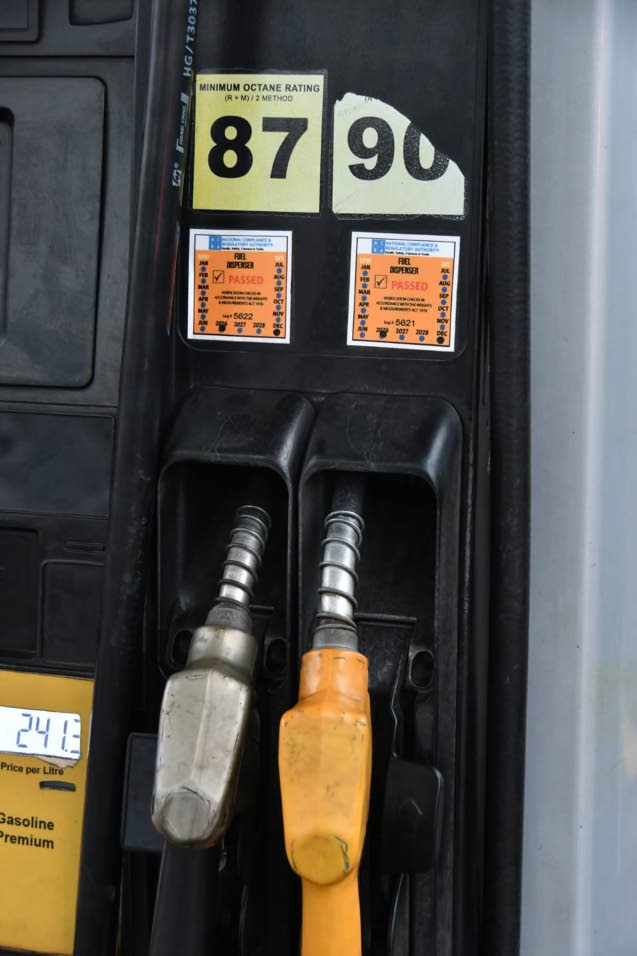
Jamaica’s pumps use the AKI octane scale, while many vehicle manuals use RON. Petrojam says local 87 is approximately equivalent to 91 RON, while 90 is approximately equivalent to 95 RON. Garfield Robinson
“Where a higher grade is recommended but regular gasoline is permitted, the lower grade may be used, although some reduction in performance or fuel economy may occur,” Petrojam explained.
Meanwhile, the refinery acknowledged that it sees an opportunity for vehicle dealers to clear up these questions before customers establish their buying habits.
“We think that it is important for motor vehicle dealers to advise owners that, where applicable, 87-octane should be the recommended fuel type,” it said.
In response to queries from the Business Observer on what more can the industry do to explain fuel requirements clearly, Petrojam reasoned that dealers could explain at the point of sale that Jamaica’s 87 is approximately equivalent to 91 RON, helping buyers match the instructions in their manuals to the grades available locally.
The refinery said it also supports making that information easier to find when motorists pull up to refuel.
“In this regard, Petrojam would also support clearer fuel grade labelling at service stations, including a simple RON-to-AKI conversion guide at the pump, to help motorists make informed purchasing decisions.” That would give drivers a reference when deciding what to buy, alongside advice from mechanics and fellow motorists.
—Additional reporting by Jason Cross


