



Beekeepers get post-Melissa boost
More than 100 beekeepers are being trained in advanced queen-breeding techniques as Jamaica works to replace up to 16,000 colonies lost during Hurricane Melissa and boost honey production in a market in which demand has long outstripped local supply.
The week-long programme, which took place in different communities across Jamaica, comes as the local apiculture industry tries to recover from one of the most damaging periods in its recent history. Beyond toppling hives, Melissa stripped trees and flowering plants across large sections of the island, leaving bees without nectar and pollen for weeks and deepening an already persistent shortage of locally produced honey.
“We lost probably about anywhere in the region of 10,000 to 16,000 colonies due to the hurricane,” Hugh Smith, chief plant protection officer in the Ministry of Agriculture, Fisheries and Mining’s Apiculture Unit told the Jamaica Observer in an update on the industry post-Hurricane. Before the storm, Jamaica had an estimated 120,000 colonies.
The damage was felt almost immediately, but according to Smith, the full impact unfolded over the weeks that followed. With flowering plants destroyed and many apiaries inaccessible because of fallen trees and blocked roads, weakened colonies were left without food and thousands failed to survive.
“There were some commercial beekeepers that lost more than 50 per cent of their stock,” Smith said.
The training programme is designed to help reverse that trend.
Organised by the ministry and the Women for Jamaica Recovery Coalition (WJRC), the initiative has brought together local and overseas specialists to train beekeepers in queen breeding, colony management, pollinator health, nutrition, and pest control. More than 100 participants attended the sessions, which were delivered both in person and online.
At the heart of the programme is queen rearing, a technique that allows beekeepers to rapidly multiply their best colonies by selecting queens with desirable traits such as strong honey production, disease resistance, and calm temperament.
Logan Cutts, a fifth-generation beekeeper and pollinator consultant who led the training, believes Jamaica is well positioned to become a regional centre for queen bee production and a stronger supplier of honey to both local and export markets.
His presentation was largely focused on identifying the best-performing colonies already in Jamaica and breeding from them to multiply desirable traits. Over time, that process can improve honey yields, reduce aggressive behaviour and strengthen resistance to disease and environmental stress.
Further, Cutts stressed the importance of farmers adopting good bee nutrition practices. During periods when flowers are scarce, many beekeepers supplement colonies with sugar. But he cautioned that brown sugar with high molasses content can be difficult for bees to digest and may leave colonies more vulnerable to disease.
“Beekeepers were feeding them sugar as a global standard during dearth periods or when hives are struggling, but the understanding of how the molasses and the brown sugar could affect the bees’ digestive system and then ultimately affect the overall health of the colony, leading them more susceptible to diseases, less likely to thrive, and so on and so forth,” he said.
“The maximum amount of molasses is about 3 per cent. Beyond that, it becomes very hard for the bees to digest it at all,” he continued.
As an alternative, he suggested that beekeepers consider high fructose corn syrup or readily available granulated sugar, which he said could provide a cleaner energy source and help colonies maintain better health during periods of stress.
The sessions also covered pest and disease management, including techniques to monitor and control Varroa mites, one of the most destructive parasites affecting honeybees worldwide.
The Women for Jamaica Recovery Coalition has committed to supporting the apiculture initiative for at least three years as part of a wider effort to strengthen livelihoods and promote sustainable recovery through agriculture.
“The role the WJRC played was really vital to the development of our beekeeping industry. It’s a voluntary organisation made up of individuals who just want to give back to their country, and the initiative is really welcomed by the Ministry. They have given their time and put together all the resources needed for this programme. All the Ministry had to do was find the location,” Smith said.
Meanwhile, the ministry is pairing the training with a broader recovery programme aimed at rebuilding what Smith describes as the bees’ “pasture”— the flowering trees and plants that provide the nectar and pollen needed to sustain healthy colonies.
As part of that effort, approximately 1,500 fruit and nectar-producing trees are to be planted across Jamaica over the coming months. The initiative will begin with 200 trees in a new housing development in Old Harbour, St Catherine, where newly built homes have left large sections of land with little established vegetation.
The first batch will include smaller fruit trees such as mango, ackee, and cherry that residents can plant and maintain in their backyards. A further 1,300 trees will be distributed through beekeeper associations and extension officers across the island, with each parish expected to receive roughly 100 trees for planting in carefully selected locations.
Smith said the ministry is placing particular emphasis on ensuring that the trees are not simply handed out, but properly maintained. The aim is to create long-term food sources for bees while helping to restore vegetation lost during Hurricane Melissa and improving pollination for nearby crops.
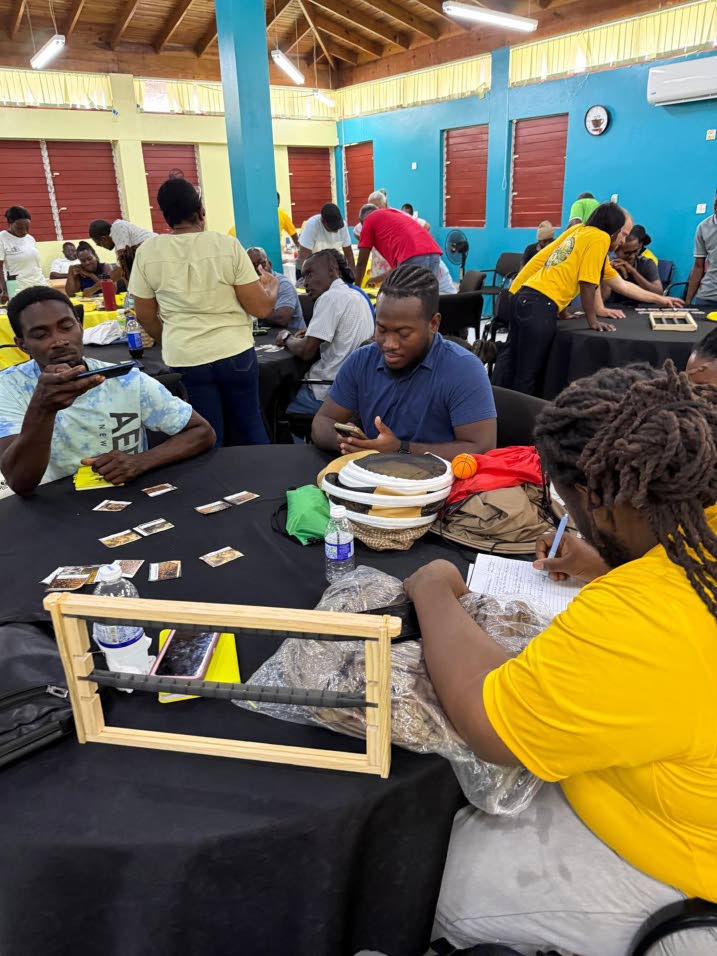
Participants in a specialised apiculture training session at Bodles Research Station in St Catherine engage in classroom exercises on queen breeding and colony management.


