



Debt trumps equity on JSE
PUBLIC corporate bond offers have raised more than three times the amount secured via ordinary share offers since the start of 2023 as more firms reap the benefits associated with listing their debt.
A Jamaica Observer review found that Jamaican-dollar (JMD) and United States-dollar (USD) bond offers cumulatively raised the equivalent of approximately $29.77 billion between January 2023 to June 2026, compared with the $9.06 billion raised via initial public offering (IPO) and additional public offerings (APO).
The review excluded the portions of bonds which were refinanced with new offers and the $9-billion offer for sale of TransJamaican Highway Limited’s (TJH) ordinary shares by the National Road Operating and Constructing Company Limited (NROCC). Although this represents the largest equity deal during the period, NROCC received all of the proceeds while TJH did not receive any new capital.
These figures show that listed bonds have become a more important funding channel for some companies compared to new share issuances over the last 3.5 years. However, the move doesn’t represent a definitive shift in how capital is raised on the JSE, but more so part of a strategic move to broaden the pool of investors to access capital.
By having publicly listed debt some institutional investors can increase their uptake of the offer due to regulations giving more favourable treatment to listed versus unlisted investments. An example is a pension fund which is currently limited to five per cent of their portfolio being invested in the debt and equity of a private company. There are higher limits available for pension funds to invest in assets of a publicly listed company, which includes their debt.
For fund managers, it’s also easier to invest in listed debt instruments due to the firm having a similar limit adjustment for unlisted debt which is carried at the original purchase price versus listed debt, which can have an established market price.
For the firms or companies raising or issuing the bonds, they have used the public bond market to seek cheaper interest rates than what they would have had available via a strictly private bond offer. This is underpinned by the public bond market having a smaller barrier to entry for smaller investors who were effectively locked out from owning debt instruments.
Financial firms dominate bond market activity
The JSE Bond Market has eight public JMD bond offers raising $24.75 billion during the review period while two USD offers raised a combined US$32 million ($5.02 billion) on the JSE USD Bond Market. These offers were all oversubscribed, with some raising more sums by being upsized to access these funds.
Mayberry Investments Limited (MIL) executed its first public bond offer in January 2023 when it raised $6.39 billion across four tranches. It has since issued or refinanced different maturities for a cumulative deal size of $9.19 billion, including its recent $3-billion bond which closed on May 1. Its fellow subsidiary, Mayberry Jamaican Equities Limited, has raised a cumulative amount of $3.88 billion over the last two years, including a recent $1.50-billion bond.
VM Investments Limited, Barita Investments Limited, and Dolla Financial Services Limited are among the other financial companies that raised JMD funding via the JSE Bond Market. Express Catering Limited remains the only non-financial company to tap either the JMD- or United States-dollar (USD) bond market. Its US$12-million bond is set to mature in March 2027.
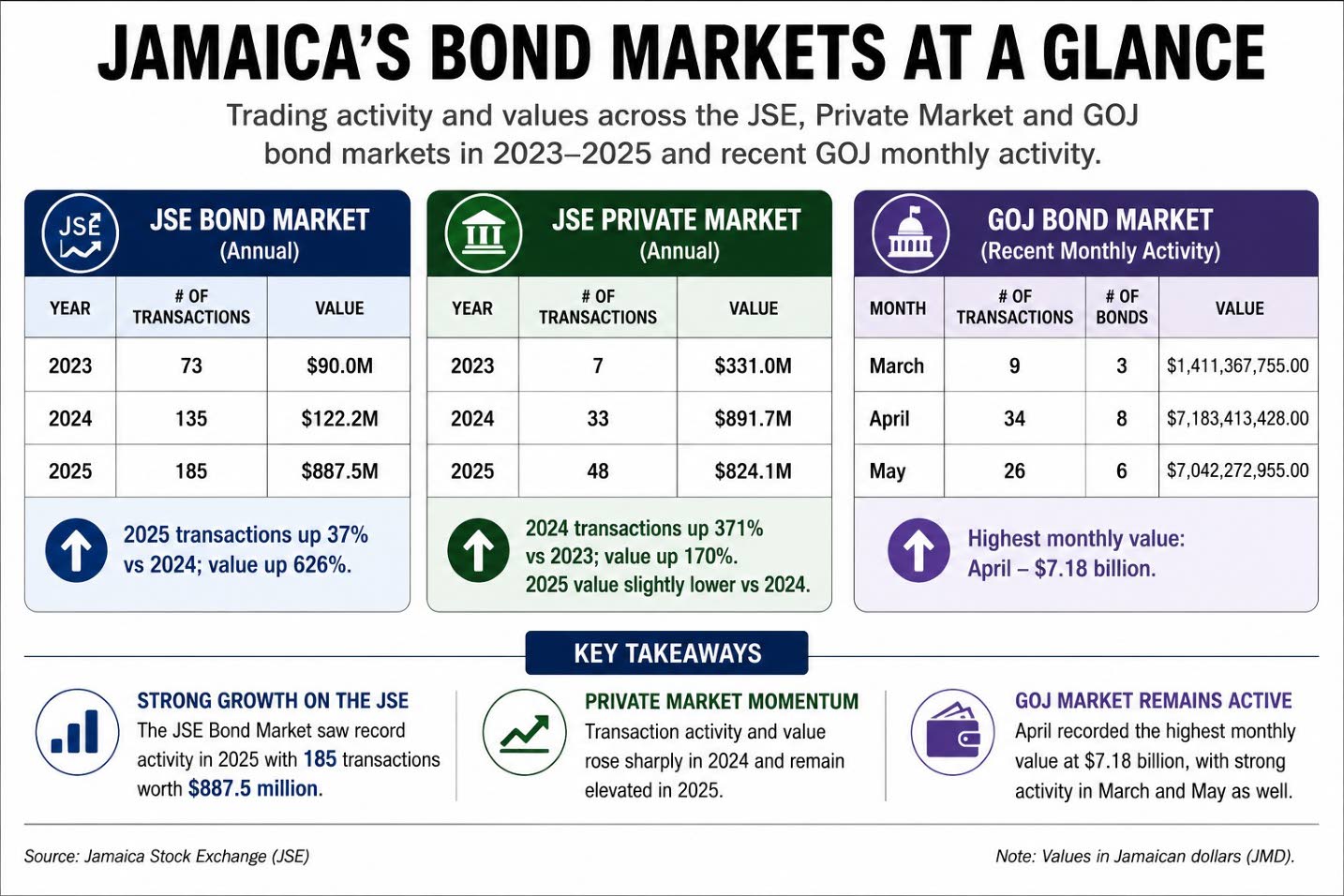
A table showing information on different JSE debt markets.
The public bond market has given some firms the ability to expand their business affairs for margin loans, investment banking, or even complete the expansion of crucial facilities. It has also become a route to allow for companies to refinance their debt at sometimes cheaper rates,, and optimise the duration and maturity profile of their debt.
The equity market has seen more companies come to market to expand their business via IPOs while firms have been using APOs as a route to reduce debt. While both offers see companies raise new equity capital, the success rate between both offers are quite starkly different.
Seven IPOs raised a combined $5.37 billion during the review period, with Quantas Advantage Inc’s $2.39-billion offer being the largest. Quantas was also unique since it was the only Main Market company to go public via IPO while the remaining firms went public via the Junior Market. All of these IPOs were oversubscribed, enabling some owners to monetise their ownership as well at listing.
However, the three APOs executed in the review period garnered $3.69 billion, with none getting even half of their intended targeted amounts. NCB Financial Group Limited (NCBFG) raised $2.48 billion relative to its $5.097 billion target.
Equities dominate trading
Despite the tight fund-raising period for equities, stocks continued to make up most of the trading activity on the JSE. The combined JMD market (Main & Junior Market) had $66.94 billion in transaction value last year while the USD market had US$13.19 million ($2.09 billion) in 2025.
The JSE Bond Market had $887.5 million across 185 trades during 2025, with the USD Bond Market having US$1.7 million in value across 27 transactions. The JSE Private Market, which is restricted to institutional or high net worth investors, had $824.1 million in value traded across 48 transactions.
The relatively lower trading activity isn’t a symptom of lower market interest but a reflection of investors largely holding bonds in a still-expanding market. The JSE’s three main markets having 131 securities compared to 24 securities on the bond and private market. Also, investors who don’t use the JSE’s JTraderPro platform cannot trade these bonds due to the API (application programming interface) not connecting to those external brokers’ systems.
Whilst those JSE bond markets continue to develop, the Government of Jamaica bond market went live on March 25 and has already garnered more than $15.64 billion in trades up to the end of May. The early activity indicates that the government securities segment could become considerably larger than the existing corporate bond market.
So, whilst the equity market continues to recover momentum the bond market has created a new avenue for companies to raise funding, with investors now having easier access to debt instruments.


