



Climate pitches move into funding talks after Barbados summit
MILLIONS of US dollars in climate-focused investment proposals are now moving into active discussions between Caribbean entrepreneurs and financiers following last week’s Climate Smart Summit in Barbados, with several Jamaican projects among those now being tracked for possible funding over the next 18 months.
The investor pipeline includes everything from a US$2.5-million push to expand Kingston Harbour’s clean-up infrastructure to a US$45-million blue economy financing platform being developed by Jamaican entrepreneur Nicholas Kee, alongside regional projects in renewable energy, sustainable tourism and agricultural resilience. Recycling Partners of Jamaica also pitched for just over US$900,000 to support the expansion of its recycling and waste recovery operations in Jamaica.
For the Caribbean Climate-Smart Accelerator, which hosted the summit’s investor forum, the real work starts now.
Over the next 18 months the organisation will track whether the pitches made to financiers such as Sygnus Capital, Caribbean Development Bank, Afreximbank, IDB Invest, and the Development Bank of Latin America and the Caribbean or CAF (formerly Corporación Andina de Fomento), translate into actual deals.
And there is already movement.
Sygnus Capital says it entered the summit with live discussions already under way regarding two of the six projects that formed part of the main investor pitch competition — Barbados-based Rum and Sargassum and GrenadaGrows.
“Two of the six companies we were already in discussion with,” senior vice-president at Sygnus, Gregory Samuels told the Jamaica Observer in a follow-up interview.
“These companies are Rum and Sargassum and GrenadaGrows.”
Rum and Sargassum, founded by Barbadian entrepreneur Dr Legena Henry, is developing a waste-to-energy business that aims to convert two major Caribbean waste streams — invasive sargassum seaweed and rum distillery wastewater — into renewable natural gas, tackling both the region’s energy costs and a growing environmental problem.
Meanwhile GrenadaGrows, led by Judlyn Telesford-Checkley, is focused on building a climate-resilient ecotourism and agriculture project in Grenada, combining sustainable construction, food production, and nature-based tourism to create a lower-impact tourism model.
Samuels said Sygnus is also now in discussions involving Jamaican projects including The Kingston Harbour Cleanup initiative and Kee’s proposal.
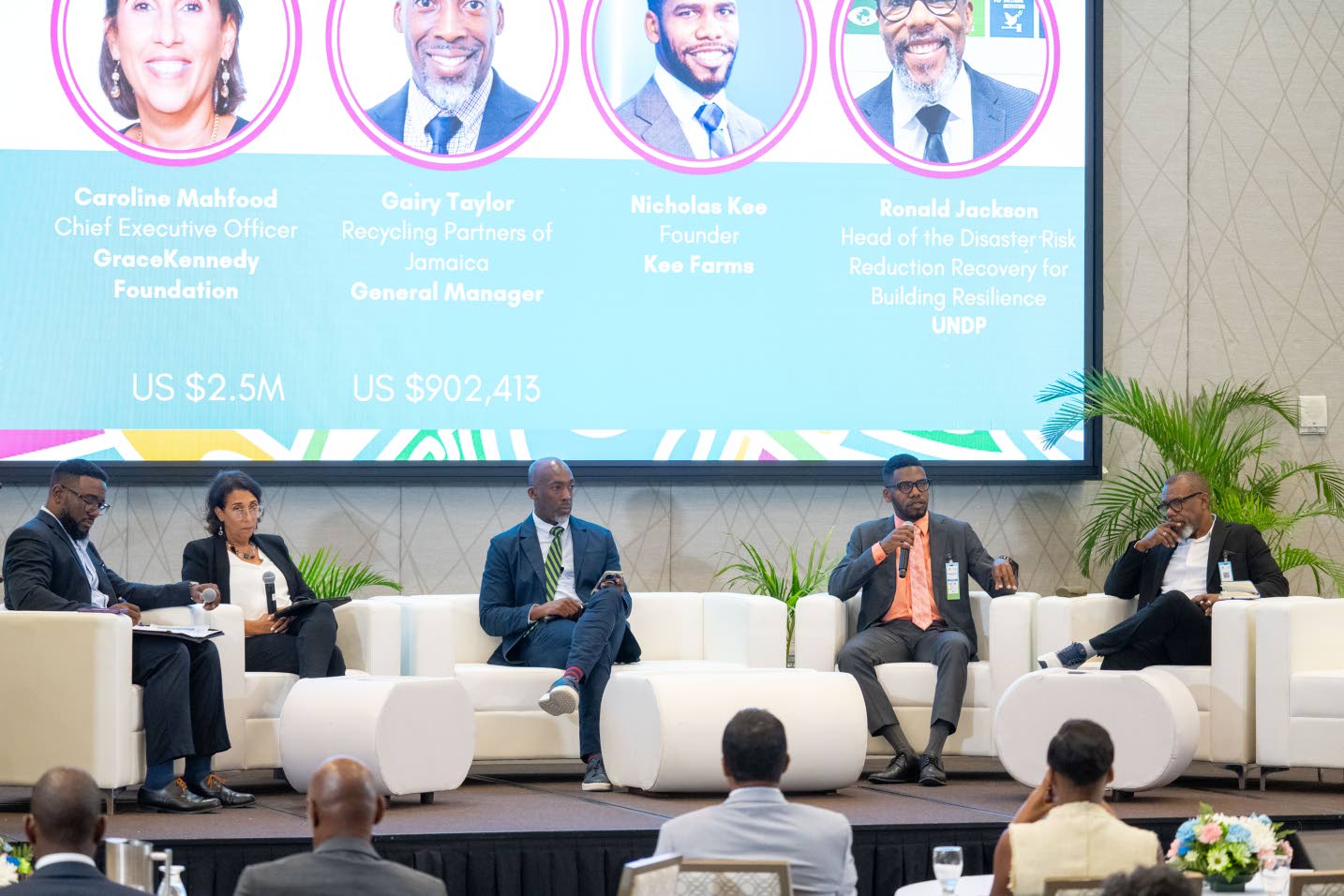
Gerald Lindo (left), director of the Caribbean chapter of the Glasgow Financial Alliance for Net Zero, moderates a discussion on climate finance and investment opportunities featuring Caroline Mahfood of GraceKennedy Foundation; general manager of the Recycling Partners of Jamaica, Gairy Taylor; Nicholas Kee of Kee Farms; and head of Disaster Risk Reduction Recovery for Building Resilience at the UNDP, Ronald Jackson.
“We definitely believe that a deal is possible and we can do something,” he said.
Sygnus currently manages about US$140 million in climate capital and expects that pool to grow closer to US$180 million by final close.
The fund can deploy between US$500,000 and roughly US$6 million into individual projects using its own capital, while partnering with other lenders for larger raises.
Nicholas Kee is seeking US$45 million to expand Kee Farms, a Jamaican regenerative ocean farming venture that trains artisanal fisherfolk to cultivate seaweed, oysters, and sea cucumbers while restoring marine ecosystems. The capital would support a broader climate finance platform built around blue economy development, biodiversity data, and ecosystem valuation, aimed at helping Jamaica better measure the economic value of its natural assets and the cost of climate damage.
The project drew strong early investor attention.
“Maybe about 10,” Kee said when asked how many parties expressed interest after his pitch.
That does not mean funding is imminent but it does mean the project has moved beyond concept stage into serious capital conversations.
Kee told the Business Observer that the immediate goal is a smaller bridge raise of US$5 million to US$7 million to build the legal and financial structure needed for the larger facility.
“When you’re raising that amount of money, it’s very slow,” he said. “It’s a lot of documentation and preparation.”
At the other end of the spectrum is The Kingston Harbour Cleanup Project. Unlike Kee’s proposal, the GraceKennedy Foundation-led initiative offers no obvious financial return to investors, despite potentially large economic benefits for Jamaica.
That makes it a different kind of funding challenge.
Caroline Mahfood, chief executive officer of the GraceKennedy Foundation, pitched for US$2.5 million to expand interceptor barriers now being used to stop plastic and solid waste from entering Kingston Harbour through heavily polluted gullies.
Nine barriers have already been installed, but more are needed. Sandy Gully is among the most urgent.
“It’s grant funding that we would go after versus an investor, and the only entity at the summit that we thought might have a grant fund that we could look at was Sygnus…the others were multilateral funders, which wouldn’t work for us,” Mahfood said.
“We [GraceKennedy Foundation and Sygnus] talked about it and he will send me the details of what their grant is. Their maximum amount for a grant is US$500,000. Obviously we need more, but every mickle makes a muckle,” she continued.
Mahfood reasoned that the project should not be viewed as a simple environmental clean-up. “This is not a clean-up project. This is an investment in building resilient infrastructure across Jamaica.”
Cleaner waterways improve flood management, reduce coastal damage, and protect mangroves that serve as natural storm buffers. But even so, Mahfood acknowledges that projects like this sit outside traditional private investment models.
“You’re investing in the country… but you’re not going to put money in and make that money back,” she told the
Jamaica Observer.
Still, the summit generated useful leads. Mahfood said discussions with potential funders, including Sygnus, are continuing.
That broader investor interest comes as financing institutions announced sharp increases in climate capital earmarked for the region.
Afreximbank has raised its Caribbean allocation to US$5 billion from US$1.5 billion. IDB Invest is targeting US$750 million in regional deployment over the next year. CAF has also allocated more than US$800 million for Caribbean operations in 2026, while CDB’s current portfolio stands at US$2.1 billion.
— Additional reporting by Vanassa McKenzie
Gregory Samuels, senior VP at Sygnus Capital, says the investment firm is in active discussions regarding several climate-focused ventures following the Climate Smart Summit in Bridgetown, Barbados — including Jamaican projects such as the Kingston Harbour Cleanup initiative and Kee Farms.


