



United looks to Jamaica oil licence as funding pressure mounts
UNITED Oil and Gas, the British company searching for oil and gas off Jamaica’s south coast, says it needs a partner or fresh cash to keep the project moving.
The company’s audited financial statements, released Wednesday, show that United has no revenue, remains under funding pressure, and is depending on its Walton-Morant licence to attract support for more exploration.
United reported a US$1.25-million loss for 2025, smaller than the US$2.44-million loss recorded in 2024.
It ended the year with US$1.7 million in cash, up from US$0.8 million a year earlier, after raising money from investors. But United still had more short-term debts than short-term assets at year-end.
The company said it has only a few ways to fund itself: Bring in a partner for the Jamaica licence, raise more money from investors, or get cash from existing investors buying more shares.
A partner deal, known in the oil industry as a farm-out, would involve another company taking part ownership of the Walton-Morant licence in return for helping to pay for exploration.
For United, that would mean giving up part of its ownership of the licence in exchange for money and technical support.
In simple terms, United needs fresh cash this year to continue its work in Jamaican waters.
The company’s directors said they believe a Jamaica partner deal or new investor funding is reasonably likely, but acknowledged that neither is guaranteed.
Because funding is not guaranteed, the directors said there is “material uncertainty” over United’s ability to keep operating. In accounting language, that is a going-concern warning. In plain English, the company says there is serious uncertainty unless expected funding or a partner comes through.
Still, the directors said they believe United has enough cash to meet its obligations and continue operating for at least 12 months from the date the accounts were approved.
That makes Walton-Morant even more important to United’s future.
Chief Executive Officer and Interim Chairman Brian Larkin said United’s focus is the Jamaica asset and securing a partner for it, while continuing talks on its smaller United Kingdom project.
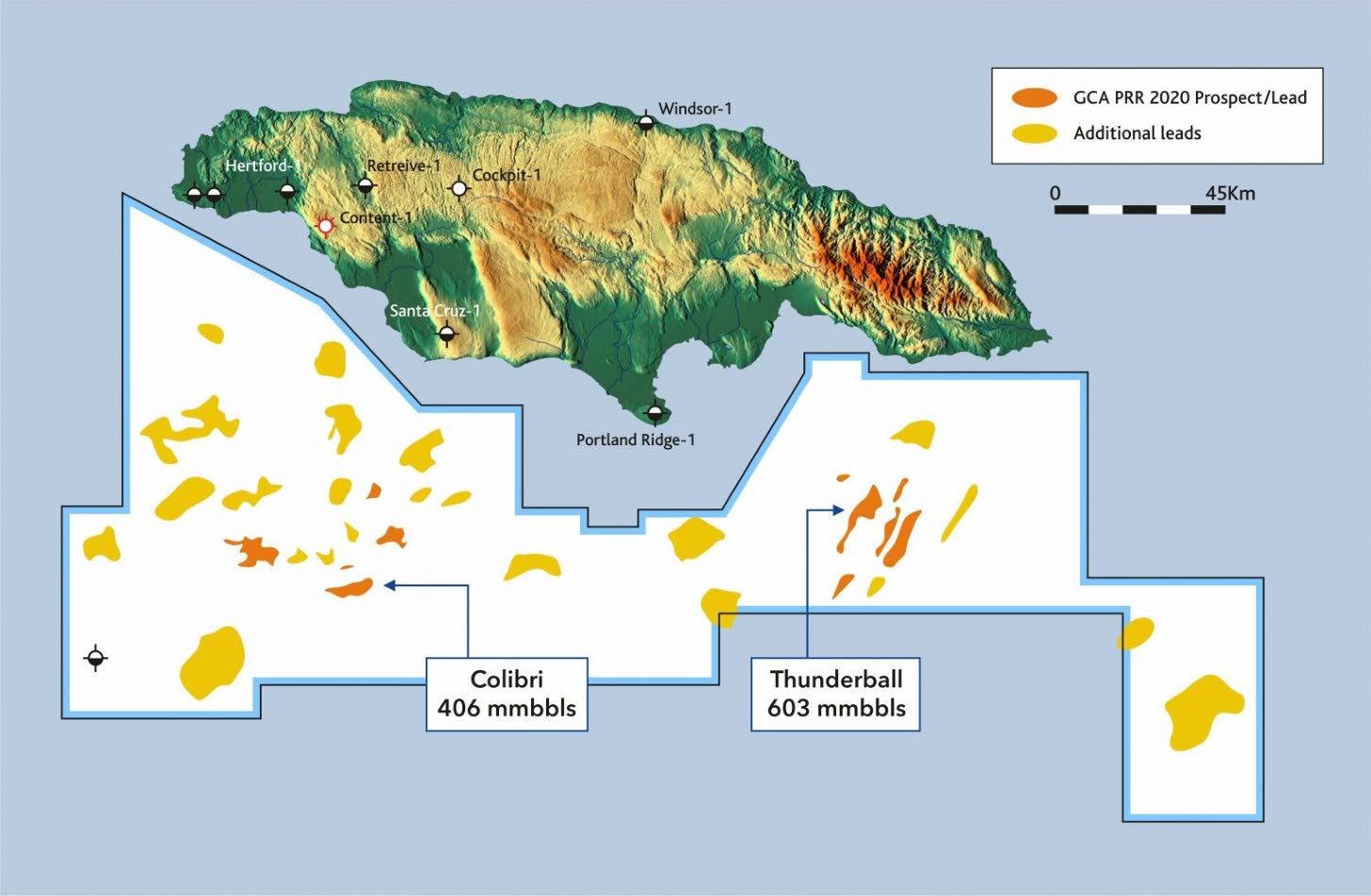
A map showing Jamaica’s offshore oil and gas prospects, including the Walton-Morant licence area off the island’s south coast, where United Oil and Gas is seeking a partner to help advance exploration..
The Walton-Morant licence covers about 22,400 square kilometres offshore southern Jamaica.
United says the area could contain the equivalent of more than seven billion barrels of oil, but that does not mean oil has been found. The figure is an estimate of what may be present if exploration is successful. It is not proven reserves, and no commercial discovery has been made.
United says the licence area contains more than 40 possible drilling targets. Eleven were previously assessed by Gaffney Cline and Associates, an independent petroleum consultancy, which estimated that selected targets could contain the equivalent of more than 2.4 billion barrels of oil. Those estimates remain unproven and have not been adjusted for the risk that exploration may fail.
During 2025, United secured a two-year extension of the Walton-Morant licence to January 31, 2028. It also received an environmental permit from the National Environment and Planning Agency in July 2025 and a beach licence in September 2025.
Those approvals allowed United to carry out a survey testing seabed samples for chemical signs of oil and gas.
The company hired TDI Brooks International, a US-based offshore survey firm, to do the work, including taking core samples from the seabed.
The survey was completed by the end of February 2026, with no environmental or work-related incidents, according to United. It mapped about 2,710 square kilometres of seabed and collected 42 core samples.
United had previously said analysis from the survey found butanes and pentanes in selected samples. These are hydrocarbons, compounds found in oil and gas systems.
United said they may point to oil or gas forming deeper underground, but the results do not amount to a commercial discovery and no reserves have been proven by drilling.
The company said several interested parties have signed confidentiality agreements and are involved in the partner search.
Larkin described 2025 as a “landmark year” for United, pointing to the licence extension, regulatory approvals, funding and survey work in Jamaica. He said major oil companies have renewed interest in large exploration projects in stable countries with access to major markets.
United also holds a stake in the Waddock Cross oil field redevelopment project in the United Kingdom, where talks continue on restarting production.


