



WHO FUNDS THE GLORY?
Jamaica’s sporting bodies chase sponsors, data and sustainable support
JAMAICA celebrates when the Sunshine Girls win, when athletes stand on international podiums and when young talent rises from schools and communities with the promise of representing the country.
Less visible is the cost of producing those moments — and the volunteer-run machinery often expected to deliver professional results.
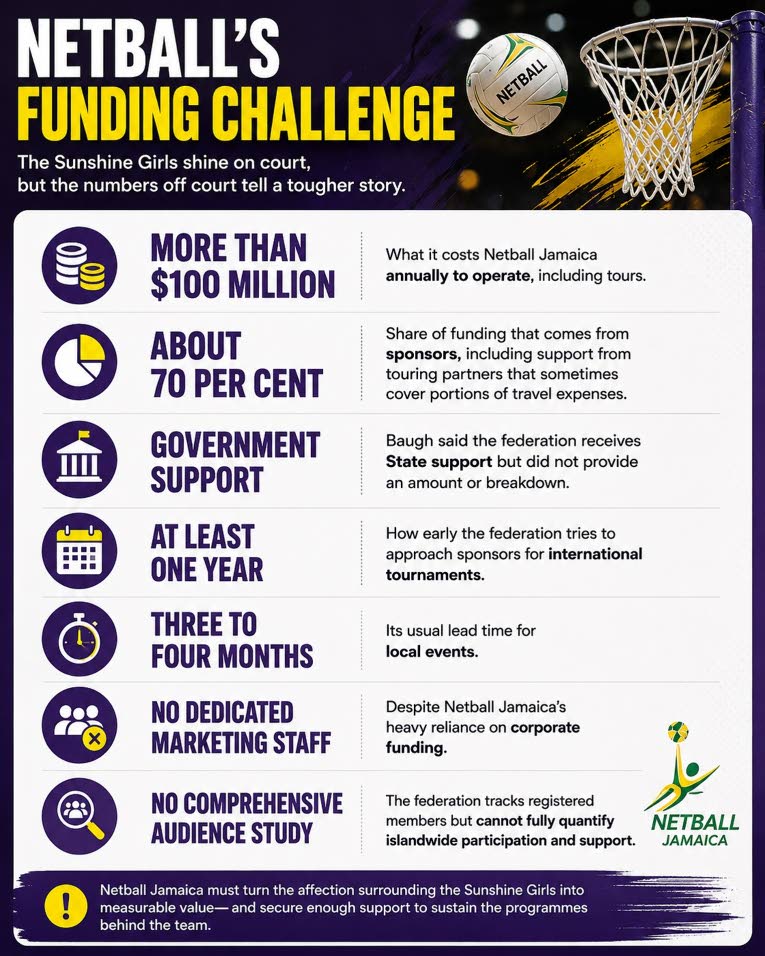
Netball Jamaica alone costs more than $100 million annually to operate, including tours, according to federation president Karen Rosen Baugh. About 70 per cent of its funding comes from sponsors, including touring partners that sometimes cover portions of travel expenses. Government also provides support, although Baugh did not give a figure or specify whether that support is recurring or tied to particular programmes or events.
For Netball Jamaica, that money supports more than the senior national team. The federation must maintain junior-player pathways, stage local competitions, prepare teams for international tournaments and meet tour-related expenses.
Yet the organisation behind the internationally recognised Sunshine Girls has no dedicated marketing staff and no comprehensive audience study to show companies exactly who they can reach by investing in the sport.
That contradiction sits at the centre of a wider challenge facing Jamaican sport: sponsors increasingly want measurable commercial returns, but many federations lack the staff, data, events and reporting systems needed to prove and deliver the value they create.
The challenge is not confined to volunteer-heavy federations. Roy Simpson, general manager of the Jamaica Football Federation, said the federation, which has a more formal commercial structure, has annual expenditure typically ranging between US$3 million and US$6 million, rising significantly during FIFA World Cup qualification cycles and major tournament years. He also said development grants often have designated purposes and cannot fully offset national-team operating costs.
Public spending helps support the sector, but it does not fully answer the federation-funding question.
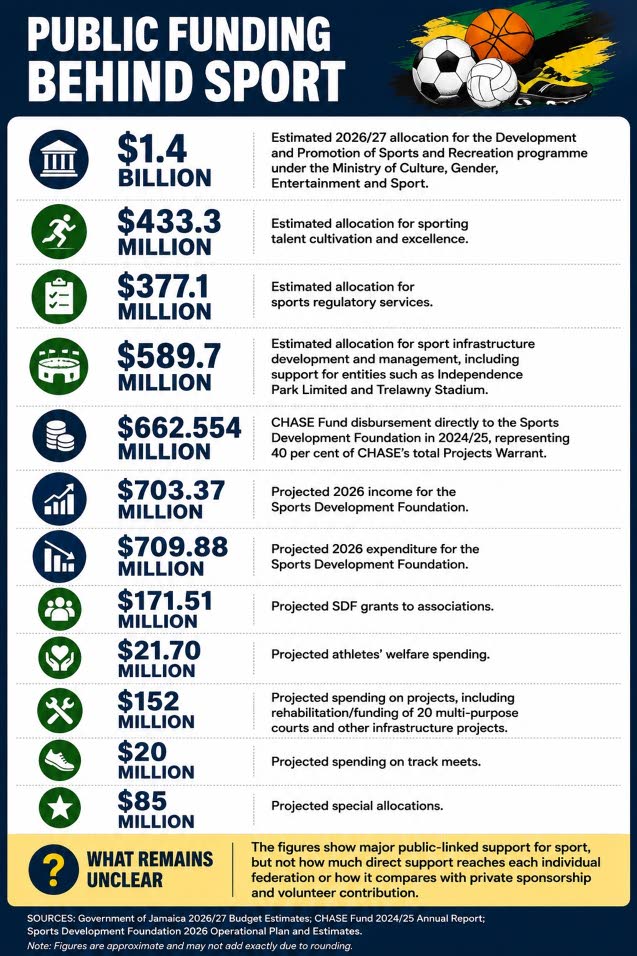
Budget documents show that the Government has estimated $1.4 billion for the Development and Promotion of Sports and Recreation programme in the 2026/27 fiscal year, under the Ministry of Culture, Gender, Entertainment and Sport. The allocation includes approximately $433.3 million for sporting talent cultivation and excellence, $377.1 million for sports regulatory services, and $589.7 million for sport infrastructure development and management. The infrastructure provision includes support for entities such as Independence Park Limited and Trelawny Stadium.
Public funding also flows through other channels. The CHASE Fund’s 2024/25 annual report shows that, from a $1.865-billion subvention in the 2024/25 financial year, CHASE disbursed $662.554 million directly to the Sports Development Foundation, representing 40 per cent of the total Projects Warrant received by the Fund.
Separate public-body estimates for the SDF show projected 2026 income of $703.37 million and expenditure of $709.88 million, leaving a projected deficit of $6.51 million. Its projected spending includes $171.51 million in grants to associations, $21.70 million for athletes’ welfare, $152 million for projects, $20 million for track meets and $85 million in special allocations.
The SDF’s operational plan also refers to ongoing support for national sporting associations, national athletes and sports administrators, including funding for track meets, summer camps, sporting events, the Athletes Welfare Fund and scholarships. It also lists rehabilitation or funding of 20 multi-purpose courts and other infrastructure projects at schools and communities islandwide at a cost of $152 million among its 2026 priorities.
But even with those public-funding channels, the available documents do not show how much direct support reaches each individual federation, or how that support compares with private sponsorship, volunteer contribution and the actual cost of preparing national teams.
That is where the pressure on corporate sponsorship becomes sharper.
The issue was examined during the Private Sector Organisation of Jamaica’s recent Masterclass Series at the S Hotel in Kingston, where corporate representatives and sporting administrators discussed the changing demands of sports sponsorship. The session was held under the theme Winning Sponsors: The Power of Packaging Sports.
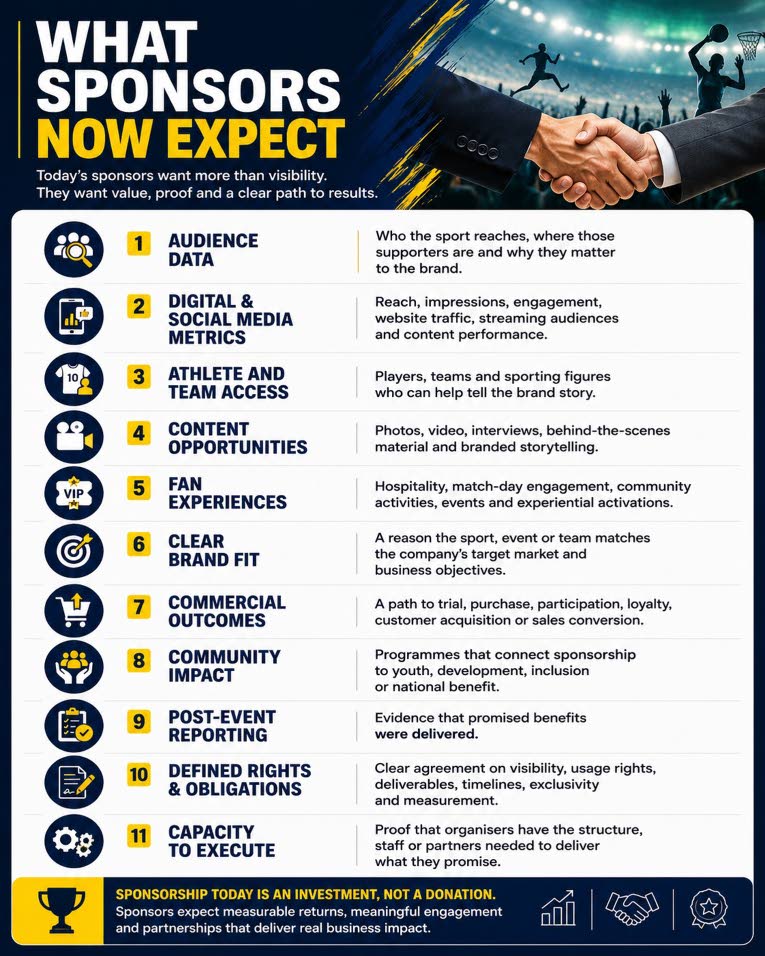
Globally, sponsorship has moved beyond logo placement into audience access, digital engagement, fan experiences, commercial activation and measurable returns. Sporting bodies are no longer only asking companies to help fund teams; they are being asked to sell a defined package of value.
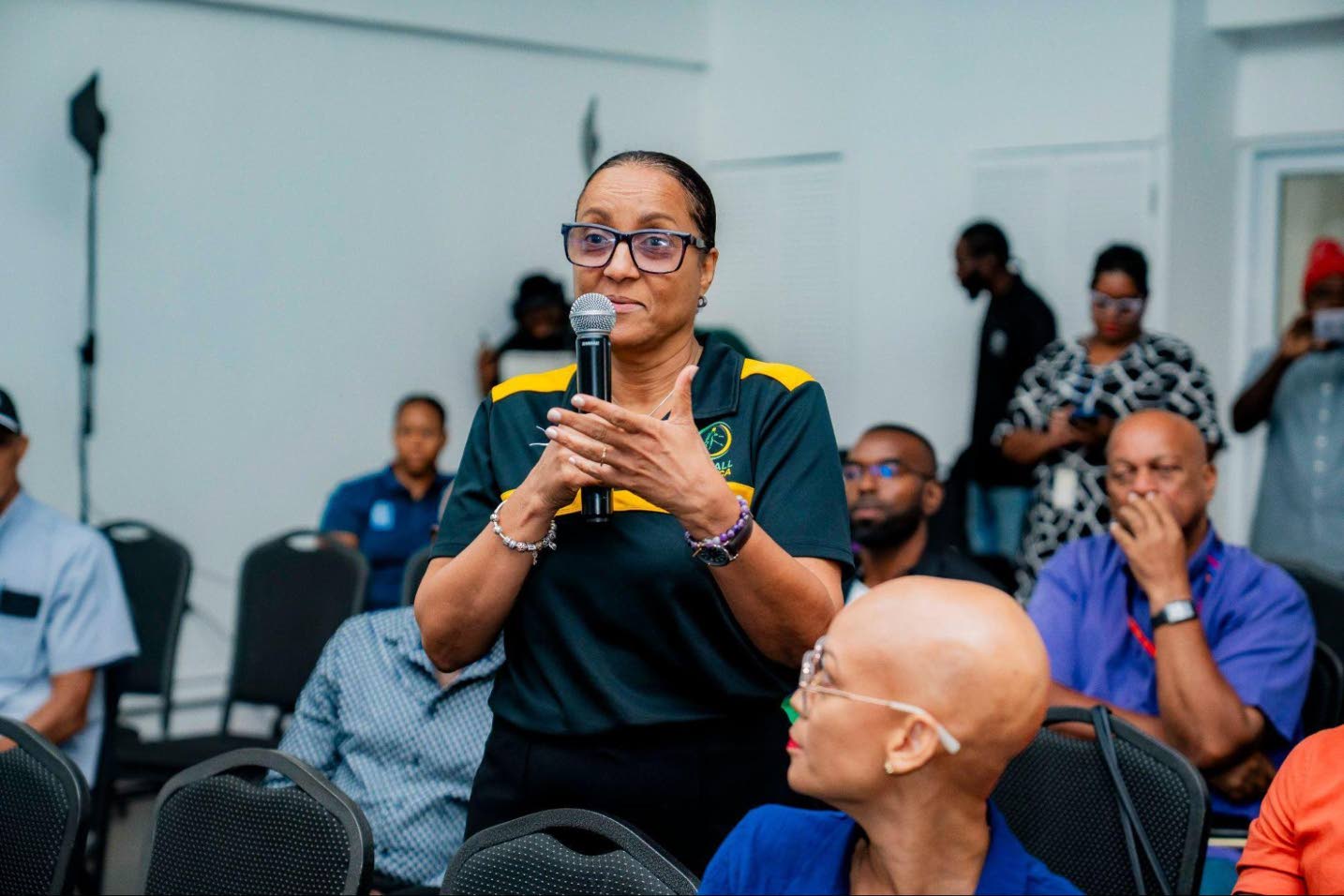
President of Netball Jamaica Karen Baugh shares insights on how smaller sporting organisations can collaborate with other sporting entities to strengthen partnerships and expand opportunities for corporate assistance.
Sponsorship consultant and GC Foster College of Physical Education and Sport adjunct lecturer Carole Beckford said Jamaica’s sporting reputation should be viewed as an economic asset, not only a source of national pride.
She pointed to the country’s internationally recognised athletes, its history of strong performances and sport’s ability to connect brands with people across age, income and social groups.
“Jamaica is a great destination for sport. Its athletes are well known and the history of performance carries significant weight,” Beckford said.
“Jamaica can do more to attract dollars by planning, instituting better governance and exploring marketing as a direct case for exposure.”
Treating sport as an economic asset would mean looking beyond one-off sponsorship requests and using Jamaica’s athletes, reputation and sporting culture to attract events, visitors, media attention and longer-term corporate partnerships.
But to do that consistently, sporting bodies need more than passion and performance. They need commercial systems: marketing staff, audience information, digital analytics, sponsorship packages, event calendars, content plans, activation opportunities and post-event reporting.
They also need clear agreements setting out what sponsors are buying, where brands will appear, what access is being granted, what content can be used, how athlete images will be handled and how delivery will be measured.
Sponsorship or assistance?
Red Stripe Head of Commerce Sean Wallace said many sponsorship approaches still struggle because they do not begin with the sponsor’s business problem.
He offered a simple example.
A sporting organisation may approach the company promising that sponsorship will increase awareness of Red Stripe among sports fans. But Wallace said Red Stripe already had 99 per cent brand awareness among sporting audiences, although the company did not provide the underlying research.
In that case, the organisation is offering to solve a problem the company says it does not have.
A more useful offer, Wallace said, would show how the partnership could encourage product trial, deepen customer loyalty or generate sales.
“What brands are increasingly looking for is a strong commercial value proposition: how the partnership will help build brand equity, drive consumer engagement and, ultimately, support sales conversion,” Wallace told BusinessWeek in follow-up responses.
Wallace said the difference between sponsorship and corporate assistance rests on what each side receives.
“A donation is typically support given for goodwill. Sponsorship is a commercial investment,” he said.
While he believes the quality of Jamaican sponsorship proposals is improving, Wallace said some approaches still resemble requests for financial help more than commercial partnerships.
Many organisations still lead with logo placement, sponsor mentions and event visibility. Wallace said those benefits are only the starting point. Stronger proposals first identify what the sponsor is trying to achieve, then show how the sporting body can help deliver it.
At the PSOJ masterclass, he put the shift plainly.
“Brands are looking for partnerships that create engagement, build relevance and deliver measurable commercial impact,” Wallace said.
Red Stripe receives a significant number of requests each year across sport, entertainment and community initiatives. Wallace did not provide a figure for sports proposals alone, but said only a fraction reach serious consideration and fewer are ultimately approved.
The company considers whether the sport, event or association matches the audience and business objectives it wants to pursue, what benefits and access are being offered and whether the organisers can deliver what they promise.
“Can the organisers deliver what they are promising, and do they have the track record or structure to support it?” Wallace asked.
Not every partnership has the same objective. Some build visibility; others focus more heavily on consumer participation or sales. Wallace said both sides must agree from the beginning on how success will be judged.
“The strongest partnerships are the ones that can connect brand visibility with meaningful consumer action, whether that is trial, purchase, participation or advocacy,” he said.
“Reach is important, but reach without connection or conversion is less valuable than a smaller, more engaged audience that can drive real business outcomes.”
Simpson made a similar point in written responses, saying the sponsorship environment has “evolved significantly” as sponsors focus more on measurable returns than traditional brand exposure alone. He said sponsors now seek digital and social-media engagement metrics, athlete personalities, content-creation opportunities, hospitality and experiential activations, community-impact programmes and deeper brand integration.
“Modern sponsors expect partnerships to deliver tangible commercial outcomes alongside brand visibility,” Simpson said.
Winning is not enough
Baugh sees the issue from both sides. She works full-time as a marketer while serving voluntarily as president of Netball Jamaica, giving her direct knowledge of what companies expect and what sporting federations can realistically deliver.
Her experience suggests that weak proposals are only part of the problem.
“The most difficult part is getting in front of the movers and shakers,” Baugh said.
“We are ahead of the game in that we have a properly crafted sponsorship deck, but sometimes, to be honest, female sports — even one as successful as netball — have a hard time making that connection to corporate Jamaica.”
The Sunshine Girls are internationally recognised and consistently highly ranked, while netball is widely played in Jamaican schools and communities.
With sponsors providing about seven of every 10 dollars Netball Jamaica receives, the loss of a major partnership could quickly disrupt planning.
Despite that dependence, Netball Jamaica has no dedicated marketing staff. It relies heavily on relationships and personal connections to reach corporate decision-makers, while many of those helping to run the federation balance those duties with full-time jobs.
Sporting bodies must prepare proposals, collect audience information, organise events, create content, give sponsors opportunities to engage supporters and report on whether promised benefits were delivered.
Netball Jamaica tries to approach sponsors at least one year before international tournaments and three to four months ahead of local competitions.
Baugh acknowledged that the shorter period can still be inadequate, especially when companies have already committed their annual marketing budgets.
“This is often a bandwidth issue and trying to manage a professional environment in a part-time way, as all volunteers have full-time jobs,” she said.
Wallace said sporting organisations should learn the planning cycles of the companies they intend to approach and begin discussions well before an event or season.
An audience they cannot fully count
Companies increasingly want proof that a sporting body can reach the right people.
But Baugh said sporting organisations generally do not possess the formal audience studies, participation research and digital information sponsors increasingly seek.
Larger sports such as track and field, football, cricket and netball can point to active social-media pages, school participation and regular competitions. Those indicators suggest reach, but they are not the same as an independently measured audience.
Netball Jamaica can track registered members, but that figure does not capture everyone playing the sport in schools, communities and informal competitions.
“Do we have any studies? No,” Baugh said.
The federation may know that Jamaicans care deeply about netball, but it cannot always tell a prospective partner exactly how large the audience is, where it is concentrated, which age groups it includes or how supporters behave.
Baugh said rebuilding parish organisations could help Netball Jamaica organise more activity outside urban centres, track participation more accurately and give sponsors a clearer picture of the sport’s national reach.
Football has more data to take to sponsors. Simpson said the JFF uses national-team match attendance, broadcast and streaming audiences through JFFLive TV, social-media reach, impressions and engagement, website traffic, youth-football participation, women’s football participation and community-programme outreach in discussions with sponsors and partners.
He said those metrics help demonstrate the value and impact of football, which he described as Jamaica’s most-followed sport.
Without clearer sport-by-sport information on public funding, private sponsorship, federation income and volunteer contribution, it remains difficult to assess how much of Jamaica’s sporting success is being carried by the State, companies, administrators, athletes and families.
Sporting bodies also organise junior development, coaching, local competitions, overseas travel and national-team preparation. When they remain under-resourced, the pressure can affect how many competitions they stage, the development programmes they sustain and how they prepare and fund teams for travel.
The activation trap
Keeping a sponsor can be as difficult as securing one.
Baugh said companies increasingly want repeated opportunities to connect with supporters rather than a single burst of visibility around one event.
“Retaining sponsorship now is often dependent on how many events you can present for activation,” she said.
In sponsorship, activation refers to the promotions, events, branded content and sales opportunities a company builds around its association with a sport.
Creating those opportunities requires events, staff and reliable organisation, even as Netball Jamaica manages the Sunshine Girls and develops junior players largely through volunteers.
It creates an activation trap: sporting bodies need sponsorship to stage more events, but sponsors increasingly want more events before committing or renewing their support.
Potential partners want access to the Sunshine Girls brand and its passionate following, Baugh said. They also want assurance that events will be well organised, attract an audience and offer visibility, consumer contact and, where possible, sales opportunities.
But Baugh said sporting bodies cannot carry the entire promotional burden. Companies must also invest in amplifying their connection to the “much-loved Sunshine Girls”, rather than expecting the federation alone to generate all the attention and engagement.
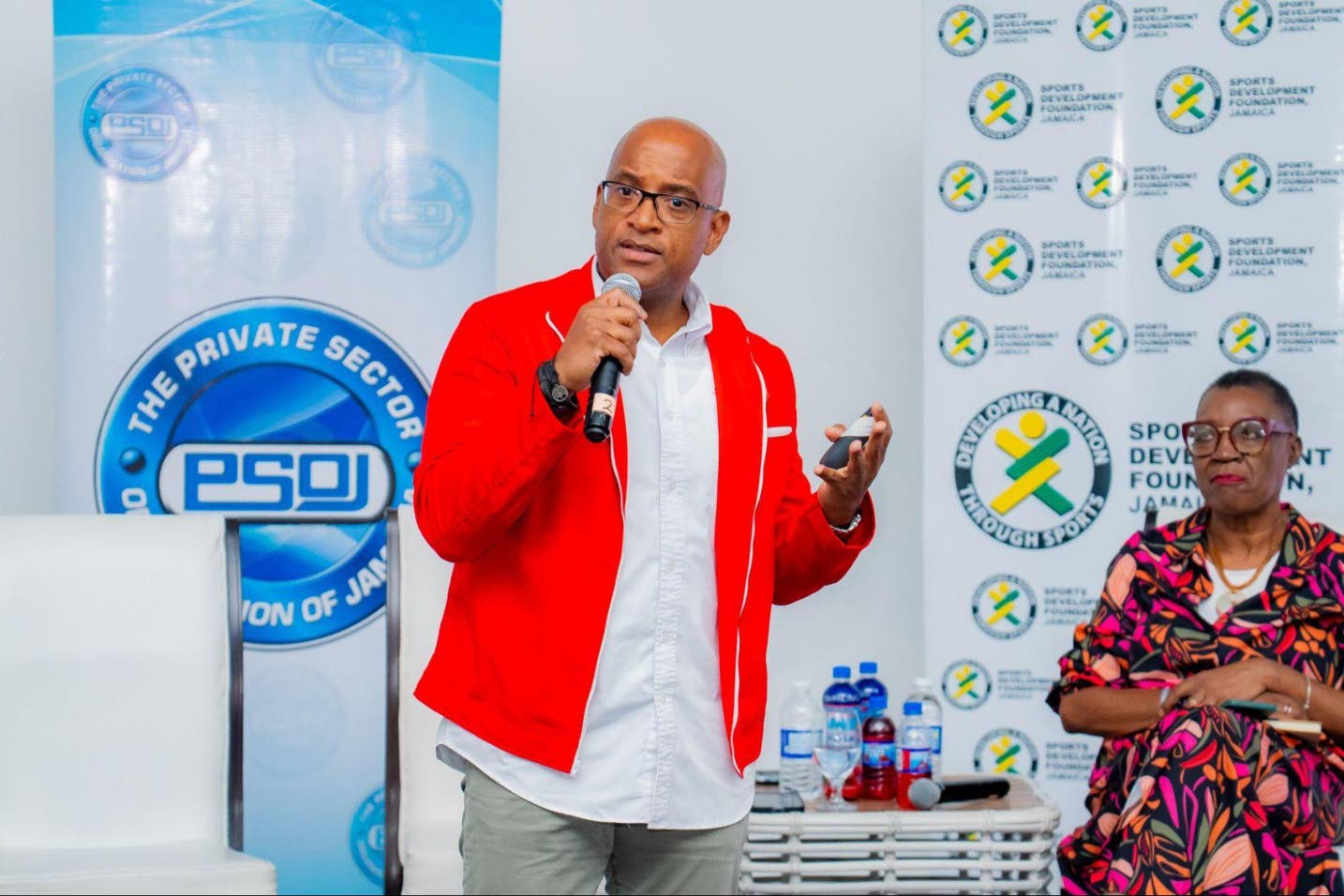
Red Stripe Head of Commerce Sean Wallace addresses stakeholders during the Private Sector Organisation of Jamaica’s Masterclass Series session focused on the evolving expectations surrounding sports sponsorship and corporate investment.
Small sports can still compete
Wallace said smaller sporting bodies are not automatically shut out.
A modest but deeply loyal audience can be more valuable to a company than a larger audience that has little connection with the brand or is unlikely to act.
“Bigger is not always better when it comes to sponsorship,” he said.
Smaller organisations, however, must be able to explain who they reach, why that audience matters and what distinctive access or experiences they can offer.
The level of commercial support also varies across federations. The Jamaica Football Federation, for example, has a marketing manager, Avery Campbell, and a sponsorship manager, Tanya Lee-Perkins, according to its communications manager. The federation also works with 876stream, which assists with marketing, promotions and sponsorship.
The JFF’s Adidas arrangement also includes a direct merchandise-linked revenue stream, with the federation receiving 20 per cent of every jersey sale, according to the communications manager.
In written responses, Simpson said FIFA and Concacaf grants and development programmes generally account for 50 to 60 per cent of the JFF’s funding, while corporate sponsorship and commercial partnerships account for 10 to 20 per cent. Government support and agency assistance generally account for five to 10 per cent, with match revenues, gate receipts, hospitality, broadcast rights, licensing and merchandising making up smaller shares.
That gives football a more formal commercial-support structure than some other national bodies, including Netball Jamaica, which Baugh said has no dedicated marketing staff. But it also shows that even larger, more visible federations face pressure to fund programmes that are costly, continuous and not always commercially attractive.
Simpson said the hardest areas to fund consistently are youth development, women’s football, grassroots football, infrastructure development, and international travel and preparation camps. While senior national teams often attract greater visibility and sponsorship interest, he said long-term sustainability depends on investment in development pathways and grassroots programmes, which traditionally attract less commercial support.
Baugh said smaller sporting bodies face an even steeper challenge because many lack staff for marketing, sponsorship sales, digital media and audience research. Netball Jamaica is not considered a small federation, yet it has no dedicated marketing team.
She suggested that an umbrella sporting organisation could establish a shared hub providing marketing and digital support to federations that cannot afford teams of their own. College students could also provide assistance while gaining practical experience.
Baugh also proposed joint event planning and profit-sharing among sports.
“We could actually consider some joint event planning and profit-sharing to make the landscape a bit more interesting,” she said.
Several sports, or sport combined with entertainment, could pool audiences, create more varied events and offer sponsors a broader platform instead of competing individually for the same money.
What is the sport worth?
Even when both sides agree that a sponsorship has value, they may disagree sharply over what it is worth.
Wallace said Red Stripe considers the audience, the benefits and access included in the deal, the level of exclusivity and the likely commercial return.
“In many cases, organisations requesting sponsorships do overestimate the value of what they are offering,” he said.
One possible reason is that the amount requested may reflect what the organisation needs rather than what the sponsorship rights are worth to the company.
A federation may require millions of dollars to send a team overseas. But that cost does not automatically determine the value of the logo placement, audience access or promotional opportunities included in the package.
The relationship is also judged after the money is provided. Depending on the partnership, Red Stripe may assess attendance, audience reach, digital engagement, media exposure, promotional results and sales impact.
“If the value delivered consistently falls short of what was agreed, that will influence whether a partnership is renewed, scaled back or discontinued,” Wallace said.
Beyond sponsorship cheques
Simpson also said longer-term sponsorships would allow federations to plan more strategically, invest more confidently in development programmes and deliver greater value to partners through sustained engagement rather than short-term activations.
For Baugh, the immediate challenge remains practical.
Sporting organisations must improve their commercial offers, reach younger and digital audiences and build stronger systems for attracting and retaining sponsors. Companies unable to provide money, she said, may still be able to assist with marketing, commercial planning and digital strategy.
Baugh also urged corporate Jamaica to consider sport’s contribution to national development alongside immediate financial returns.
Netball Jamaica must turn the affection surrounding the Sunshine Girls into something sponsors can measure, promote and value — and secure enough support to sustain the programmes behind the team.
Baugh joked that Netball Jamaica would bottle the Sunshine Girls’ “passion and pride” if it could.
The passion is already there. The unanswered question is whether Jamaica will build the staff, data and commercial systems needed to convert it into durable support for the programmes behind the glory.
Stakeholders from across Jamaica’s sporting landscape attended the session and engaged in lively discussions examining sponsorship, audience engagement and long-term growth opportunities within the sports industry.


