



Charities paying big money to file taxes
...groups complain this takes away from their impact
CHARITY organisations are complaining that the expenses associated with conducting audits and compiling reports have been taking away from the impact those operating locally should be having on vulnerable groups.
The issue was raised during a recent Jamaica Observer Monday Exchange forum at the newspaper’s Beechwood Avenue offices in St Andrew.
The leaders have been vocal in recent times, calling for broad and meaningful consultation as Jamaica moves toward introducing a new Act that will govern how non-profit organisations operate.
The proposed legislation intends to modernise the legislative framework governing non-profits, and will directly affect thousands of organisations that deliver services in disaster response, education, social protection, community resilience, and youth development.
Christine Gore, director of the Phillip and Christine Gore Family Foundation, said in the past year, her non-profit organisation spent roughly $800,000 on audits and trying to meet various reporting mechanisms that have been imposed.
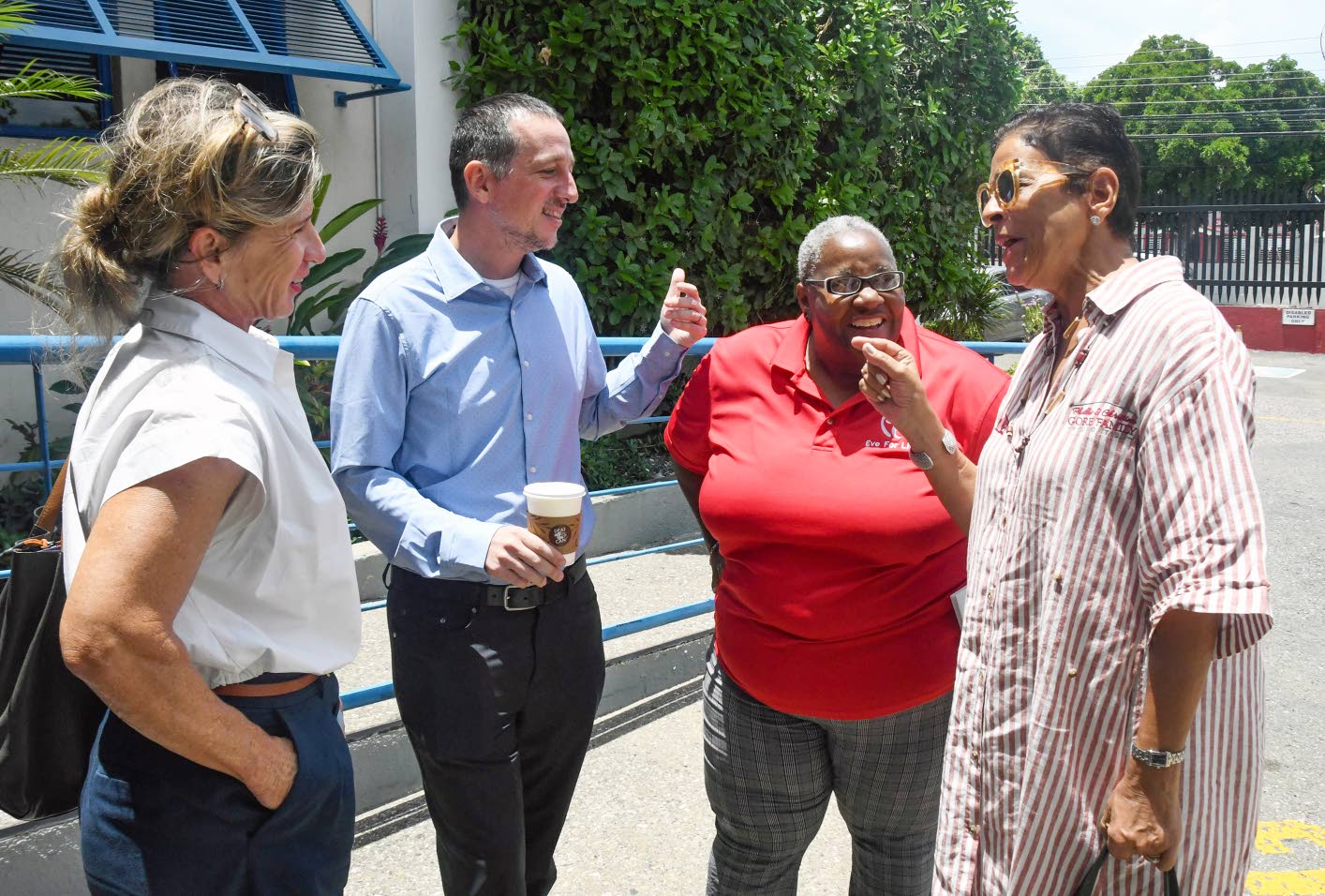
From left: Nancy Pinchas, executive director of the Council of Voluntary Social Services; Blake Widmer, co-founder of Deaf Can Coffee; Joy Crawford, executive director of EVE for Life; and Christine Gore, director of the Phillip and Christine Gore Family Foundation, engage in conversation after participating in a Jamaica Observer Monday Exchange on the future of Jamaica’s non-profit sector. (Photo: Naphtali Junior)
“We are in education and we use our own money. We do work in schools… in those schools, we do remedial work. We support Jamaica College because our chairman is an old boy. He, along with R Danny Williams and Karl Hendrickson, took over the school and so we are trying to replicate that programme in the schools in which we work. We don’t do fund-raisers and nobody donates to us,” Gore said as she bemoaned the fact that the foundation is already spending big bucks to execute its programmes.
Gore is one of the stakeholders who have called for government to engage players in the philanthropic sector before implementing new regulations. She said her foundation already has to report to the Department of Co-operatives and Friendly Societies (DCFS).
“I have to report to the DCFS what I am doing with money that is really my own, and how I am going to spend it in these schools. It is public knowledge. Everything I do is public knowledge and is on the Internet. I have spent close to $800,000 to comply with regulations instead of it going into my programmes. I have been a lawyer for a long time and I don’t understand some of the things they ask us for,” Gore said.
She shared that, for example, the foundation has to write out its philosophy, and all the procedures that reflect its philosophy.
“Who runs a business like that, even a charity? I have to write down the procedure and get competing quotations. I must get at least two quotations for each service or product that you buy and then you have to write down who is to sign off on each of those products. By the time I have finished doing that the issue has long passed,” she said.
Blake Widmer, director of the charity group HarvestCall, an international non-profit that has a team operating in Jamaica, told reporters and editors at the forum that the entity spent more than $1 million in the past year to prepare and file necessary reports regarding its operations.
“Our expenses ran around $1.2 million this past year to meet our auditing requirements. That in itself is not the biggest burden. What we are concerned about is what will happen if the current legislation changes. The current legislation has been there for years. We are familiar with it, adapted to it, and we are working with it,” he said, explaining that while certain elements may not be convenient, he has developed a system that works well with the current regulations. He implied that the organisation may not be in a position to fit in well with whatever new system comes along.
“Hearing that there is going to be new legislation coming without our voice and representation is concerning, because it is a big ‘what if’. What if the current manner of doing business completely changes? We understand that there is an expense that ties to regulation, but we don’t want to be facing new legislative changes without any voice in the process or input into what is happening,” he said.
The existing Charities Act of 2013 and the 2022 regulations seek to keep Jamaica in line with the standards of the Financial Action Task Force and monitor non-profit organisations’ compliance with anti-money laundering and counter-terrorism financing measures.


