



Jamaica’s foreign policy: Principle must guide, not political rhetoric
Former Prime Minister P J Patterson has made important contributions to Jamaica’s foreign policy. His service deserves recognition and respect, both of which he knows I always accord him.
It is therefore disappointing that his recent article concerning Jamaica’s abstention on the United Nations resolution on the embargo against Cuba lacks factual basis and, instead, relies heavily on emotions, mischaracterisations, and conclusions that do not withstand scrutiny.
Firstly, Jamaica has not changed its opposition to the embargo. We remain concerned about its impact on the Cuban people and value our long-standing friendship and co-operation with their country. What has changed is our assessment of whether continued support for an annual resolution addressing only one dimension of Cuba’s circumstances represents the most constructive approach.
Patterson’s suggestion that an abstention amounts to support for the embargo, or silence in the face of Cuban suffering, is simply incorrect.
The UN system offers three voting approaches which are quite distinct and not inter-changeable — for, against and abstention. Jamaica did not vote against the resolution. We abstained. We also were not silent. We formally explained our position immediately after the vote. Our ambassador and permanent representative to the UN expressly acknowledged the contribution of external economic restrictions to Cuba’s difficulties, while also recognising the domestic economic and structural challenges affecting the country. Jamaica called for reduced restrictions, constructive engagement, and Cuba’s greater integration into the international economic system.
It is true that Jamaica could have voted in favour while expressing reservations. But an explanation of vote does not alter the position conveyed by the vote itself. Our decision reflected an assessment of the resolution in its entirety. Furthermore, within minutes of the vote, I also addressed the post-Cabinet press briefing in Kingston, not only advising of the vote, but explaining, referencing even the relevant motion in the Parliament. and sharing verbatim the explanation of the vote delivered by Jamaica’s ambassador in the General Assembly.
In what world can this be honestly described as silence?
For more than three decades the General Assembly has called for an end to the embargo, yet it remains in place and the circumstances facing the Cuban people have deteriorated. Surely it is reasonable to consider whether a broader approach might better serve the objective I presume we all share — an improvement in the lives of the Cuban people.
Principle should guide policy, not prevent us from examining its effectiveness.
Perhaps more troubling from a national perspective, is former Prime Minister Patterson’s assertion that Jamaica’s abstention violated Parliament’s unanimous resolution and constituted a parliamentary offence warranting ministerial resignation. This is a serious allegation, particularly from a former prime minister familiar with our constitutional system.
The motion brought before Parliament expressed concern for the Cuban people and supported constructive engagement, reduced economic restrictions, and Cuba’s greater integration into the international economic system. These positions are consistent with Jamaica’s explanation of vote.
Crucially, the motion did not direct the Government to vote in favour of the UN resolution, nor did it purport to bind the executive to a particular voting position. In any event, Parliament’s important responsibility to debate policy and hold ministers accountable must not be confused with the executive’s constitutional responsibility for conducting policy which must include its foreign relations. Certainly it could not be suggested that the Parliament or the executive could be bound by the fact that Opposition parliamentarians called for an end to the blockade in their contributions to the debate. There was therefore no parliamentary instruction defied, and no credible basis for the extraordinary allegation of a parliamentary offence.
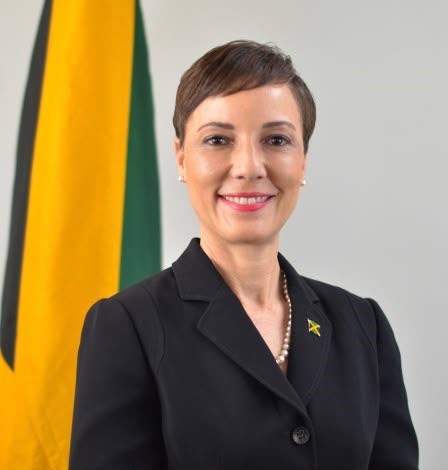
Kamina Johnson Smith.
Patterson also invokes Jamaica’s historic assertion of independence in establishing relations with Cuba, while insinuating that the present decision resulted from external pressure or the pursuit of favour. He offers no evidence for that suggestion.
Indeed, the Government’s posture was articulated well before the vote. Prime Minister Andrew Holness addressed the need for a more considered approach to Cuba’s circumstances at the Caricom Heads of Government meeting earlier this year, and Jamaica’s national policy statement at the United Nations General Assembly in September reflected the same thinking. Both were promoted in traditional and social media.
With all due respect to former Prime Minister Patterson, sovereignty cannot mean that a decision is independent only when it accords with the preferences of former leaders. The suggestion that his view may also be shared by former Prime Minister Bruce Golding would therefore not persuade me otherwise. Each Government has the responsibility to exercise its own judgement in the national interest.
Patterson rightly recalls Cuba’s valuable contributions to Jamaica, particularly in health care and education. While there is still a conversation to be had about the terms of these agreements, the contributions of the Cuban people will always be deeply appreciated, and we continue to express this. But genuine friendship does not require us to overlook the complex challenges confronting the Cuban people, or even to conclude that removing external restrictions alone will resolve them.
His references to third-country nationals, medical cooperation, and a previous vote concerning Palestine similarly do not establish the broader allegation of foreign policy subservience. Each matter has its own circumstances and should be judged on its merits, rather than assembled to create an impression unsupported by evidence.
Jamaica’s distinguished foreign policy tradition was built over generations and across administrations. It is a national inheritance, not the exclusive possession of any political party or individual.
Patterson’s description of Jamaica’s decision as an abominable betrayal, his allegation that Parliament was defied, and his insinuations of foreign control do not become accurate merely because they are expressed with conviction.
The Cuban people deserve more than an annually repeated expression of solidarity that has not achieved its central objective. They deserve constructive international engagement directed towards meaningful improvements in their lives.
Furthermore, our responsibility as a sovereign Government is not simply to repeat the decisions of the past, but to uphold the principles behind them while exercising independent judgement in the present. Our responsibility is also to recognise that, in a changing world, an unexamined principle which has been as ineffective as this one is more likely to land one’s foreign policy in the frame of irrelevance, than the respect which we work every day in the foreign ministry to preserve.
Our vote was not a betrayal of Jamaica’s foreign policy tradition; it is an affirmation of it.
Senator Kamina Johnson Smith is minister of foreign affairs and foreign trade.


