



Tourism boom, local bust, says Purkiss
Opposition spokesperson charges benefits flowing overseas instead of into local communities
While the Government celebrates billions in tourism earnings, Opposition spokesperson on tourism and linkages Andrea Purkiss says as much as 70 cents of every dollar spent by all-inclusive visitors leaves Jamaica, depriving local communities of the industry’s full economic benefits.
Purkiss made the claim during her contribution to the 2026/27 Sectoral Debate in Parliament on Tuesday, arguing that despite record visitor arrivals and foreign exchange earnings, too little of the industry’s wealth remains in the hands of Jamaican workers and businesses.
In a wide-ranging presentation, the first-term Member of Parliament representing Hanover Eastern accused the Government of focusing on impressive headline figures while ignoring what she described as deep structural weaknesses within the tourism sector.
“Jamaica welcomed 4.27 million visitors in 2024, generating approximately US$4.35 billion. These numbers are impressive. They reflect hard work across this industry. However, behind every reported statistic is a workforce in distress and a local business sector under siege. So let us examine what this Government’s numbers actually tell us and what they are designed to conceal,” she said.
Central to her argument was what she described as a failure of the Tourism Linkages Network to meaningfully reduce the flow of tourism earnings out of the Jamaican economy.
“International financial benchmarks reveal a scandalous reality: Yet under his [Tourism Minister Edmund Bartlett] watch, ‘linkage’ has become a euphemism for massive economic leakage. For every single dollar spent by an all-inclusive tourist in Jamaica, up to 70 cents leaks straight back out of our economy to overseas travel agents, foreign-owned mega-airlines, and international supply chains. Every single dollar earned in this sector exits Jamaica immediately. It does not circulate. It does not multiply. It takes an immediate U-turn right back across our borders,” Purkiss said.
She also argued that the problem is particularly evident in agriculture, in which successive administrations have promoted stronger connections between hotels and local farmers.
She pointed to statements made by Bartlett as far back as 2016 regarding opportunities for local producers to supply the tourism sector and reduce import dependence.
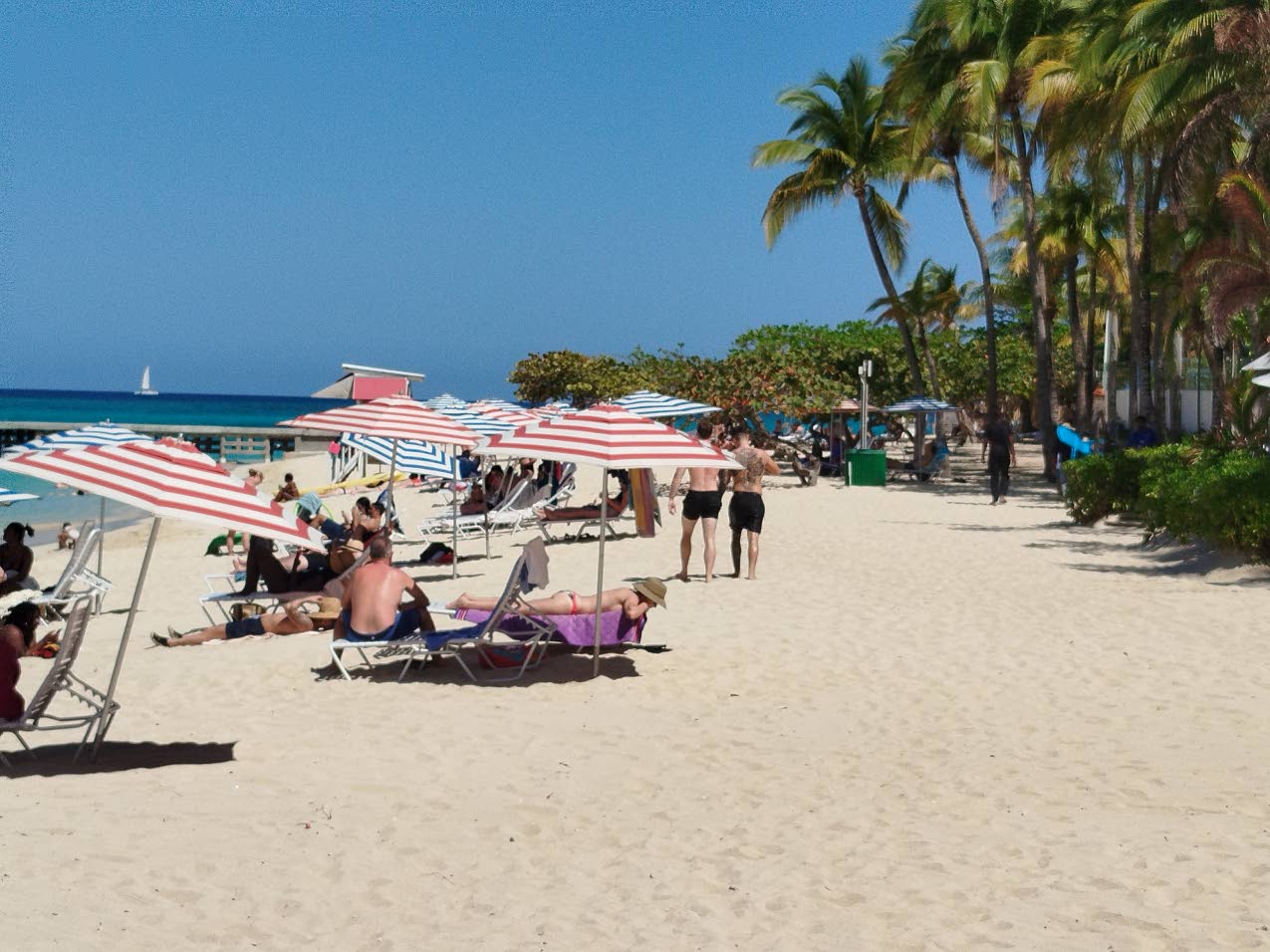
Visitors to the island enjoying a property on Jamaica’s North Coast.
According to Purkiss, those ambitions have not materialised despite significant growth in demand from the industry.
“The demand for fruits and vegetables in our sector has exploded to a staggering $67 billion and processed foods have shattered all barriers to hit $115 billion and are still being imported from overseas wholesalers. Foreign-owned mega-resorts import their fruits and processed meats from overseas wholesalers while hard-working farmers in St Elizabeth and Hanover watch their crops rot in the field,” she said.
Purkiss also challenged the Government’s long-standing efforts to diversify Jamaica’s tourism markets beyond North America, arguing that years of international marketing campaigns and travel missions have yielded limited results.
She noted that the United States accounted for just over 64 per cent of Jamaica’s stopover arrivals in 2017 but had grown to more than 70 per cent by the end of 2025. Combined with Canada, she said North America now represents more than 84 per cent of the country’s visitor market.
She also questioned the value of billions spent on seat-support arrangements designed to encourage airlines to operate routes from non-traditional markets.
“Since 2015, this Administration has spent over $2.86 billion on seat support,” she said, arguing that arrivals from targeted markets in Africa, India, and the Middle East remained relatively small despite years of promotional efforts.
Beyond the economic statistics, Purkiss contended that tourism workers continue to bear the burden of an industry that is celebrated internationally but remains fragile at the community level.
“Tourism is not an abstraction in Jamaica. It is the school fees. It is the mortgage. It is the food on the table. And today, for too many of my constituents, it is the anxiety of waiting for a hotel that has not reopened, for a pay cheque that has not come,” she said.


