



Restrepo wants more opportunities for developing athletes
WORLD Athletics presidential hopeful Ximena Restrepo says providing consistent, high-level competition for athletes who are not yet at the top level of track and field should be a priority for the next Administration of the global governing body.
Restrepo, the first woman to serve as a vice-president of World Athletics and its current senior vice-president, was in attendance at the recent World Under-20 Championships in Eugene, Oregon. She believes more can and should be done for athletes who do not have the resources to compete at top-level meets, most of which are staged in Europe.
The candidate, who is seeking to replace incumbent Sebastian Coe, believes a circuit that includes venues across the North American, Central American and Caribbean Athletic Association (NACAC) and South American regions would benefit athletes from those areas.
Restrepo, who attended the Carifta Games for the first time this year and was impressed with what she saw, said there are plenty of opportunities for junior athletes but questioned what happens after they leave school.
“There are competitions for the juniors. What happens with the seniors? What happens when the kids get out of school? That’s when things get tricky and not only on the islands; it happens all over the world,” she told the Jamaica Observer.
Not every athlete who signs their first professional contract will be able to get into the more prestigious meets. While there will be local competition, Restrepo said more needs to be done to keep those athletes in the sport.
“That’s when we really need to find out how to keep those kids in the sport. What do we offer them?” she said.
While athletes such as three-time world-record holder Usain Bolt were able to remain in Jamaica while gaining access to top-level competition, Restrepo said that is not an option for everyone.
“In Jamaica you had Usain Bolt, he never left the island, and many of your athletes don’t really have to leave the island, but many others do. Which it’s okay. I mean, if they want to come to the US it’s their choice,” the former University of Nebraska sprinter said.
“But it has to be a choice, not something that they have to do because to survive because they can’t have something at home with their families or with their own coaches. So we have to create opportunities for our athletes so that they can choose where they want to go and what’s better for them. That’s at least the way I see it.”
Restrepo said although standards are good in the NACAC region, which includes the United States and Canada, there is still room for improvement.
“Well, I think everything can be always better. Even the best things can always get improved, so we have to keep working with the area together with World Athletics because it is a motor for World Athletics,” she said.
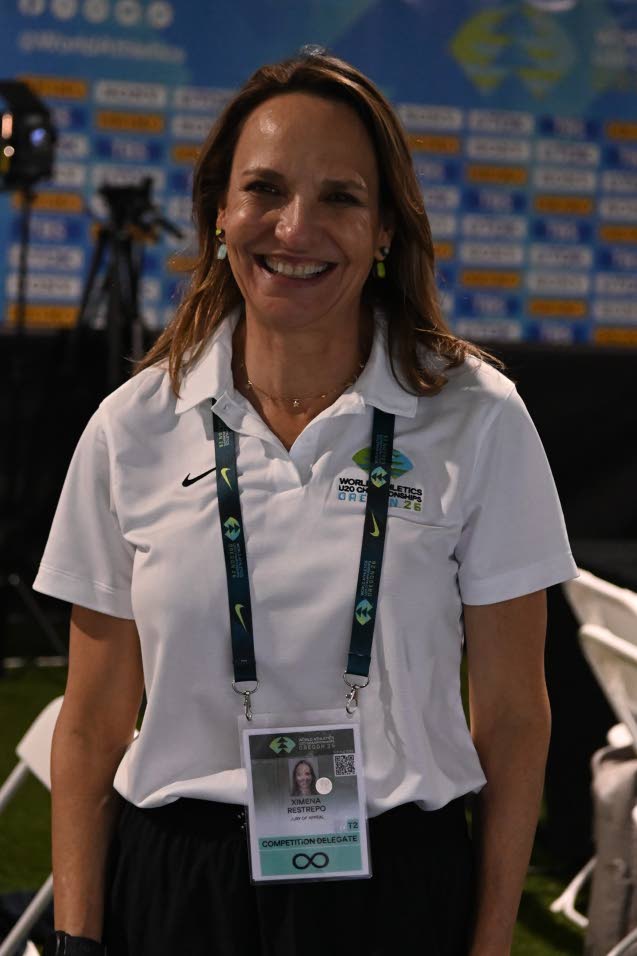
RESTREPO…we have to create opportunities for our athletes so that they can choose where they want to go and what’s better for them.
“I mean, sprinting in the Caribbean is just amazing. It’s the best in the world. You got excellent athletes. You got good weather, so you can train all year round. There are many good things that you do have in the Caribbean.”
In discussions with several presidents in the region, the former NCAA 400m champion and current Colombian national record-holder in the 200m and 400m said they discussed the need for more in-person coaching and refereeing courses, as well as greater access to meets for athletes unable to travel to Europe.
She said she had proposed the idea of a Caribbean Diamond League-style competition to provide more opportunities for those athletes.
“Why don’t we have a competition for our athletes in the Caribbean? You can bring people from other parts of the world as well,” she said. “It might sound crazy, but maybe we could do something. Maybe not for the top-top athletes, but flying to Europe is very expensive.”
While acknowledging that travel within the region is also expensive, Restrepo said the idea could work with the right financial backing.
“So it’s not an easy thing to do. But it takes money. But money can be found. I mean, if you have a good product and you know how to sell it. We could have something for those athletes that finish school. They can have a circuit in the islands that they can probably compete a little bit more,” she said.
“I may be wrong [but] it seems there is a lack of competition for that category of athletes.”
Restrepo said a South American circuit, with meets in Brazil, was another idea she was working on restoring.
“We are already talking Colombia, Brazil, Chile, Mexico may join us too. We are just talking about it because it’s difficult. We’re hoping to have three or four Continental Tour-Silver meets, that means a lot of points,” she said.
“You can go there and get points, not having to travel all the way to Europe with time change and if you go to Europe, it can’t be for just one meet, you need to go to different meets, and then you need to have a good manager to get you into the meets, which is complicated.”
“And what if you get injured, or if you need your coach, you have to travel with your coach, with your physio. I mean, that’s a lot of money. So we have to try to find middle ground solutions for many athletes because I think the top top athlete they have it fixed. They don’t have any problems. They have the money. They have good managers. They know they’re going to be entering into the big Diamond League competitions, they’re fine.”
“But we have a group of people that are B class that want to get to A class, and they’re still too young, they don’t have the experience. So, I would like to make it easier for them to get into that stage.”


